
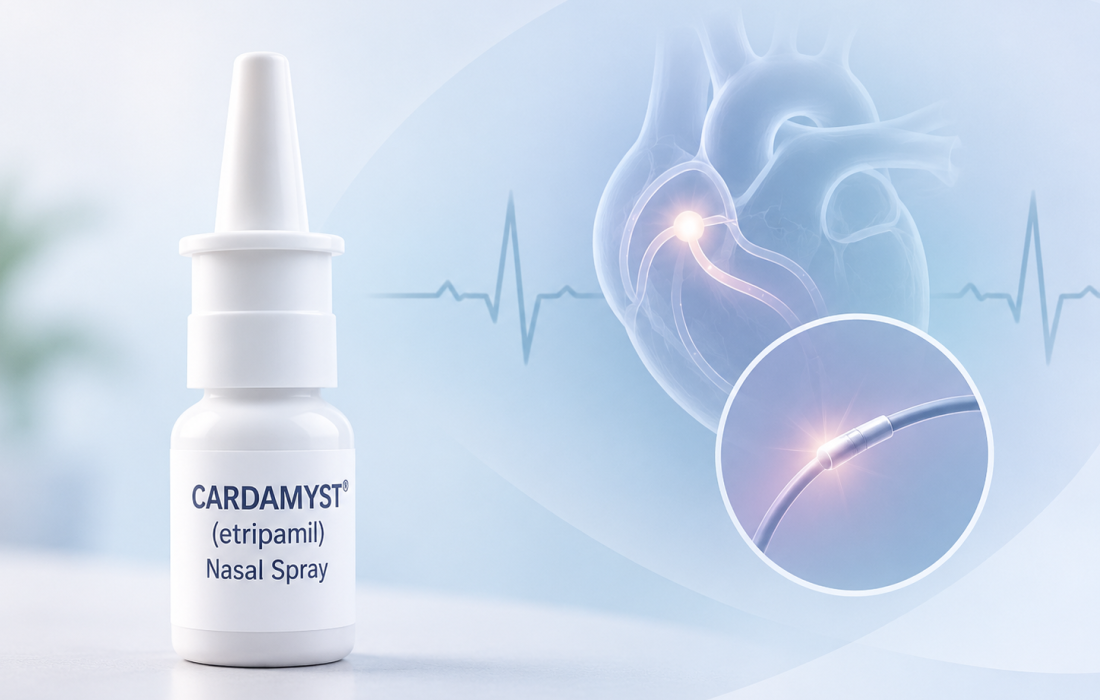
CARDAMYST (etripamil) converted recurrent PSVT to sinus rhythm within 30 minutes in 66.7% of treated patients with prior catheter ablation in a Phase 3 RAPID subgroup analysis.
Written By: Saniya Katakdhond, PharmD
Reviewed By: Pharmacally Editorial Team
Milestone Pharmaceuticals has reported new Phase 3 data showing that CARDAMYST® (etripamil) nasal spray converted recurrent symptomatic paroxysmal supraventricular tachycardia (PSVT) to sinus rhythm within 30 minutes in 66.7% of etripamil-treated patients with a history of catheter ablation. The findings come from a subgroup analysis of the Phase 3 RAPID trial (NCT03464019) and are scheduled for presentation at the American Heart Association (AHA) Scientific Sessions 2026 on November 7.
The findings highlight the potential role of self-administered etripamil in managing acute PSVT episodes among patients who continue to experience recurrences after catheter ablation. However, the small subgroup size and descriptive nature of the analysis limit the strength of the conclusions.
Recurrent PSVT Following Catheter Ablation: An Unmet Treatment Need
Catheter ablation is an established treatment for PSVT and is successful for most patients. Nevertheless, some individuals continue to experience symptomatic episodes following the procedure. Managing these recurrences can be challenging, particularly when patients require an option to treat an acute episode outside an emergency care setting.
CARDAMYST is a calcium channel blocker formulated as a nasal spray and approved by the U.S. Food and Drug Administration (FDA) for converting acute symptomatic PSVT episodes to sinus rhythm in adults. Its self-administered formulation provides an on-demand treatment option for patients experiencing an episode.
The newly announced analysis specifically examined patients with documented ECG evidence of recurrent PSVT following a previous catheter ablation.
Phase 3 RAPID Trial: Efficacy Findings in the Prior-Ablation Subgroup
The subgroup analysis used data from the randomized, double-blind, event-driven, placebo-controlled Phase 3 RAPID trial, which evaluated self-administered etripamil during perceived PSVT episodes. The study investigated a 70 mg nasal spray dose, with an optional repeat dose permitted under the trial protocol. Episodes were adjudicated using ambulatory ECG recordings.
Among 692 randomized participants, 46 (6.6%) reported a history of catheter ablation. In the efficacy population of patients with adjudicated, confirmed PSVT, 11 of 184 participants (6.0%) had undergone prior ablation.
Of these 11 patients, six received etripamil and five received placebo. Conversion to sinus rhythm within 30 minutes was observed in:
- Etripamil: 66.7% (4 of 6 patients).
- Placebo: 20.0% (1 of 5 patients).
The observed conversion rate in etripamil-treated patients was consistent with the response reported in the overall RAPID efficacy population.
However, these findings are descriptive and the subgroup analysis was not powered for between-group comparisons. The numerical difference should therefore not be interpreted as definitive comparative evidence of treatment efficacy.
Patient Characteristics and Safety Assessment
Patients in the prior-ablation efficacy subgroup had a mean age of 50.9 years, and 82% were female. Additionally, 54.5% were receiving oral medications that act on the atrioventricular (AV) node.
Safety was assessed through continuous electrocardiogram (ECG) monitoring and adverse-event reporting. Specific monitoring considerations included AV block and prolonged pauses.
However, the company announcement did not provide detailed subgroup-specific safety event rates. Consequently, the available information does not permit a comprehensive assessment of the safety profile specifically in these 11 patients.
Clinical Interpretation: Potential On-Demand Option After Ablation
The findings address a clinically relevant treatment challenge: recurrent symptomatic PSVT in patients who have already undergone catheter ablation. Conversion to sinus rhythm in four of six etripamil-treated patients suggests that the nasal spray may provide an additional on-demand treatment option for this population.
An important observation is the consistency between the subgroup response and the overall RAPID efficacy population. This supports further consideration of etripamil in patients with persistent episodes following ablation, including those who may be considering repeat intervention.
Nevertheless, the evidence remains limited by the small sample size. With only 11 patients in the efficacy subgroup, the findings cannot establish a definitive treatment benefit or demonstrate comparable outcomes between patients with and without prior ablation. The analysis also does not establish whether etripamil reduces the frequency of future PSVT episodes or eliminates the need for repeat ablation.
Upcoming AHA Presentation to Further Characterize CARDAMYST’s Role
Milestone Pharmaceuticals will present the subgroup analysis during a moderated poster session at the AHA Scientific Sessions 2026 on November 7. David Bharucha, MD, PhD, FACC, Chief Medical Officer of Milestone Pharmaceuticals, is scheduled to present the findings.
The company will also host a CARDAMYST Product Theater on November 7, from 9:30 to 10:15 a.m. CT, featuring Matthew Budoff, MD, FACC, FAHA.
Beyond its approved adult PSVT indication, etripamil is being investigated in Phase 2 development for pediatric PSVT and Phase 3 development for acute atrial fibrillation with rapid ventricular rate (AFib-RVR) in adults.
The upcoming scientific presentation may provide additional information on subgroup characteristics and safety observations. These details will help further characterize the potential role of self-administered etripamil in patients experiencing recurrent PSVT after catheter ablation.
Reference
New Data Presented at AHA Scientific Sessions 2026 Demonstrate That CARDAMYST® (etripamil) Nasal Spray Converted Recurrent PSVT to Normal Heart Rhythm in Patients with Prior Catheter Ablation, Milestone Pharmaceuticals, 02 November 2026
Efficacy and Safety of Etripamil for the Termination of Spontaneous Paroxysmal Supraventricular Tachycardia (PSVT). (NODE-301), ClinicalTrials.gov ID NCT03464019

About the Writer
Saniya Sanjay Katakdhond (Linkedin) is a Doctor of Pharmacy professional with hands-on experience in patient case review, clinical documentation, medical record analysis, and patient care.
Her hospital experience has strengthened her understanding of clinical conditions, treatment approaches, and multidisciplinary healthcare practices.
With ICH-GCP certification and a research-oriented approach, she brings clinical insight and attention to detail to healthcare content development.
As a healthcare writer, Saniya focuses on translating clinical knowledge and patient-care experience into clear, accurate, and evidence-informed medical conte