
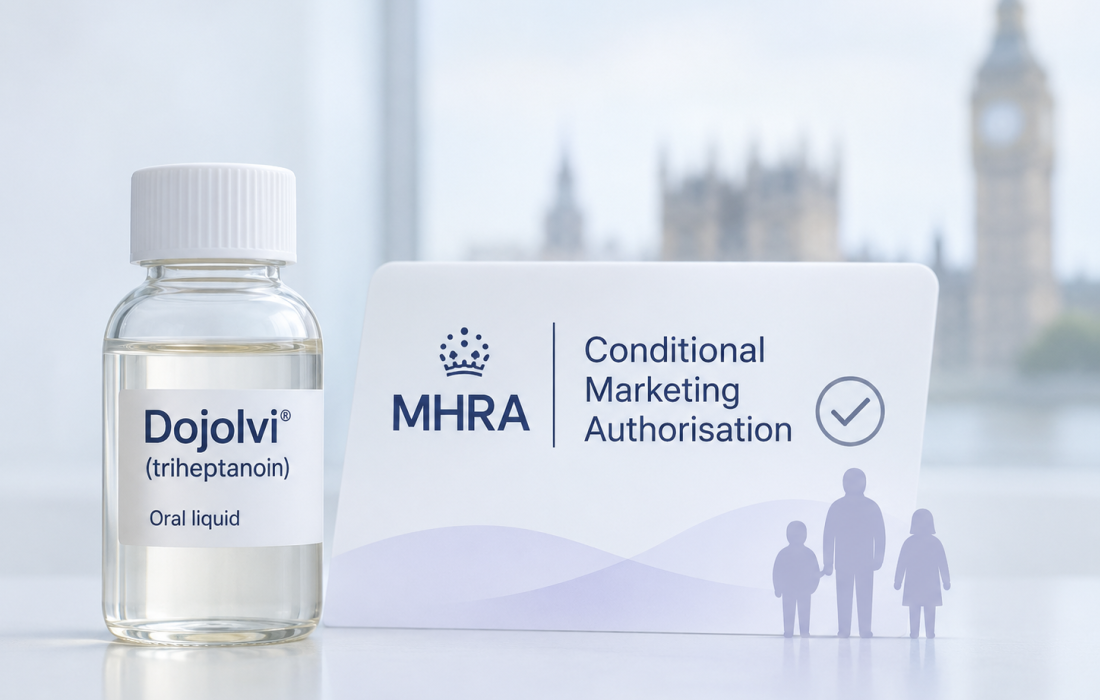
MHRA grants conditional marketing authorisation to triheptanoin (Dojolvi) for adults and children with LC-FAOD, requiring further paediatric evidence.
Written By: Kirti Kumbhar, M. Pharm (QA)
Reviewed By: Pharmacally Editorial Team
The UK Medicines and Healthcare products Regulatory Agency (MHRA) granted a conditional marketing authorisation to Ultragenyx Netherlands for its oral liquid formulation of triheptanoin (Dojolvi) on October 30, 2026, for the treatment of adult and paediatric patients with long-chain fatty acid oxidation disorders (LC-FAOD).
The authorisation provides a treatment option for patients with these rare inherited metabolic disorders. However, the conditional status requires additional efficacy and safety evidence from an ongoing paediatric study before full marketing authorisation can be considered. The MHRA will continue to monitor the medicine’s safety following authorisation.
Understanding LC-FAOD and Triheptanoin
LC-FAOD comprises a group of rare inherited metabolic disorders that impair the body’s ability to use long-chain fatty acids as an energy source. The resulting energy deficiency can cause serious clinical complications, including rhabdomyolysis, cardiomyopathy and hypoglycaemia, potentially leading to emergency medical interventions and hospitalisations.
Triheptanoin is an odd-chain triglyceride supplied as an oral liquid. It provides an alternative energy substrate and anaplerotic carbon that helps replenish intermediates in the tricarboxylic acid cycle, supporting cellular energy production. It is administered daily as part of a carefully controlled dietary regimen under healthcare professional supervision.
Clinical Evidence Supporting Triheptanoin
The clinical development programme included two important open-label studies, CL201 and CL202, which evaluated triheptanoin’s efficacy and safety in patients with LC-FAOD.
Study CL201 (NCT01886378) was a Phase II, single-arm, open-label study involving 29 adults and children aged six months or older with severe LC-FAOD. Participants received triheptanoin for up to 78 weeks. The study reported a reduction in the mean annualised rate of major clinical events, from 1.69 events per patient-year before treatment to 0.88 during treatment.
However, the absence of a concurrent control group and changes in dietary management complicated interpretation of the findings. The US Food and Drug Administration (FDA) did not rely on CL201 to establish efficacy in its 2020 regulatory review.
Study CL202 (NCT02214160) was an open-label extension study designed to evaluate long-term safety and efficacy. Its final published analysis included 94 patients across three cohorts: patients previously treated in CL201, triheptanoin-naïve patients and patients previously treated through investigator-sponsored studies or expanded access programmes. The study followed patients for up to seven years and reported that reductions in major clinical events and the safety profile were consistent with earlier observations.
Both studies contributed to the clinical evidence supporting triheptanoin development, although their uncontrolled designs limit conclusions about treatment efficacy.
Further paediatric evidence: Study CL302 (NCT05933200), a Phase III randomised, double-blind study, is evaluating triheptanoin against even-chain medium-chain triglycerides in paediatric patients with LC-FAOD. The study assesses major clinical events and represents an important part of continued clinical evidence generation. The MHRA announcement does not identify the specific protocol number of the ongoing paediatric study required under the conditional authorisation.
Safety Information and Monitoring
The MHRA identified stomach pain, diarrhoea and vomiting as the most common side effects, each potentially affecting more than 1 in 10 patients.
Patients experiencing suspected side effects are advised to consult their doctor, pharmacist or nurse and report them through the UK’s Yellow Card scheme.
Commenting on the authorisation, Julian Beach, MHRA Executive Director of Operations, highlighted the importance of access to high-quality, safe and effective medicines, particularly for people living with rare diseases. He also confirmed that the agency would continue to monitor triheptanoin’s safety.
Regulatory Outlook
The conditional marketing authorisation, granted on October 30, 2026, provides an authorised treatment option for adults and children with LC-FAOD in the UK. However, the requirement for further paediatric efficacy and safety data highlights the importance of continued clinical investigation after regulatory approval.
The decision also reflects the regulatory challenge of evaluating treatments for rare metabolic disorders, where small patient populations and limited clinical datasets can complicate conventional evidence generation. Continued study results and post-authorisation safety monitoring will therefore remain important in determining the medicine’s longer-term clinical and regulatory position.
Reference
Triheptanoin (Dojolvi) approved to treat adults and children with a group of rare inherited disorders, MHRA, 30 October 2026
A Study of UX007 (Triheptanoin) in Participants with Long-Chain Fatty Acid Oxidation Disorders (LC-FAOD), ClinicalTrials.gov ID NCT01886378
Long-Chain Fatty Acid Oxidation Disorders (LC-FAOD) Extension Study for Subjects Previously Enrolled in Triheptanoin Studies, ClinicalTrials.gov ID NCT02214160
A Study to Determine the Effect of Triheptanoin Compared with Even-Chain MCT on MCEs in Pediatric Patients With LC-FAOD, ClinicalTrials.gov ID NCT05933200

About the Writer
Kirti Kumbhar (LinkedIn) is an M.Pharm graduate with experience in Quality Assurance at Lupin Limited and a strong interest in clinical research, regulatory affairs, and Trial Master File (TMF) management. She has developed knowledge of regulatory documentation, quality systems, compliance, and healthcare research through her professional experience. Passionate about clinical development and continuous learning, Kirti is committed to supporting high-quality healthcare documentation, regulatory excellence, and research-driven healthcare advancements.