
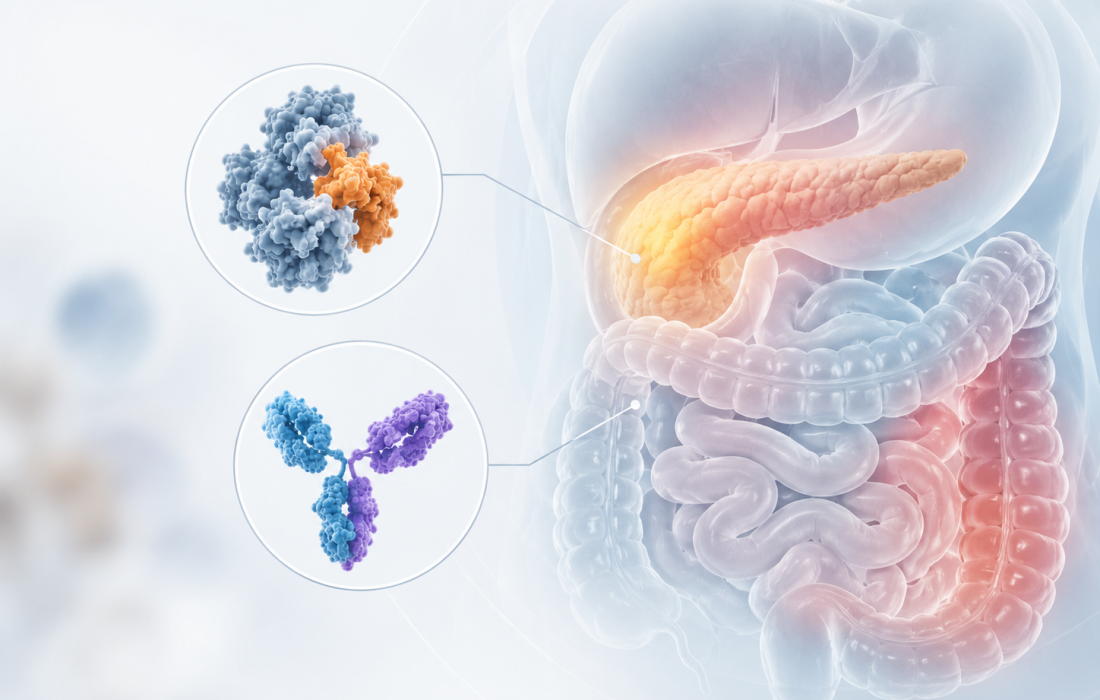
Incyte reports Phase 1 results for INCB161734 in KRAS G12D-mutated pancreatic and colorectal cancers and INCA33890 in advanced colorectal cancer.
Written By: Sravani Pamanji, PharmD
Reviewed By: Pharmacally Editorial Team
Incyte reported preliminary clinical activity for two investigational therapies, INCB161734 and INCA33890, in pancreatic and colorectal cancers at the 2026 European Society for Medical Oncology (ESMO) Congress. The findings support continued clinical development, including Phase 3 programmes, but the early-phase results do not establish comparative efficacy or confirm long-term clinical benefit.
Two Investigational Approaches Target Gastrointestinal Cancers
INCB161734 is an oral inhibitor of KRAS G12D, a mutation found in approximately 40% of pancreatic ductal adenocarcinoma (PDAC) cases and 15% of colorectal cancer (CRC) cases. INCA33890 is a bispecific antibody targeting transforming growth factor beta receptor 2 (TGFβR2) and programmed cell death protein 1 (PD-1), designed to modulate tumour-associated immune signalling.
INCB161734 Shows Activity in Pancreatic Cancer
In a Phase 1 analysis (NCT06179160) with a data cut-off of July 6, 2026, Incyte reported results in 54 patients with metastatic, KRAS G12D-mutated PDAC treated with INCB161734 1,200 mg once daily alongside modified FOLFIRINOX (mFOLFIRINOX) or gemcitabine plus nab-paclitaxel (GEMNabP). The reported treatment-group sizes were 27 and 26 patients, respectively.
With mFOLFIRINOX, the reported objective response rates (ORRs) were 89% and 81%, with the company identifying the latter figure in relation to confirmed and pending responses. The disease control rate (DCR) was 100%, and six-month progression-free survival (PFS) was 90%.
With GEMNabP, the corresponding reported ORRs were 69% and 58%, with the latter similarly described in relation to confirmed and pending responses. The DCR was 96%, and six-month PFS was 80%.
The safety profile was broadly consistent with established chemotherapy regimens. Common treatment-related adverse events included diarrhoea, nausea, vomiting and decreased neutrophil counts. One patient discontinued INCB161734 because of a treatment-related adverse event in the GEMNabP group; none did so in the mFOLFIRINOX group.
These findings indicate substantial preliminary antitumour activity across both combinations. However, differences between the cohorts cannot establish the superiority of either regimen.
Colorectal Cancer Results Support Further Evaluation
In the colorectal cancer cohort of the same Phase 1 study, Incyte reported results in 49 patients with advanced or metastatic KRAS G12D-mutated CRC. Patients received INCB161734 either alone or in combination with cetuximab. Among 22 heavily pretreated patients receiving the combination, the ORR was 36%, the DCR was 100%, and median PFS was 7.2 months (95% confidence interval, 5.4 months to not estimable).
No dose-limiting toxicities were observed during combination dose escalation, and the maximum tolerated dose was not reached.
The findings provide an early signal in previously treated CRC. Nevertheless, the absence of a comparator arm and the limited patient population prevent conclusions about benefit relative to existing treatments.
INCA33890 Shows Activity with First-Line CRC Therapy
In a Phase 1 analysis (NCT05836324) with a data cut-off of August 26, 2026, Incyte reported results from 94 patients with advanced or metastatic CRC across several treatment combinations.
Among 42 patients receiving INCA33890 with FOLFOX and bevacizumab as first-line treatment, the ORR was 71%, the DCR was 100%, and six-month PFS was 81%.
Reported ORRs were 83% among patients with liver metastases (24/29), 62% among those with peritoneal metastases (8/13), and 81% among patients with a PD-L1 tumour area positivity score of at least 1% (21/26).
No dose-limiting toxicities were reported across the treatment combinations. In the first-line cohort, common treatment-emergent adverse events included neuropathy, neutropenia and stomatitis. Four patients (9%) discontinued treatment.
The results support further investigation of TGFβR2×PD-1 targeting in microsatellite-stable CRC. However, subgroup findings remain exploratory and do not establish predictive biomarkers. Adverse events must also be interpreted in the context of combination therapy.
Phase 3 Programmes and Development Plans
Incyte is evaluating INCB161734 with standard chemotherapy in the Phase 3 DAWN-303 study (NCT07522073) in previously untreated metastatic KRAS G12D-mutated PDAC, with topline results anticipated in 2028. An adjuvant PDAC Phase 3 study is planned for 2027.
The Phase 3 DAWN-302 study will evaluate INCB161734 plus cetuximab in previously treated metastatic CRC, with initiation expected in the first half of 2027. Additional Phase 1 research is exploring combinations with standard chemotherapy and other approaches, including tumour-agnostic development.
INCA33890 plus FOLFOX and bevacizumab is being evaluated in the Phase 3 NEXERA-303 study (NCT07284849) for first-line metastatic microsatellite-stable CRC, with topline results expected in 2029. The Phase 2 NEXERA-204 study (NCT07823322) is evaluating INCA33890 in the adjuvant setting for selected patients with stage 2 or 3 disease.
Incyte also plans Phase 1b collaborations evaluating INCB161734 with navlimetostat from Bristol Myers Squibb and SNV1521 from Synnovation in advanced or metastatic PDAC.
Clinical Interpretation
The findings highlight two distinct strategies: direct inhibition of mutant KRAS G12D and targeted modulation of tumour-associated immune signalling. INCB161734 has shown preliminary activity across pancreatic and colorectal cancer cohorts, while INCA33890 has produced encouraging response rates alongside first-line CRC treatment.
The key uncertainty is whether these signals translate into durable clinical benefit and improved outcomes relative to standard therapy. The small, non-comparative early-phase cohorts, exploratory subgroup analyses and use of combination regimens limit conclusions about efficacy and individual-drug safety.
The ongoing and planned larger trials will determine whether these approaches can deliver clinically meaningful benefits and establish their role in gastrointestinal cancer treatment.
References
Incyte Highlights New Data Advancing its Gastrointestinal Cancer Portfolio at ESMO 2026, Incyte, October 26, 2026.
A Study to Evaluate INCB161734 in Participants with Advanced or Metastatic Solid Tumors with KRAS G12D Mutation, ClinicalTrials.gov ID NCT06179160
A Study to Evaluate the Safety of INCA33890 in Participants with Advanced or Metastatic Solid Tumors, ClinicalTrials.gov ID NCT05836324

About the Writer
Sravani Pamanji is a PharmD (LinkedIn) professional with experience in scientific writing, medical literature review, drug profile preparation, and clinical case documentation. She has contributed to scientific publication and presented at the 74th Indian Pharmaceutical Congress. Her training includes ICH GCP E6(R3), scientific research, and medication safety. She is passionate about evidence-based medical communication and accurate dissemination of clinical and pharmaceutical information.