
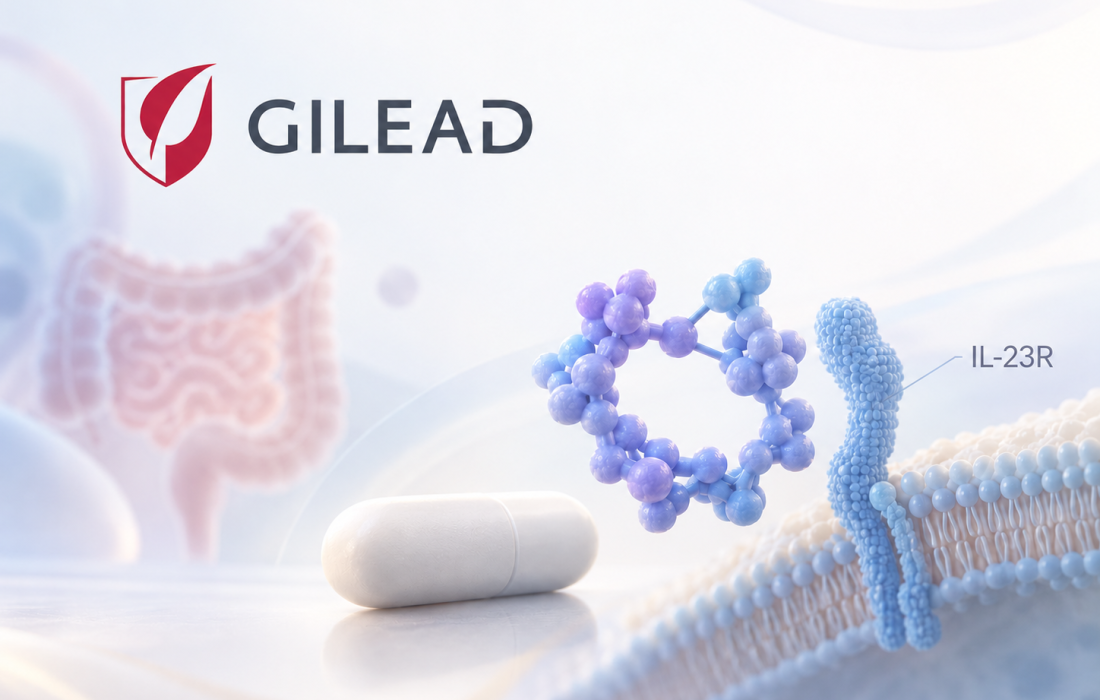
Gilead will pay $1.275 billion upfront to acquire PepStar’s Phase 1 oral IL-23R inhibitor HCXT-2001, expanding its inflammation pipeline.
Written by: Siddhi Bhadekar, M. Pharm (QA)
Reviewed By: Pharmacally Editorial Team
On October 22, 2026, Gilead announced a definitive agreement to acquire an oral interleukin-23 receptor (IL-23R) inhibitor program from privately held biotechnology company PepStar Therapeutics Limited. The program’s lead asset, HCXT-2001, is an investigational macrocyclic peptide currently in Phase 1 clinical development.
The transaction will give Gilead worldwide rights to the program and strengthen its inflammation and immunology portfolio. Gilead identified inflammatory bowel disease (IBD), including Crohn’s disease and ulcerative colitis, as a potential development area, with psoriasis also cited as a possible application.
Gilead’s Chief Medical Officer, Dietmar Berger, MD, PhD, said HCXT-2001 could have potential as a daily oral treatment, either alone or in combination with other pipeline assets, including emvistegrast. However, the proposed combination remains a development strategy rather than an established clinical approach.
Financial Terms and Expected Closing
Gilead will pay $1.275 billion in upfront cash consideration, subject to customary adjustments, at closing. The announcement does not specify additional milestone payments or royalties. Completion is expected in the fourth quarter of 2026, subject to customary closing conditions.
Gilead expects the transaction to reduce both GAAP and non-GAAP earnings per share by approximately $0.79 to $0.83 in the fourth quarter of 2026. Lazard is advising Gilead, while Centerview Partners LLC is advising PepStar.
The size of the upfront payment represents a substantial investment in an early-stage asset. Its eventual commercial value, however, will depend on clinical development, regulatory outcomes and the ability to establish a meaningful therapeutic advantage.
HCXT-2001: An Oral Macrocyclic Peptide Targeting IL-23R
HCXT-2001 is designed to inhibit IL-23R, a receptor involved in immune signalling associated with inflammatory diseases. Gilead describes the molecule as an oral macrocyclic peptide with an extended half-life.
Its proposed differentiation lies in combining oral administration with receptor-level inhibition. Although peptide-based medicines can face challenges related to stability and oral absorption, the available announcement does not establish HCXT-2001’s human bioavailability, duration of receptor inhibition or optimal dosing schedule.
The molecule remains investigational, and its safety and efficacy have not been established. The company’s interest in once-daily treatment reflects a potential development objective rather than a validated clinical regimen.
IL-23 Pathway Rationale in Inflammatory Bowel Disease
IL-23 signalling contributes to immune responses involved in chronic inflammation, making the pathway an established therapeutic target in immune-mediated diseases. Approved IL-23-pathway biologics provide clinical precedent for targeting this biology, although their mechanisms and routes of administration vary.
An oral IL-23R inhibitor could offer a different treatment option if it achieves adequate target inhibition, acceptable tolerability and clinically meaningful efficacy. These advantages cannot yet be assumed for HCXT-2001.
Gilead’s broader inflammation strategy includes IBD, type 2 inflammatory diseases, lupus and B-cell-mediated autoimmune diseases. The acquisition adds another mechanism and modality to this portfolio, but the extent of HCXT-2001’s eventual role remains uncertain.
Phase 1 Study: NCT07792928
ClinicalTrials.gov lists HCXT-2001 study NCT07792928, sponsored by Shanghai Peptidstar Therapeutics Limited. The randomized, double-blind, placebo-controlled Phase 1 study is designed to evaluate the safety, tolerability, pharmacokinetics and immunogenicity of single-dose HCXT-2001 tablets and HCXT-2001 Tablets(A) in healthy adults. Estimated enrollment is 40 participants.
The registry lists psoriasis as the condition associated with the study, but its participants are healthy adults. The trial therefore does not establish efficacy in psoriasis or IBD. No clinical results are reported in the cited sources, and the registry lists the study as not yet recruiting.
Clinical Interpretation
Gilead’s acquisition is a pipeline investment, not evidence of clinical validation. The key question is whether HCXT-2001 can achieve sufficient and sustained IL-23R inhibition with an acceptable safety profile to support further development.
The Phase 1 study is intended to generate initial safety and pharmacokinetic information, not demonstrate therapeutic benefit. Subsequent patient studies will be needed to assess efficacy in IBD or other potential indications. Similarly, the proposed combination with emvistegrast requires clinical evaluation before its potential benefit can be determined.
The $1.275 billion upfront payment underscores the strategic importance Gilead assigns to the program, but the investment alone does not establish its scientific or commercial prospects. HCXT-2001’s value will ultimately depend on the evidence generated during clinical development.
References
Gilead to Acquire Investigational Oral IL-23R Inhibitor HCXT-2001, Strengthening Its Inflammation Pipeline in IBD, Gilead, 22 October 2026
A Study of HCXT-2001 Tablets and HCXT-2001 Tablets(A) in Healthy Adults, ClinicalTrials.gov ID NCT07792928

About the Writer
Siddhi Rajendra Bhadekar (Linkedin) is an M.Pharm professional with expertise in medical and scientific writing, literature review, publication writing, and evidence synthesis, supported by four peer-reviewed publications.
She brings working knowledge of ICH-GCP, MedDRA, pharmacovigilance, ADR/AE reporting, clinical data management, and regulatory documentation.
With experience across pharmaceutical R&D, Quality Control, and Quality Assurance, she combines scientific research skills with strong attention to accuracy and detail.
Her background in manuscript development, publication planning, and scientific communication enables her to translate complex healthcare information into clear, reliable content.