
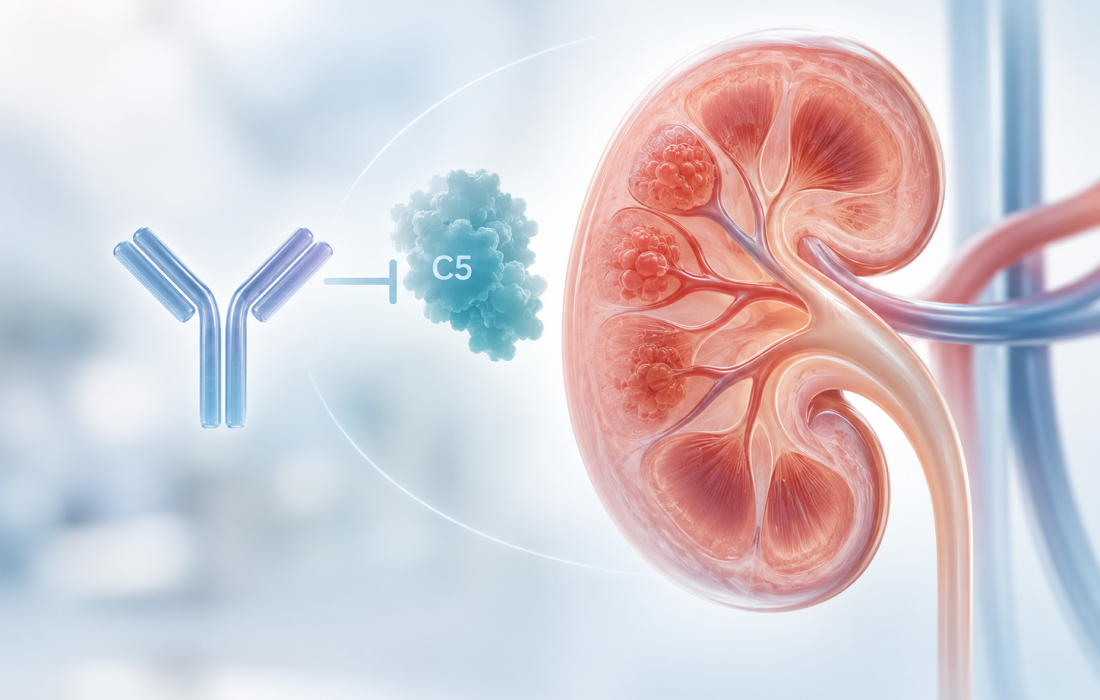
FDA grants accelerated approval to AstraZeneca’s Ultomiris for IgA nephropathy after a 43.4% placebo-adjusted proteinuria reduction in Phase III I CAN. Long-term kidney benefit remains unconfirmed.
Written By: Mayuresh Salvi, PharmD
Reviewed By: Pharmacally Editorial Team
AstraZeneca announced that the US Food and Drug Administration (FDA) has granted accelerated approval to Ultomiris (ravulizumab) to reduce proteinuria in adults with primary immunoglobulin A nephropathy (IgAN) at risk of disease progression. Developed by Alexion, AstraZeneca Rare Disease, the treatment is the first and only C5 complement inhibitor approved in the United States for this indication.
The decision followed Priority Review and was supported by a prespecified interim analysis of the Phase III I CAN trial. Although the results demonstrate a substantial reduction in proteinuria, whether ravulizumab slows long-term kidney function decline remains unconfirmed.
Addressing Progressive Kidney Injury in IgAN
IgAN is an immune-mediated kidney disease in which abnormal immunoglobulin A-containing immune complexes contribute to inflammation and glomerular injury. Progressive damage can lead to chronic kidney disease and, in some patients, kidney failure.
Proteinuria, or excess protein in the urine, is an important marker of kidney injury and disease progression. Despite available treatments, some patients remain at risk of progressive kidney damage, highlighting the need for additional therapeutic options.
Phase III I CAN Trial Demonstrated Sustained Proteinuria Reduction
The global, randomised, double-blind, placebo-controlled Phase III I CAN trial (NCT06291376) evaluated ravulizumab in adults with IgAN at risk of disease progression. Participants received intravenous ravulizumab or placebo alongside stable background treatment consistent with standard care.
At Week 34, 24-hour urine protein-to-creatinine ratio (UPCR) decreased by 46.6% from baseline with ravulizumab, compared with 5.6% with placebo. The placebo-adjusted treatment effect was 43.4% (95% confidence interval [CI]: 33.5%–51.8%; p<0.0001).
The reduction emerged early. At Week 10, UPCR had declined by 36.7% with ravulizumab, compared with 8.5% with placebo. The effect was sustained through Week 34 and was consistent across the patient subgroups reported by the company.
These findings provide the principal efficacy evidence supporting accelerated approval. However, a reduction in proteinuria should not be interpreted as an equivalent reduction in kidney failure risk. The magnitude of long-term clinical benefit remains to be established.
C5 Inhibition and Administration
Ravulizumab is a long-acting monoclonal antibody that inhibits complement component C5, preventing terminal complement activation. This mechanism targets a pathway implicated in complement-mediated inflammatory kidney injury in IgAN.
In the I CAN trial, ravulizumab was administered by intravenous infusion using a weight-based loading dose on Day 1, followed by maintenance dosing beginning on Day 15 and continuing every eight weeks. The blinded treatment period lasted 106 weeks.
Safety Profile and REMS Requirements
The safety profile observed in the interim analysis was consistent with the established profile of ravulizumab, with no new safety concerns identified. The most frequently reported adverse events in the treatment group were upper respiratory tract infection (11.3%), nasopharyngitis (9.2%) and infusion-related reactions (8.4%). In the placebo group, the most common events were upper respiratory tract infection (10.2%), nasopharyngitis (9.0%) and hypertension (6.6%).
C5 inhibition carries a risk of serious, potentially fatal meningococcal infections. In the United States, Ultomiris is available only through the ULTOMIRIS and SOLIRIS Risk Evaluation and Mitigation Strategy (REMS) programme. Prescribers must follow applicable vaccination, infection-prevention and monitoring requirements in the current US prescribing information. Vaccination does not eliminate the risk of meningococcal infection.
Week 106 Assessment Will Determine the Longer-Term Benefit
The ongoing I CAN trial will assess change from baseline in estimated glomerular filtration rate (eGFR) at Week 106 as the primary endpoint of the final analysis. The results are intended to verify clinical benefit and support consideration of traditional FDA approval. Continued approval under the accelerated pathway may depend on verification and description of clinical benefit.
Late-breaking I CAN results are scheduled for presentation at the American Society of Nephrology’s Kidney Week 2026. Regulatory submissions based on the interim findings are also under review in Japan and other countries.
The 43.4% placebo-adjusted reduction in proteinuria establishes a measurable treatment effect on a clinically relevant marker of kidney injury. However, the Week 106 eGFR results will be essential to determining whether this effect translates into preservation of kidney function. For now, Ultomiris expands treatment options for adults with progressive-risk IgAN, while its long-term impact on disease progression remains to be confirmed.
References
Ultomiris received accelerated approval in the US as first and only C5 complement inhibitor to reduce proteinuria in adults with primary immunoglobulin A nephropathy, AstraZeneca, 21 October 2026
Study of Ravulizumab in Immunoglobulin A Nephropathy (IgAN) (I CAN), ClinicalTrials.gov ID NCT06291376

About the Writer
Mayuresh Sunil Salvi (Linkedin) is a PharmD professional and healthcare writer with a strong interest in pharmacovigilance, drug safety, and emerging medical research. He is passionate about exploring new drug discoveries, clinical research, and advances in evidence-based medicine. His interests also include ward rounds, prescription audits, and treatment analysis to support rational pharmacotherapy and improved patient care.