
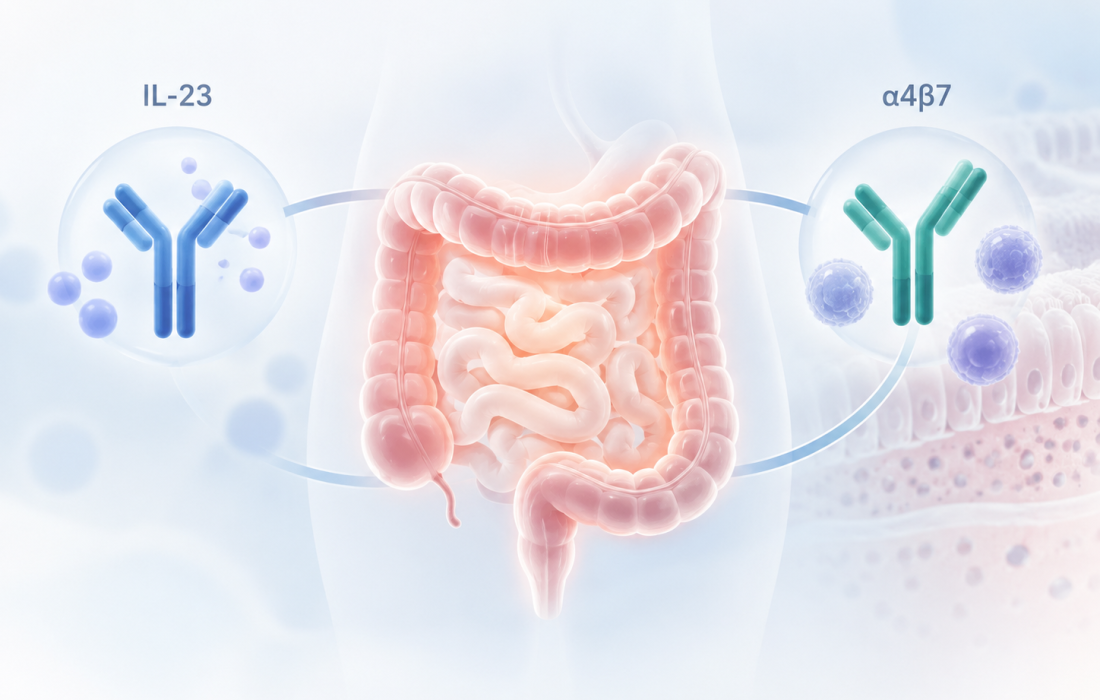
AbbVie’s ABBV-466 achieved higher endoscopic remission rates than either monotherapy in a Phase 2a Crohn’s disease study, with results through Week 24.
Written By: Anamika Koshti, PharmD
Reviewed By: Pharmacally Editorial Team
AbbVie has reported that ABBV-466, an investigational combination of risankizumab and trosunilimab, achieved higher endoscopic remission rates than either drug alone in patients with moderate-to-severe Crohn’s disease. The Phase 2a TARGET-CD study (NCT06548542) findings were presented as a late-breaking abstract at United European Gastroenterology (UEG) Week 2026 in Barcelona.
At the primary endpoint of Week 12, endoscopic remission was reported in 30.2% of patients receiving ABBV-466, compared with 21.3% receiving risankizumab and 18.0% receiving trosunilimab. The numerical differences were larger at Week 24, although statistical significance cannot be assessed from the results reported in the announcement.
Targeting Crohn’s Disease Through Two Pathways
ABBV-466 combines risankizumab, an interleukin-23 (IL-23) p19 inhibitor, with trosunilimab, an investigational integrin α4β7 inhibitor that targets immune-cell trafficking to the gut. The combination is designed to address complementary inflammatory mechanisms by inhibiting cytokine signalling and limiting immune-cell migration into intestinal tissue.
According to Kori Wallace, MD, AbbVie’s global head of immunology clinical development, the company’s research identified persistent α4β7-associated inflammation despite IL-23 p19 inhibition, providing the rationale for combining the two agents.
Risankizumab is approved in the European Union for moderate-to-severe Crohn’s disease, whereas trosunilimab and ABBV-466 remain investigational.
A Three-Arm Comparison Within the TARGET-CD Platform
TARGET-CD is an ongoing, open-label, treat-through Phase 2a platform study. The reported comparison included 300 patients receiving ABBV-466 (n=106), risankizumab (n=94) or trosunilimab (n=100), with treatment continuing through Week 24.
Approximately 25% of participants were biologic-naïve, while 75% had failed at least one advanced therapy. This included 9.3% who had failed prior IL-23 therapy and 12% who had failed a Janus kinase (JAK) inhibitor; 25% had failed three or more advanced therapies.
The primary endpoint was endoscopic remission at Week 12, defined as a Simple Endoscopic Score for Crohn’s Disease (SES-CD) of 4 or less, with no subscore above 1 in any individual variable. Additional prespecified assessments were conducted at Weeks 12 and 24.
Endoscopic Remission at Weeks 12 and 24
At Week 12, endoscopic remission rates were 30.2% with ABBV-466, 21.3% with risankizumab and 18.0% with trosunilimab. At Week 24, the respective rates were 40.5%, 22.4% and 20.0%.
Compared with risankizumab, ABBV-466 showed an absolute difference of 8.9 percentage points at Week 12 and 18.1 percentage points at Week 24. The corresponding differences versus trosunilimab were 12.2 and 20.5 percentage points.
These results indicate a numerical advantage for the combination at both assessments. However, AbbVie did not report p-values or confidence intervals in the announcement, limiting assessment of statistical uncertainty. The Week 24 findings reflect continued treatment in a treat-through design and do not establish that the combination’s advantage necessarily increases over time in individual patients.
Gene-expression analyses reportedly showed changes associated with colonic epithelial repair and barrier restoration at Week 12, followed by tissue-remodelling and metabolic changes at Week 24. These findings were generally not observed with either monotherapy. Their clinical significance remains uncertain without detailed analyses linking the molecular changes to patient outcomes.
Serious Adverse Event Rates Across Treatment Arms
Serious adverse events occurred in 10.4% of patients receiving ABBV-466, 9.6% receiving risankizumab and 9.0% receiving trosunilimab through Week 24.
The most common adverse events, occurring in at least 5% of patients, were Crohn’s disease and nausea in the ABBV-466 and trosunilimab groups, and Crohn’s disease and arthralgia in the risankizumab group. Although reported serious adverse event rates were similar, the study’s size and follow-up duration limit conclusions about longer-term safety. The announcement does not provide sufficient detail to establish whether any new safety signals or deaths occurred.
Clinical Interpretation
TARGET-CD provides early evidence that combining IL-23 p19 and α4β7 inhibition may improve endoscopic outcomes compared with either monotherapy in Crohn’s disease. The numerical differences persisted at Week 24 in a population with substantial prior treatment exposure, supporting further investigation of dual-pathway inhibition.
However, the open-label Phase 2a design, relatively small treatment groups and absence of reported statistical testing limit conclusions about comparative efficacy. The announcement also does not provide detailed clinical remission or symptom-outcome results, so it remains unclear whether the endoscopic findings translate into improved symptoms or other clinical benefits. The gene-expression findings offer a potential biological explanation but remain exploratory.
The findings support further evaluation of ABBV-466 but do not establish its superiority over risankizumab or demonstrate a long-term clinical benefit. Larger controlled studies and longer follow-up will be needed to determine whether the observed differences translate into meaningful benefits for patients.
References
AbbVie Presents Data for ABBV-466, a Novel Dual-Targeting Therapy Demonstrating Higher Endoscopic Remission Rates Than Either Anti-IL-23 or Anti-α4β7 Monotherapy in Moderate to Severe Crohn’s Disease, Abbvie, 19 October 2026
Study of Targeted Therapies for the Treatment of Adult Participants with Moderate to Severe Crohn’s Disease (Target CD), ClinicalTrials.gov ID NCT06548542

About the Writer
Anamika Koshti (LinkedIn) is a PharmD professional and healthcare writer with interests in clinical research, pharmacovigilance, and evidence-based medicine. She has authored peer-reviewed publications on Alzheimer’s disease and PCOS, presented research at national conferences, and gained hands-on experience in medical content development and clinical data interpretation. She is committed to translating complex medical research into accurate, accessible content for healthcare professionals and patients.