
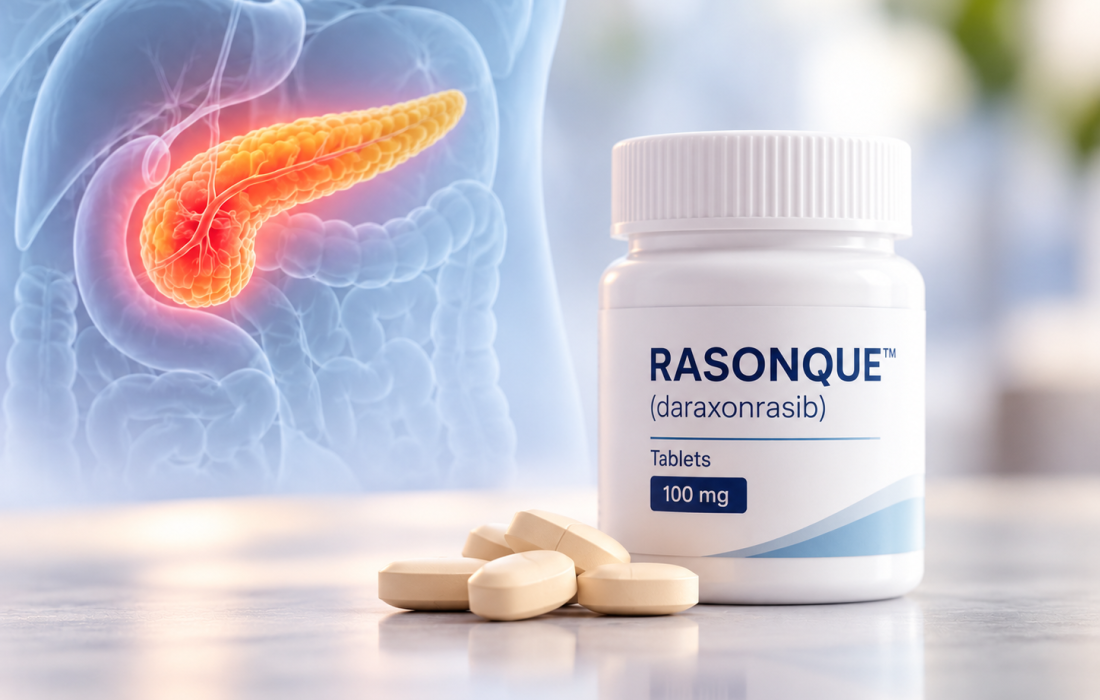
Revolution Medicines’ RASONQUE receives a positive CHMP opinion for metastatic pancreatic cancer after Phase 3 results showed improved overall and progression-free survival.
Written By: Kalyani Boharapi,
M.Pharm (Reg. Affairs)
Reviewed by: Pharmacally Editorial Team
Revolution Medicines announced that the European Medicines Agency’s Committee for Medicinal Products for Human Use (CHMP) has adopted a positive opinion recommending marketing authorization for RASONQUE™ (daraxonrasib) as monotherapy for adults with metastatic pancreatic adenocarcinoma who have received at least one prior systemic therapy. The recommendation is based on Phase 3 RASolute 302 results, which showed a 60% reduction in the risk of death compared with chemotherapy in the overall study population. The European Commission will make the final authorization decision.
If approved, RASONQUE would provide the first broad RAS-targeted treatment option in the European Union for eligible patients with metastatic pancreatic cancer. The CHMP recommendation followed an expedited, phased review under the EMA’s Cancer Medicines Pathfinder project.
Phase 3 RASolute 302 Demonstrates Survival Benefit
RASolute 302 (NCT06625320) was a global, randomized Phase 3 trial comparing RASONQUE with investigator’s choice of chemotherapy in patients with previously treated metastatic pancreatic ductal adenocarcinoma (PDAC). The trial met its primary and key secondary endpoints in both the RAS G12-mutant population and the overall intent-to-treat (ITT) population, which included patients with or without an identified tumor RAS mutation.
The primary analysis, presented at the 2026 American Society of Clinical Oncology Annual Meeting and published in The New England Journal of Medicine, showed median overall survival (OS) of 13.2 months with RASONQUE, compared with 6.7 months with chemotherapy. The hazard ratio (HR) was 0.40 (95% confidence interval [CI]: 0.30–0.53; p<0.0001), corresponding to a 60% lower estimated hazard of death during the analysis period.
RASONQUE also improved progression-free survival (PFS), with a median of 7.2 months versus 3.6 months with chemotherapy. The HR was 0.49 (95% CI: 0.38–0.64; p<0.0001). Results were generally consistent in the RAS G12-mutant population.
A subsequent ad hoc analysis reported median OS of 12.4 months with RASONQUE and 6.7 months with chemotherapy, with an HR of 0.49 (95% CI: 0.39–0.62). The company described these findings as generally consistent with the prespecified primary analysis. The two estimates represent different analyses and should not be interpreted as interchangeable.
Safety Profile and Monitoring Requirements
The most common adverse reactions reported in the RASolute 302 announcement included diarrhea (63.1%), acneiform dermatitis (62.4%), stomatitis (55.5%), nausea (50.8%), vomiting (41.6%) and fatigue (33.2%).
The US prescribing information identifies warnings for dermatologic and soft-tissue toxicity, oral complications, diarrhea, gastrointestinal perforation, interstitial lung disease (ILD)/pneumonitis and embryo-fetal toxicity. In the relevant pancreatic cancer safety population, dermatologic toxicity occurred in 86% of patients, including Grade 3 events in 10%. Stomatitis occurred in 57%, including Grade 3 events in 9%, while diarrhea occurred in 63%, including Grade 3 events in 6%.
Gastrointestinal perforation was reported in 0.9% of patients, including one fatal event. ILD/pneumonitis occurred in 2.4%, also including one fatal event. These label-based figures should be distinguished from adverse-event rates reported specifically in the randomized trial.
In RASolute 302, Grade 3 or higher adverse events occurred in 61.8% of patients receiving daraxonrasib and 69.6% receiving chemotherapy. Treatment-related adverse events leading to discontinuation occurred in 1.2% and 11.2%, respectively. The findings indicate that the survival benefit must be considered alongside the need for active toxicity monitoring and supportive care.
Regulatory Status and Development Outlook
The US Food and Drug Administration approved RASONQUE on August 26, 2026, for adults with metastatic pancreatic adenocarcinoma who have received at least one prior systemic therapy or are not candidates for multiagent systemic therapy. The proposed EU indication is narrower, specifying patients who have received at least one prior systemic therapy.
The positive CHMP opinion is a recommendation, not a final marketing authorization. The European Commission must make the final decision. If granted through the centralized procedure, authorization would cover EU member states and the European Economic Area countries Iceland, Norway and Liechtenstein. The United Kingdom and Switzerland have separate regulatory procedures.
Daraxonrasib is an oral, noncovalent RAS(ON) multi-selective tri-complex inhibitor designed to target the active state of RAS proteins and disrupt downstream signalling. Revolution Medicines is also investigating the drug in clinical development programmes for pancreatic cancer and RAS-mutant non-small cell lung cancer.
The CHMP recommendation marks an important regulatory step for a treatment that demonstrated significant improvements in overall and progression-free survival in previously treated metastatic PDAC. The European Commission’s decision will determine whether these findings translate into an additional treatment option for eligible patients in Europe.
Reference
Revolution Medicines’ RASONQUE™ (daraxonrasib) Receives Positive CHMP Opinion Recommending Marketing Authorization in European Union for Metastatic Pancreatic Cancer, Revolution Medicine, Revolution Medicine, 15 October 2026
Rasonque, CHMP OPINION, European Medicine Agency, 15 October 2026

About the Writer
Kalyani Boharapi (LinkedIn) is a pharmacy professional and healthcare writer currently pursuing an M.Pharm in Regulatory Affairs at Dr. D. Y. Patil College of Pharmacy, with interests in pharmaceutical regulations, drug development, and healthcare innovation. She has academic exposure to dossier preparation, scientific writing, and regulatory documentation. Kalyani has also completed certification courses in Generative AI, AI in Pharma, and Bioinformatics, and actively participates in pharmaceutical conferences to stay updated with emerging trends and advancements in the healthcare and pharmaceutical industry.