
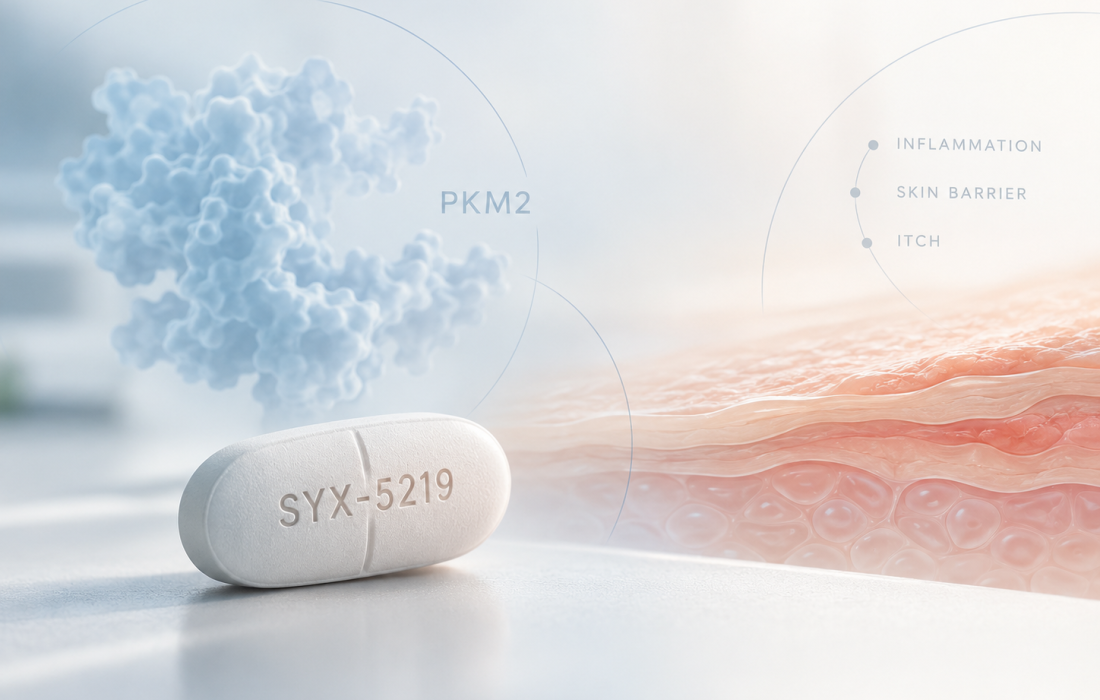
Sitryx reports Phase 1b results for SYX-5219, an oral PKM2 modulator, showing early improvements in eczema severity and itch in adults with atopic dermatitis.
Written By: Saniya Katakdhond, PharmD
Reviewed By: Pharmacally Editorial Team
Sitryx Therapeutics has reported positive topline Phase 1b results for SYX-5219, an investigational oral pyruvate kinase M2 (PKM2) modulator, in adults with moderate-to-severe atopic dermatitis (AD). After six weeks of treatment, the company reported placebo-adjusted improvements in skin disease severity and itch, alongside supportive investigator assessments and inflammatory biomarker findings. The results provide preliminary clinical evidence for targeting immune-cell metabolism in AD, with Phase 2 development expected to begin in the first half of 2027.
SYX-5219 Shows Improvements in Skin Severity and Itch
The randomized, double-blind, placebo-controlled Phase 1b trial evaluated the safety, tolerability and initial efficacy of SYX-5219 in 35 adults with moderate-to-severe AD at clinical sites in the United States and Europe. Participants were randomized in a 2:1 ratio to receive SYX-5219 or placebo for six weeks, followed by a 14-day off-treatment follow-up.
According to Sitryx, treatment differences emerged across clinical endpoints from Day 8 and increased throughout the dosing period. At six weeks, the company reported an approximately 28% placebo-adjusted change in total Eczema Area and Severity Index (EASI) score and an approximately 48% difference in Peak Pruritus Numerical Rating Scale (PP-NRS) itch score versus placebo.
The study also showed favorable findings on the validated Investigator Global Assessment (vIGA), with an increasing number of participants achieving at least a one-point improvement over time.
The findings suggest that SYX-5219 may affect two important aspects of AD burden: visible skin disease and patient-reported itch. However, the reported percentages represent placebo-adjusted comparisons, not the proportions of patients achieving a predefined response. The topline announcement does not provide the complete numerical dataset needed to independently assess treatment effects, their precision or the distribution of responses across participants.
PKM2 Modulation Offers a Different Therapeutic Approach
SYX-5219 targets PKM2, an enzyme involved in cellular metabolism that can influence immune-cell function. By modulating immune-cell metabolism rather than directly blocking a single inflammatory mediator, the investigational therapy is designed to alter inflammatory activity through a different biological pathway.
This approach warrants investigation in AD, a chronic inflammatory skin disease characterized by itching, skin-barrier dysfunction and immune dysregulation. However, the proposed mechanism does not yet establish that SYX-5219 will provide superior disease control or sustained remission compared with existing treatments.
Sitryx reported that reductions in CCL-17, also known as thymus and activation-regulated chemokine (TARC), and CCL-11, or eotaxin, significantly correlated with improvements in disease activity. Exploratory analyses also showed reductions in serum interleukin-13 (IL-13) and immunoglobulin E (IgE), with larger reductions reported among participants with comorbid asthma.
These findings support further investigation of the relationship between PKM2 modulation and inflammatory activity. Nevertheless, biomarker correlations do not establish causation, and the asthma-associated observations do not demonstrate clinical efficacy in asthma.
Safety Findings Support Further Evaluation
SYX-5219 was reported to be safe and well tolerated during the six-week treatment period. Pharmacokinetic and target-engagement findings were consistent with those observed in earlier healthy-volunteer studies.
These findings support continued clinical evaluation, but the small study population and short treatment duration limit conclusions about long-term tolerability and uncommon adverse events. Detailed safety data from larger and longer studies will be needed to characterize the treatment’s risk profile.
Clinical Interpretation: Encouraging Signals Require Confirmation
The principal finding is the consistency of reported improvements across skin severity, itch and investigator assessment, accompanied by changes in inflammatory biomarkers. This convergence provides a rationale for advancing PKM2 modulation into further clinical testing, although the magnitude and durability of benefit remain uncertain.
Sitryx is finalizing the design of a Phase 2 trial in adults with moderate-to-severe AD, which is expected to begin in the first half of 2027. The company plans to present the full Phase 1b dataset at a forthcoming scientific congress and submit the results for peer-reviewed publication.
The complete dataset will be important for assessing endpoint-level results, statistical precision, safety and the relationship between biomarker changes and clinical outcomes. Until those data and subsequent controlled studies are available, SYX-5219 should be regarded as an investigational therapy with encouraging early clinical signals rather than an established treatment option.
Reference
Sitryx Reports Positive Phase 1b Results for First-in-Class Oral PKM2 Modulator SYX-5219 in Patients with Moderate to Severe Atopic Dermatitis, sitryx, 13 October 2026
A 3-part Study of SYX-5219 in Healthy Volunteers and Participants with Atopic Dermatitis, ClinicalTrials.gov ID NCT07558668

About the Writer
Saniya Sanjay Katakdhond (Linkedin) is a Doctor of Pharmacy professional with hands-on experience in patient case review, clinical documentation, medical record analysis, and patient care.
Her hospital experience has strengthened her understanding of clinical conditions, treatment approaches, and multidisciplinary healthcare practices.
With ICH-GCP certification and a research-oriented approach, she brings clinical insight and attention to detail to healthcare content development.
As a healthcare writer, Saniya focuses on translating clinical knowledge and patient-care experience into clear, accurate, and evidence-informed medical content.