
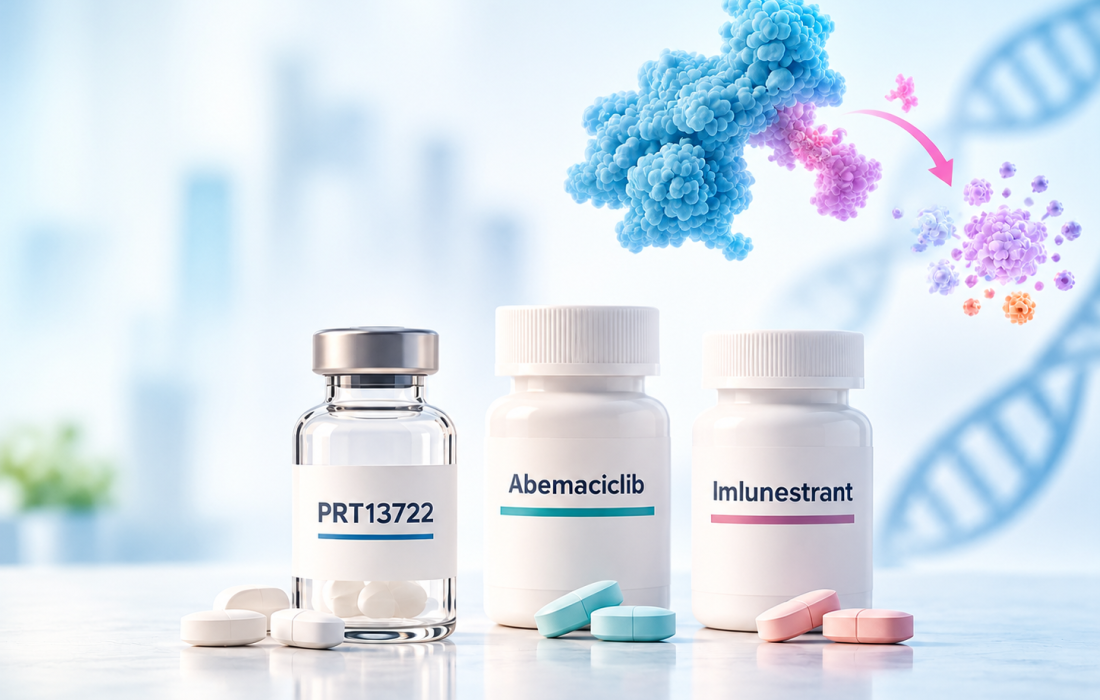
Prelude Therapeutics and Lilly will evaluate PRT13722 with abemaciclib and imlunestrant in a Phase 1 trial for HR+/HER2− breast cancer starting in Q4 2026.
Written By: Creola Gonsalves, PharmD
Reviewed By: Pharmacally Editorial Team
Prelude Therapeutics has entered a clinical trial collaboration with Eli Lilly to evaluate its oral KAT6A-selective degrader PRT13722 alongside abemaciclib and imlunestrant in hormone receptor-positive, HER2-negative (HR+/HER2−) breast cancer. The Phase 1 study is expected to begin enrollment in the fourth quarter of 2026, initially testing PRT13722 alone before advancing to combination cohorts.
Phase 1 Trial to Evaluate Combination Strategies
Under the agreement, Lilly will supply abemaciclib, a CDK4/6 inhibitor, and imlunestrant, an oral estrogen receptor antagonist, for evaluation with PRT13722. The trial will assess the safety and tolerability of the investigational degrader and establish its dosing before evaluating combination regimens.
The US Food and Drug Administration (FDA) recently cleared Prelude’s Investigational New Drug (IND) application for PRT13722, allowing the company to proceed with clinical development. Prelude expects to start with monotherapy dose escalation and advance to combination cohorts during the study.
The announcement did not disclose the planned enrollment, specific dose levels, primary endpoints or detailed study design.
Selective KAT6A Degradation Offers a Different Approach
KAT6A is an epigenetic regulator involved in gene expression and has emerged as a therapeutic target in HR-positive breast cancer. PRT13722 is an orally administered, selective KAT6A degrader that targets the protein for degradation rather than simply inhibiting its activity.
Prelude’s approach differs from dual KAT6A/B inhibitors, which target both proteins. The company hypothesizes that sparing KAT6B could improve antitumor activity and reduce hematologic toxicity, potentially allowing more effective combinations with established breast cancer treatments.
The strategy is relevant to HR+/HER2− disease, in which endocrine therapy and CDK4/6 inhibitors form key components of treatment. Resistance to these therapies, including resistance associated with ESR1 mutations, remains an important challenge.
Preclinical Results Support Combination Development
At the American Association for Cancer Research (AACR) Annual Meeting in April 2026, Prelude presented preclinical findings showing that PRT13722 produced broader and deeper antitumor activity across HR+/HER2− breast cancer models than dual KAT6A/B inhibitors.
As monotherapy, PRT13722 induced durable complete tumor regressions in cell-line-derived and patient-derived xenograft models, including models representing both endocrine therapy-naive and previously treated disease. The company reported activity at doses it described as well tolerated.
Combination experiments also showed synergistic activity with endocrine therapies, CDK4/6 inhibitors and PI3K inhibitors. Activity extended to models with ESR1 mutations and acquired treatment resistance.
Prelude further reported an improved preclinical hematologic safety profile compared with prifetrastat, a dual KAT6A/B inhibitor. These findings provide a rationale for testing PRT13722 alongside standard breast cancer therapies, although the efficacy and safety advantages remain unconfirmed in humans.
Clinical Implications and Next Milestones
Sean Brusky, Prelude’s chief business and strategy officer, said the collaboration would support evaluation of PRT13722 with Lilly’s breast cancer therapies. He highlighted the potential for selective KAT6A degradation to improve efficacy and tolerability while supporting combination treatment.
The partnership gives Prelude access to two established or investigational treatment agents for its clinical program while allowing the company to retain full global development and commercial rights to PRT13722.
The next milestone is initiation of the Phase 1 trial in the fourth quarter of 2026. Initial clinical data will need to establish whether the preclinical findings translate into an acceptable safety profile, a workable dosing regimen and evidence of antitumor activity.
For now, PRT13722 remains an investigational candidate. Whether selective KAT6A degradation can improve outcomes beyond existing endocrine therapy and CDK4/6 inhibitor regimens will depend on results from human studies.
Reference
Prelude Announces Clinical Trial Collaboration and Supply Agreement with Lilly to Evaluate KAT6A Selective Degrader PRT13722 in Combination with Verzenio® and Inluriyo® in Patients with HR+/HER2- Breast Cancer, Prelude Therapeutics, 13 October 2026

About the Writer
Creola Gonsalves (Linkedin) is an M.S. Biotechnology postgraduate with a strong interest in clinical research, evidence interpretation, and healthcare writing, with a focus on translating life-science knowledge into meaningful real-world insights.
She is trained in Good Clinical Practice (GCP), clinical research principles, and critical interpretation of randomized clinical trials, with certifications from NIH and Stanford University.
Her research background in biotechnological applications and microbial research strengthens her ability to understand scientific evidence and develop clear, accurate, and research-driven healthcare content.