
TREMFYA achieved 28.3% and 27.0% Week 24 fistula remission rates versus 10.3% with placebo in the Phase 3 FUZION Crohn’s disease trial.
Written By: Malavatu Satvika, PharmD
Reviewed By: Pharmacally Editorial Team
Johnson & Johnson reported new prespecified subgroup findings from the Phase 3 FUZION study (NCT05347095), evaluating TREMFYA® (guselkumab) in adults with Crohn’s disease complicated by perianal fistulas. Presented at the American College of Gastroenterology (ACG) 2026 Annual Scientific Meeting, the analyses extend previously reported Week 24 results by examining remission across subgroups defined by disease activity, prior biologic exposure and proctitis status.
FUZION represents the first dedicated Phase 3 randomized, placebo-controlled trial in adults with perianal fistulizing Crohn’s disease in more than 20 years, according to Johnson & Johnson.
Overall Week 24 Fistula Remission
Combined fistula remission at Week 24 was achieved by 28.3% of patients receiving TREMFYA 100 mg subcutaneously every eight weeks and 27.0% receiving 200 mg every four weeks, compared with 10.3% receiving placebo.
Both TREMFYA regimens significantly outperformed placebo, with p-values of 0.007 and 0.013, respectively. However, most participants did not achieve the composite remission endpoint by Week 24.
Combined fistula remission required complete closure of all treated external fistula openings without drainage, no new fistulas or abscesses, and no perianal fistula collections greater than 2 cm on magnetic resonance imaging (MRI), assessed through blinded central review.
Remission Across Patient Subgroups
Among patients with greater luminal disease activity at baseline, defined as a Crohn’s Disease Activity Index (CDAI) score of at least 220, remission rates were 30% with TREMFYA 100 mg every eight weeks and 21% with 200 mg every four weeks, compared with 0% with placebo.
Among patients with prior biologic exposure, remission rates were 21% and 29% with the respective TREMFYA regimens, compared with 5% with placebo. These findings are relevant because treatment challenges remain in patients who have previously received biologic therapies.
For patients with proctitis at baseline, remission occurred in 26% and 27% of patients receiving the two TREMFYA regimens, compared with 12% receiving placebo. Among patients without proctitis, the corresponding rates were 29%, 27% and 10%.
Remission was observed across all three reported subgroup categories with both TREMFYA regimens. However, the numerical differences do not establish that one regimen is superior or that treatment effects are equivalent across subgroups. Detailed subgroup statistical comparisons are needed to establish the strength of these observations.
Induction and Maintenance Regimens
Both active-treatment groups received TREMFYA 200 mg intravenously at Weeks 0, 4 and 8 before starting subcutaneous maintenance. The maintenance regimens were 100 mg every eight weeks or 200 mg every four weeks. The placebo group served as the comparator.
Consequently, the reported remission rates reflect the complete induction-plus-maintenance treatment strategies rather than the maintenance regimens in isolation.
Clinical Significance and Mechanism
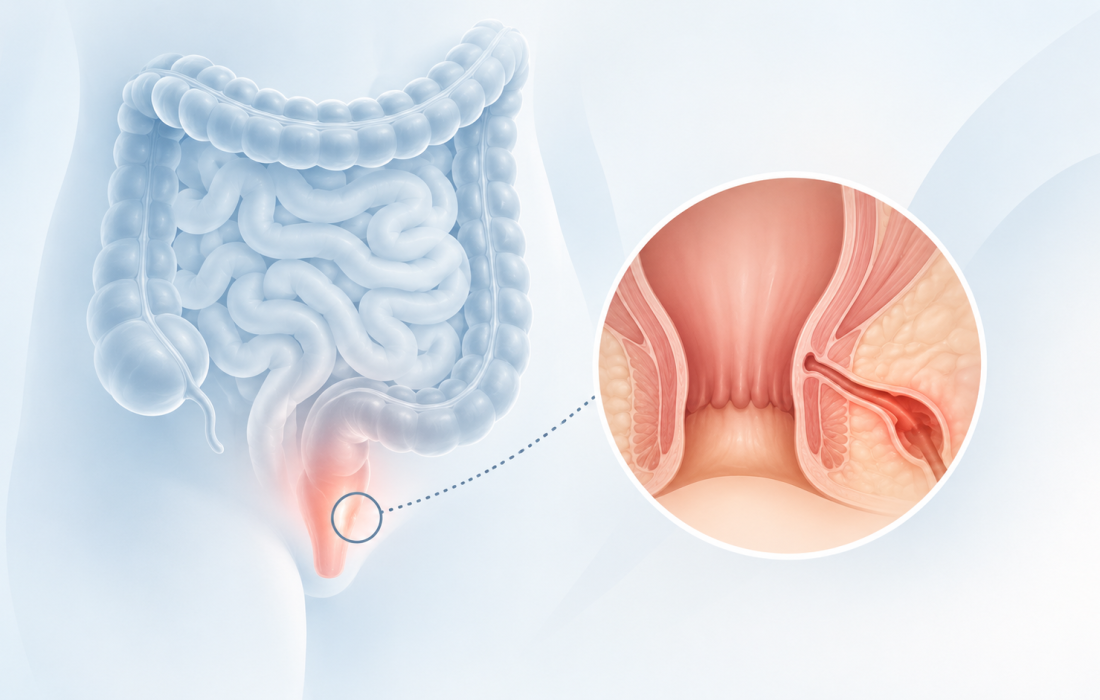
Perianal fistulas are a difficult-to-treat complication of Crohn’s disease associated with persistent drainage, pain, recurrent abscesses and, in some cases, surgery. Durable fistula healing remains an important treatment challenge.
Guselkumab is a monoclonal antibody that inhibits interleukin-23 (IL-23). Johnson & Johnson describes TREMFYA as the only IL-23 inhibitor to have demonstrated efficacy in a dedicated randomized, placebo-controlled trial specifically evaluating perianal fistulizing Crohn’s disease. This distinction reflects the available dedicated-trial evidence and does not establish superiority over other IL-23 inhibitors in head-to-head comparisons.
TREMFYA also binds to CD64, a receptor expressed on certain IL-23-producing cells. The clinical significance of this additional binding mechanism in fistulizing Crohn’s disease remains unknown.
Limitations and Clinical Outlook
The subgroup findings extend the overall FUZION results by showing numerically higher Week 24 remission rates with TREMFYA than placebo across the reported patient groups. Nevertheless, subgroup percentages alone cannot establish consistent treatment effects across populations, particularly without detailed subgroup sample sizes, confidence intervals and statistical comparisons.
The findings also do not establish long-term fistula closure, prevention of recurrence or reduced need for surgery. Adverse events were reported as consistent with the known safety profile of TREMFYA in Crohn’s disease.
FUZION adds dedicated randomized evidence in a difficult-to-treat population and supports further evaluation of guselkumab for perianal fistulizing Crohn’s disease. Longer-term follow-up and detailed subgroup analyses will be important to determine the durability and clinical relevance of the observed remission rates.
Reference
New TREMFYA® (guselkumab) study shows consistent perianal fistula remission across key Crohn’s disease patient subgroups. October 12, 2026.
A Study of Guselkumab in Participants with Fistulizing, Perianal Crohn’s Disease (FUZION CD), ClinicalTrials.gov ID NCT05347095

About the Writer
Malavatu Satvika (Linkedin) is a Pharm.D professional and aspiring healthcare medical writer with clinical exposure and research experience. Her interests include medical writing, drug safety, pharmaceutical research, and evidence-based healthcare communication. She has contributed to two research publications in pharmaceutical journals and has gained practical experience in prescription review, patient counselling, medication review, adverse drug reaction monitoring, drug information services, literature review, and clinical documentation through regular hospital training.
She has completed certifications in clinical research, ICH-GCP E6(R3), data management for clinical research, and congenital hypothyroidism. With a strong foundation in pharmacy, clinical practice, and scientific research, she aims to translate complex medical and pharmaceutical information into accurate, clear, and evidence-based healthcare content. She is also preparing to pursue a PhD and further develop her expertise in medical writing and pharmaceutical research.