
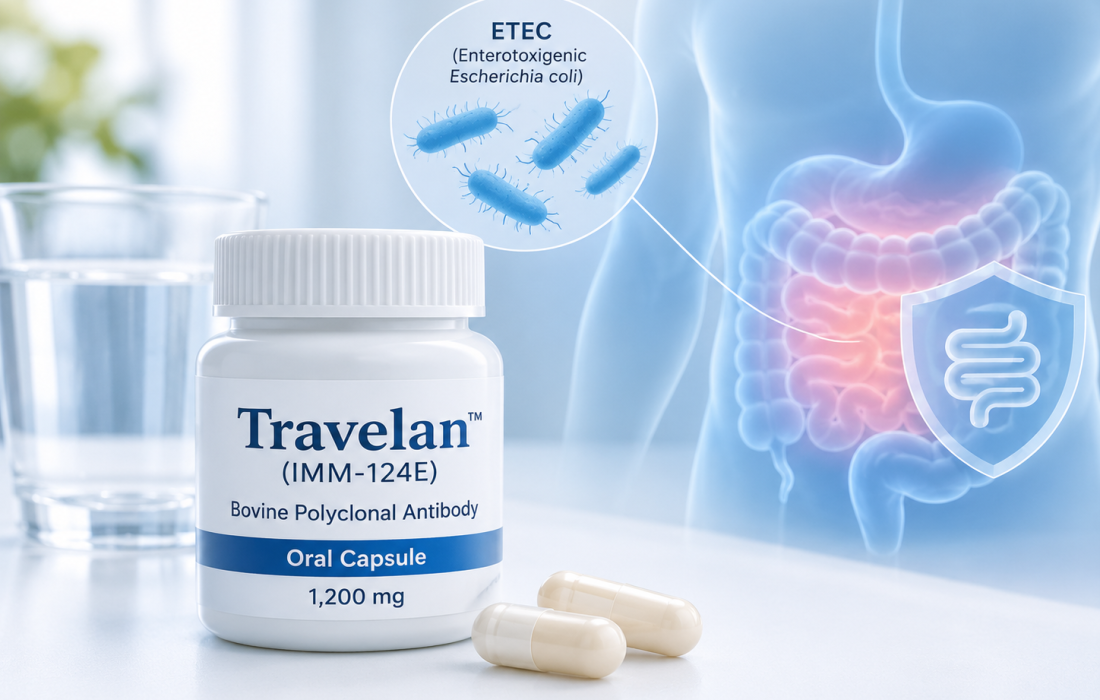
Immuron’s Phase 2 Travelan trial found a 40% relative reduction in moderate-to-severe ETEC diarrhoea, but the result was not statistically significant.
Written By: Kirti Kumbhar, M. Pharm (QA)
Reviewed By: Pharmacally Editorial Team
A Phase 2 randomized, double-blind, placebo-controlled human infection study (NCT05933525) reported by Immuron Limited and published in Scientific Reports evaluated whether once-daily oral Travelan (IMM-124E) could help prevent diarrhoea caused by enterotoxigenic Escherichia coli (ETEC), a major bacterial cause of travellers’ diarrhoea. The study examined whether a simplified dosing schedule could retain the potential protective effects previously reported with divided doses.
Travelan is a bovine polyclonal antibody product derived from colostrum collected from cattle immunized against ETEC. It is designed to act locally in the gastrointestinal tract by interfering with bacterial attachment and adhesion.
Participants received 1,200 mg of Travelan or placebo once daily for seven days, beginning two days before an oral challenge with ETEC strain H10407. Of the 63 participants included in the safety analysis, 60 completed the challenge, with 30 participants in each group. The primary endpoint was moderate-to-severe diarrhoea within five days of challenge.
Clinical Outcomes Favoured Travelan, but Efficacy Remains Uncertain
Moderate-to-severe diarrhoea occurred in 6 of 30 participants receiving Travelan (20%), compared with 10 of 30 receiving placebo (33%). This represented a 40% relative reduction, but the difference was not statistically significant (p=0.382). The reported 95% confidence interval for protective efficacy ranged from −82.2% to 82.1%, indicating substantial uncertainty around the estimated treatment effect.
The placebo attack rate was considerably lower than the approximately 70% anticipated from historical challenge studies. Only 33% of placebo recipients developed moderate-to-severe diarrhoea, leaving fewer primary endpoint events than expected and limiting the study’s statistical power. Although this may partly explain the inconclusive result, it does not establish that a larger trial would demonstrate efficacy.
Several secondary outcomes also favoured Travelan. Severe diarrhoea occurred in 4 participants versus 8 with placebo, while diarrhoea of any severity occurred in 9 versus 16 participants. Early rescue antibiotic use was reported in 2 Travelan recipients compared with 7 placebo recipients. No Travelan recipients required intravenous fluids, compared with 3 in the placebo group. These findings were not statistically significant and should be interpreted as exploratory clinical trends rather than confirmed benefits. The study also did not establish equivalence to previously investigated three-times-daily dosing regimens.
Lower Inflammation Markers Contrast with Higher Bacterial Counts
Faecal myeloperoxidase and calprotectin, markers of intestinal inflammation, were significantly lower in the Travelan group four days after challenge, with p-values of 0.04 and 0.006, respectively. Both markers returned to baseline following antibiotic treatment and clearance of the challenge infection. These biomarker findings provide evidence of a biological effect but do not independently establish clinical protection.
The microbiological results complicate this interpretation. At approximately 48 hours after challenge, viable ETEC was detected in 90% of Travelan recipients and 97% of placebo recipients. However, mean viable bacterial counts were significantly higher with Travelan than placebo (2.13 × 10⁸ versus 1.53 × 10⁸ CFU/g; p=0.0121). Exploratory microbiome analysis found lower relative abundance of Escherichia-Shigella in the Travelan group, but this does not negate the bacterial-count finding or demonstrate faster pathogen clearance.
Safety Findings and Remaining Questions
The study recorded 55 post-challenge adverse events in the Travelan group versus 109 with placebo (p=0.0001). Most events were associated with the challenge infection, so the difference should not be interpreted as proof of a protective safety effect. One participant experienced abdominal cramps, chills and headache considered possibly treatment-related after the first dose. No serious adverse events or deaths were reported.
More than 80% of participants in both groups developed ETEC O78-specific IgA and IgG seroconversion by Days 15–29. However, antibody titres were lower in the Travelan group at selected time points, distinguishing the proportion of participants who developed an immune response from the magnitude of that response.
Overall, the findings suggest potential clinical and biological activity but do not establish that once-daily Travelan prevents travellers’ diarrhoea. The small sample, unexpectedly low placebo attack rate, wide confidence interval and conflicting microbiological findings warrant further investigation. An adequately powered trial is needed to establish efficacy and determine whether once-daily dosing provides a reliable alternative to divided-dose regimens.
Reference
Travelan Phase 2 Study Results Published, Immuron Ltd. 13 October 2026
Clinical Study to Assess the Efficacy of Once-daily IMM-124E (Travelan®) in a Controlled Human Infection Model, ClinicalTrials.gov ID NCT05933525
Casey, J.L., Poly, F., Porter, C.K. et al. A phase 2, randomised, placebo-controlled study to evaluate once-daily oral Travelan for the prevention of Travellers’ diarrhoea. Sci Rep 16, 31486 (2026). https://doi.org/10.1038/s41598-026-70974-9

About the Writer
Kirti Kumbhar (LinkedIn) is an M.Pharm graduate with experience in Quality Assurance at Lupin Limited and a strong interest in clinical research, regulatory affairs, and Trial Master File (TMF) management. She has developed knowledge of regulatory documentation, quality systems, compliance, and healthcare research through her professional experience. Passionate about clinical development and continuous learning, Kirti is committed to supporting high-quality healthcare documentation, regulatory excellence, and research-driven healthcare advancements.