
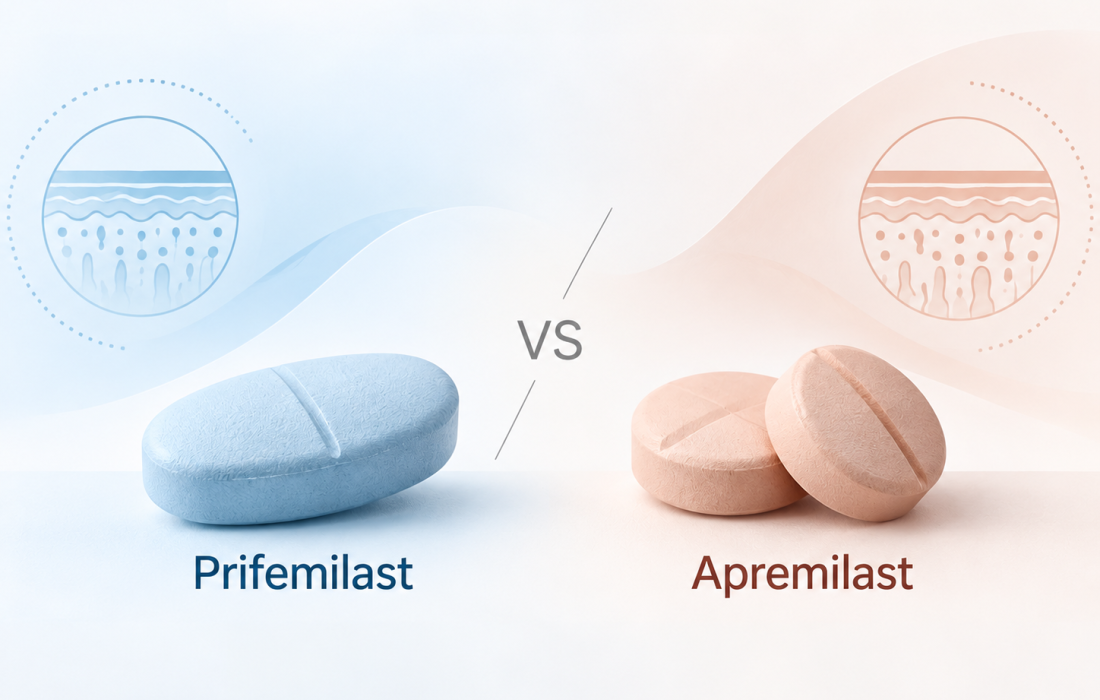
Prifemilast outperformed apremilast on both co-primary endpoints in a Phase 3 psoriasis trial, with higher PASI 75 and sPGA 0/1 response rates at Week 16.
Written By: Malavatu Satvika, PharmD
Reviewed By: Pharmacally Editorial Team
cAMPfield Therapeutics reported positive Phase 3 results for prifemilast, an investigational oral treatment for moderate-to-severe plaque psoriasis. In a head-to-head trial, prifemilast demonstrated superior efficacy to apremilast on both co-primary endpoints at Week 16. Although the findings support its potential as a treatment for psoriasis, longer-term comparative safety and the clinical implications of the observed differences require further evaluation.
Head-to-Head Phase 3 Trial Demonstrated Superior Efficacy
The Phase 3 trial (NCT07712731), sponsored and conducted in China by cAMPfield’s partner Newsoara Biopharma, randomized 607 participants in a 2:1 ratio to receive prifemilast 20 mg once daily or apremilast 30 mg twice daily for 16 weeks. Apremilast was administered following dose titration in accordance with its US prescribing information, whereas prifemilast required no titration.
The co-primary endpoints were the proportion of participants achieving PASI 75, defined as at least a 75% improvement in the Psoriasis Area and Severity Index, and sPGA 0/1, indicating clear or almost-clear skin.
At Week 16, 64.6% of participants receiving prifemilast achieved PASI 75, compared with 35.3% receiving apremilast, an absolute difference of 29.3 percentage points. For sPGA 0/1, response rates were 55.6% and 31.3%, respectively. Both endpoints favoured prifemilast, with p-values below 0.0001.
These results establish superiority on the two reported co-primary endpoints. However, PASI 75 does not indicate complete skin clearance, and the response rates alone do not establish improvements in quality of life, symptom relief or treatment adherence. The findings are currently based on company-reported results presented at a scientific conference.
Dosing and Safety Require Context
Prifemilast’s once-daily dosing without titration differs from apremilast’s twice-daily regimen, which requires initial dose titration. This may offer a dosing convenience, but improved adherence has not been demonstrated in the reported trial.
Serious adverse events occurred in 4.0% of participants receiving prifemilast and 2.5% receiving apremilast. Discontinuations due to adverse events were 2.0% and 1.5%, respectively. Although the company characterized these rates as low and similar, the numerical differences do not establish equivalent safety. Detailed adverse-event data and longer-term comparative follow-up would help clarify the relative safety profiles.
Interpreting the Week 52 Findings
A second Phase 3 trial (NCT07712705) randomized more than 500 participants to receive prifemilast 10 mg or 20 mg once daily or placebo for 16 weeks, followed by a 36-week extension in which all participants received prifemilast.
According to the company, responses appeared as early as Week 2 and were maintained through Week 52. During the initial placebo-controlled period, discontinuation rates due to adverse events were 1.7% to 1.8% across the prifemilast groups and 1.8% with placebo.
The findings provide additional evidence of efficacy and short-term tolerability. However, because the extension lacked a continuing placebo group, the Week 52 results cannot establish comparative long-term efficacy or safety.
Phase 2 Results and Future Development
A Phase 2 dose-ranging trial (NCT07707141) enrolled 123 participants who received prifemilast 6 mg, 10 mg or 20 mg once daily or placebo for 12 weeks. At Week 12, 67.7% of participants receiving prifemilast 20 mg (21 of 31) achieved sPGA 0/1, compared with 6.7% receiving placebo.
Although this finding supports further investigation, PASI 75 was the trial’s primary endpoint. The reported sPGA result should therefore be interpreted as a separate efficacy measure rather than a substitute for the primary endpoint.
Prifemilast is a preferential phosphodiesterase 4B (PDE4B) inhibitor designed to target inflammatory signalling while minimizing inhibition of PDE4D, an isoform associated with dose-limiting adverse effects. The company reports that more than 1,000 participants have received prifemilast in clinical studies, including more than 250 treated for 52 weeks.
Beyond psoriasis, cAMPfield is advancing prifemilast into global Phase 2 trials for ulcerative colitis and Crohn’s disease. Newsoara plans to submit a marketing application for prifemilast in plaque psoriasis in China by the end of 2026. This remains a planned regulatory milestone, not an approval.
The three psoriasis trials were presented in two posters at the 26th Annual Fall Clinical Dermatology Conference, held October 8–11, 2026, in Las Vegas. The company said the posters were expected to be published in Dermatology Online Journal.
Prifemilast remains investigational and has not been approved by any regulatory authority.
References
Prifemilast Demonstrates Superior Efficacy vs. Apremilast in Newsoara’s Head-to-Head Phase 3 Psoriasis Trial; cAMPfield Advancing the Potential Best-in-Class Oral PDE4 Inhibitor in IBD. cAMPfield Therapeutics, October 9, 2026
HPP737 in Adult Patients with Plaque Psoriasis, ClinicalTrials.gov ID NCT07712731
HPP737 in Adult Patients with Moderate-to-severe Plaque Psoriasis, ClinicalTrials.gov ID NCT07712705

About the Writer
Malavatu Satvika (Linkedin) is a Pharm.D professional and aspiring healthcare medical writer with clinical exposure and research experience. Her interests include medical writing, drug safety, pharmaceutical research, and evidence-based healthcare communication. She has contributed to two research publications in pharmaceutical journals and has gained practical experience in prescription review, patient counselling, medication review, adverse drug reaction monitoring, drug information services, literature review, and clinical documentation through regular hospital training.
She has completed certifications in clinical research, ICH-GCP E6(R3), data management for clinical research, and congenital hypothyroidism. With a strong foundation in pharmacy, clinical practice, and scientific research, she aims to translate complex medical and pharmaceutical information into accurate, clear, and evidence-based healthcare content. She is also preparing to pursue a PhD and further develop her expertise in medical writing and pharmaceutical research.