
Cullinan Therapeutics has dosed the first patient in a pivotal Phase 2 study of CLN-049, an investigational FLT3×CD3 T-cell engager, in relapsed/refractory AML.
Written By: Creola Gonsalves, MS Biotech
Reviewed By: Pharmacally Editorial Team
Cullinan Therapeutics has dosed the first patient in a pivotal Phase 2 study of CLN-049, an investigational FLT3×CD3 T-cell engager, in patients with relapsed or refractory acute myeloid leukemia (AML). The potentially registrational study follows a successful End-of-Phase 1 meeting with the U.S. FDA and will evaluate CLN-049 across dose optimization and expansion cohorts.
Pivotal Phase 2 Study Begins in Relapsed/Refractory AML
The Phase 2 trial will enroll patients with relapsed or refractory AML who have received up to two prior lines of therapy. The study begins with a dose-optimization phase evaluating two target dose levels before advancing seamlessly into a single-arm expansion cohort at the recommended Phase 2 dose.
The program also includes an exploratory cohort for patients with newly diagnosed AML carrying TP53 mutations, a population associated with particularly poor outcomes and limited treatment options.
Cullinan expects to report an update from the ongoing Phase 1 dose-escalation study in relapsed/refractory AML in December 2026. The Phase 1 program is evaluating intravenous CLN-049 for safety, tolerability, pharmacokinetics, pharmacodynamics and preliminary antileukemic activity.
CLN-049 Targets FLT3-Positive Leukemia Cells
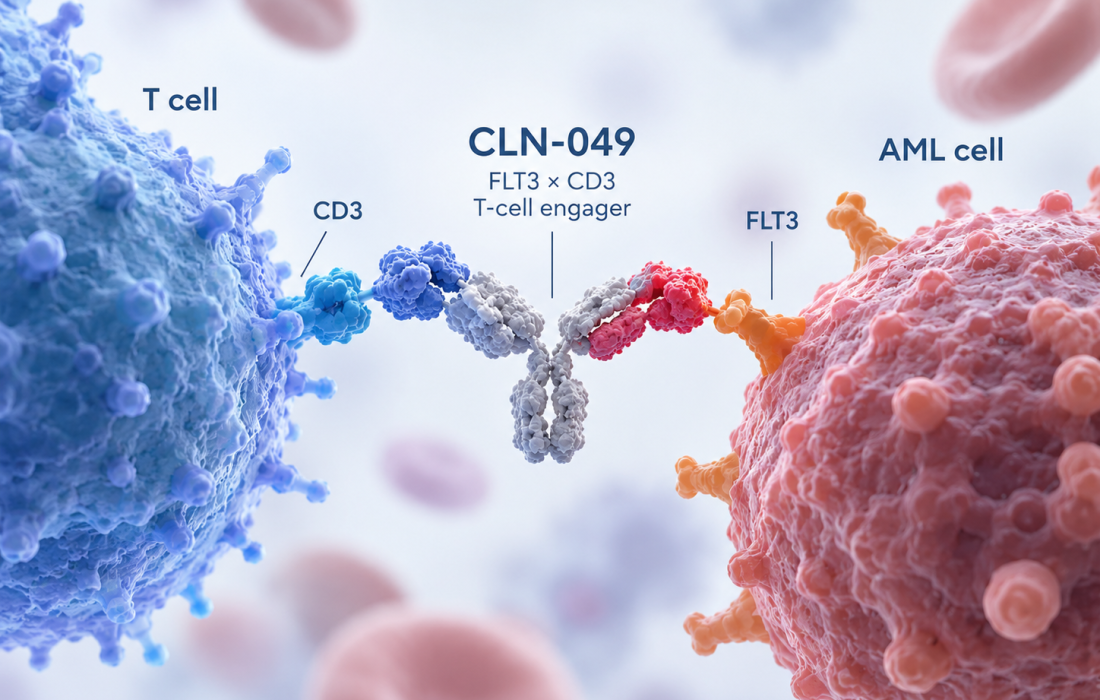
CLN-049 is a bispecific FLT3×CD3 T-cell engager that connects FLT3-expressing leukemia cells with CD3-positive T cells, enabling T-cell-mediated targeting of malignant cells.
A key feature of the program is its ability to bind both mutated and non-mutated FLT3. This could allow CLN-049 to address a broader AML population than approaches restricted to specific FLT3 mutations.
The investigational therapy is being evaluated in AML and myelodysplastic syndrome (MDS). Its lead development program is currently focused on relapsed/refractory AML, where treatment options remain limited after disease progression.
Combination Program Expands CLN-049 Development
Alongside the pivotal Phase 2 study, Cullinan is initiating a separate Phase 1/2 trial combining CLN-049 with azacitidine and venetoclax in patients with newly diagnosed AML.
The combination is intended to evaluate whether CLN-049 can be integrated with an established venetoclax-based treatment backbone earlier in the disease course. The study will assess safety, tolerability, pharmacokinetics and pharmacodynamics during dose escalation and expansion.
The relapsed/refractory AML study is registered as NCT05143996, while the newly diagnosed AML combination study is listed as NCT07722767.
Regulatory Support and Unmet Clinical Need
CLN-049 has received Orphan Drug and Fast Track designations from the FDA for relapsed/refractory AML. These designations support regulatory interaction and development of therapies addressing serious diseases with substantial unmet medical needs, but they do not establish clinical efficacy or approval.
Relapsed/refractory AML remains particularly difficult to treat, with limited durable treatment options after disease progression. High-risk molecular features, including TP53 mutations, further complicate treatment and are associated with poor outcomes.
Despite advances in targeted therapies and combinations, AML still lacks an approved T-cell engager or other broadly applicable immunotherapy. FLT3 therefore represents an important target for approaches that can potentially recruit the patient’s own immune system against leukemia cells.
Next Milestones
The immediate development milestone is completion of the Phase 2 dose-optimization stage and selection of the recommended Phase 2 dose for expansion. The company also expects to provide updated Phase 1 data in December.
Cullinan’s parallel development strategy will test CLN-049 in both relapsed/refractory disease and newly diagnosed AML, including the combination with azacitidine and venetoclax. The emerging clinical data will be important in determining whether FLT3-directed T-cell engagement can translate into meaningful clinical activity across different AML settings.
Reference
Cullinan Therapeutics Announces First Patient Dosed in Planned Registrational Phase 2 Study of CLN-049 in Relapsed/Refractory Acute Myeloid Leukemia, Cullinan Therapeutics, 08 October 2026

About the Writer
Creola Gonsalves (Linkedin) is an M.S. Biotechnology postgraduate with a strong interest in clinical research, evidence interpretation, and healthcare writing, with a focus on translating life-science knowledge into meaningful real-world insights.
She is trained in Good Clinical Practice (GCP), clinical research principles, and critical interpretation of randomized clinical trials, with certifications from NIH and Stanford University.
Her research background in biotechnological applications and microbial research strengthens her ability to understand scientific evidence and develop clear, accurate, and research-driven healthcare content.