
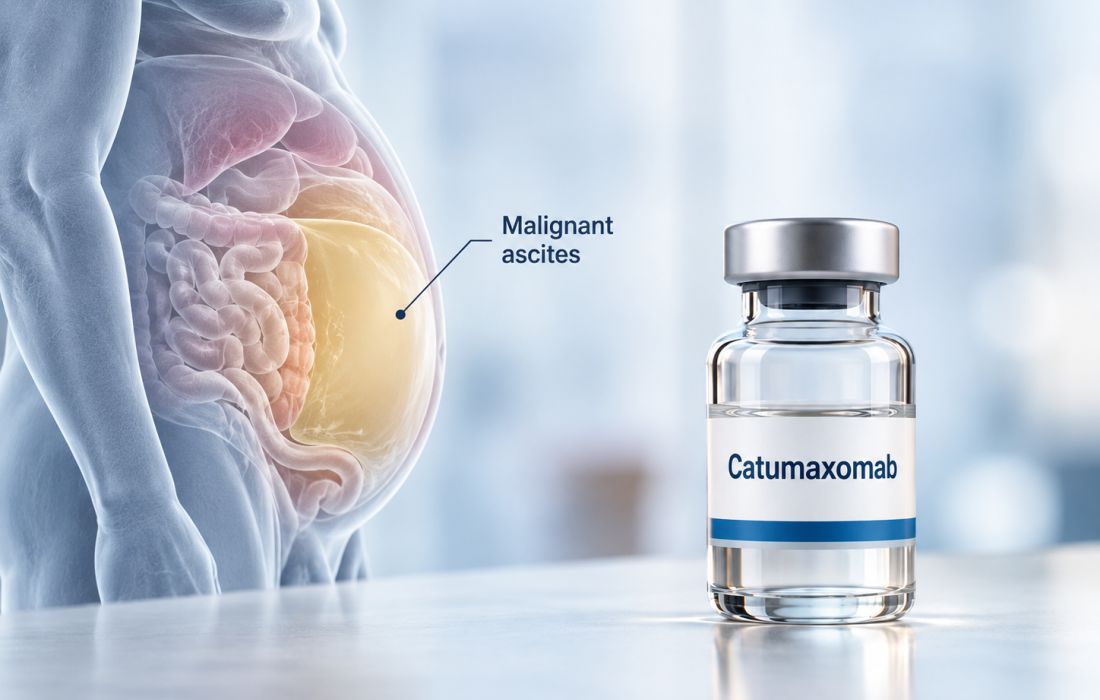
MHRA approves catumaxomab for malignant ascites in adults when standard cancer treatment is no longer feasible, supported by pivotal Phase II/III data.
Written By: Umesh Hanumante,
M.Pharm (Reg. Affair)
Reviewed By: Pharmacally Editorial Team
The UK Medicines and Healthcare products Regulatory Agency (MHRA) has approved catumaxomab (Korjuny) for adults with malignant ascites when standard cancer treatment is no longer feasible. The marketing authorisation was granted to Atnahs Pharma UK Limited on October 2, 2026, with the MHRA announcing the approval on October 7 through the International Recognition Procedure.
The approval provides a new treatment option for eligible patients with malignant ascites, a cancer-related accumulation of fluid in the abdominal cavity that can require repeated drainage procedures. Catumaxomab targets EpCAM-positive cancer cells associated with the ascitic fluid while activating immune cells against the targeted cells.
Targeting Cancer Cells Behind Malignant Ascites
Malignant ascites occurs when cancer contributes to the accumulation of fluid inside the abdominal cavity. Patients may require paracentesis, a procedure used to drain the accumulated fluid.
Catumaxomab takes a targeted approach by recognising epithelial cell adhesion molecule (EpCAM), a protein found on the surface of certain cancer cells, including those present in ascitic fluid. The antibody also activates immune cells, helping the immune system attack and destroy the targeted cancer cells.
Unlike paracentesis, which removes the accumulated fluid, catumaxomab targets the cancer cells associated with malignant ascites and is intended to extend the time before further drainage is required.
Pivotal Phase II/III Study Supported the Approval
The clinical evidence supporting catumaxomab includes IP-REM-AC-01, a randomized, open-label Phase II/III (NCT00836654). The study enrolled 258 patients with malignant ascites associated with EpCAM-positive epithelial cancers. Patients had no further chemotherapy options available or were considered unsuitable for chemotherapy.
Patients were randomized to receive paracentesis followed by intraperitoneal catumaxomab or paracentesis alone. The primary endpoint was puncture-free survival, measuring the time until another therapeutic ascites puncture or death.
The MHRA reported that patients treated with catumaxomab went approximately 46 days before requiring another drainage procedure, compared with approximately 11 days for patients who received paracentesis alone.
The published study also reported a median time to next paracentesis of 77 days with catumaxomab versus 13 days with paracentesis alone. These findings indicate that catumaxomab can delay recurrent drainage in patients with malignant ascites.
How Catumaxomab Is Administered
Catumaxomab is administered under the supervision of a doctor experienced in treating cancer. The medicine is delivered directly into the abdominal cavity through a catheter as four intraperitoneal infusions, with the dose increased at each infusion.
In the pivotal study, patients received escalating doses of 10, 20, 50 and 150 micrograms on Days 0, 3, 7 and 10, respectively.
Because catumaxomab activates the immune system, appropriate specialist supervision is required during treatment.
Safety Remains Under MHRA Monitoring
The MHRA lists nausea, vomiting, diarrhoea, abdominal pain, fever, chills, fatigue and cytokine release syndrome among the common side effects associated with catumaxomab. Cytokine release syndrome is an inflammatory reaction that can occur following strong immune activation.
The MHRA will continue to monitor the medicine’s safety and effectiveness following approval. Healthcare professionals and patients are encouraged to report suspected adverse reactions through the UK’s Yellow Card reporting scheme.
What the Approval Means for Patients
For patients with malignant ascites whose cancer can no longer be managed with standard treatment, therapeutic options may be limited. Catumaxomab adds a UK-approved treatment option that specifically targets EpCAM-positive cancer cells associated with malignant ascites.
The clinical benefit is particularly relevant to the management of recurrent fluid accumulation. The approximately 46-day puncture-free survival compared with 11 days with paracentesis alone, as reported by the MHRA, indicates that catumaxomab can delay the need for another drainage procedure in eligible patients.
The approval is specifically for the management of malignant ascites in the indicated adult population. It should therefore not be interpreted as an approval for treating or eliminating the underlying cancer.
Catumaxomab has received UK marketing authorisation through the International Recognition Procedure. The MHRA said the Summary of Product Characteristics and Patient Information Leaflet would be published on its Products website within seven days of approval.
Reference
MHRA approves catumaxomab to treat cancer-related fluid build-up in the abdomen, MHRA, 07 October 2026
Study in EpCAM Positive Patients with Symptomatic Malignant Ascites Using Removab Versus an Untreated Control Group, ClinicalTrials.gov ID NCT00836654

About the Writer
Umesh Hanumante (M.Pharm) (LinkedIn) is a pharmacy professional and healthcare writer with a background in Regulatory Affairs, pharmaceutical innovation, and clinical research. He has around two years of industry experience as an Executive PMT at Troikaa Pharmaceuticals Ltd and qualified GPAT 2024. His areas of interest include regulatory compliance, dossier preparation, clinical trials, emerging therapies, and advancements in the global pharmaceutical and healthcare sector.