
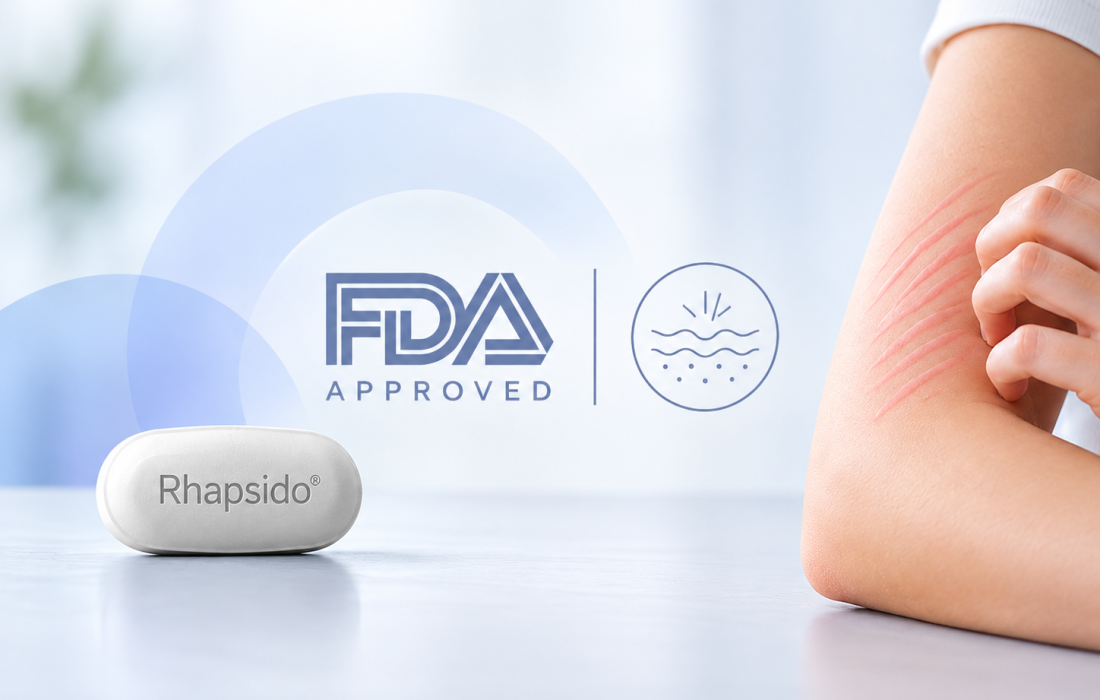
FDA approves Rhapsido (remibrutinib) for symptomatic dermographism in adults inadequately controlled by H1 antihistamines, based on Phase III RemIND data.
Written By: Siddhi Bhadekar, M. Pharm (QA)
Reviewed By: Pharmacally Editorial Team
The U.S. Food and Drug Administration (FDA) has approved Rhapsido® (remibrutinib) for adults with symptomatic dermographism (SD) whose symptoms remain inadequately controlled by H1 antihistamines, Novartis announced on October 7, 2026. Novartis describes Rhapsido as the first treatment specifically approved for adults with SD, a form of chronic inducible urticaria in which mechanical stimuli such as rubbing or scratching can trigger hives and itching.
The decision gives Rhapsido its second U.S. indication, following its initial approval for chronic spontaneous urticaria (CSU). The approval is based on results from the SD cohort of the Phase III RemIND study (NCT05976243), in which 29.3% of patients receiving remibrutinib achieved complete hive response at Week 12, compared with 14.0% with placebo.
FDA Approval Expands Rhapsido’s U.S. Role
Rhapsido is now approved in the United States for adults with CSU or SD whose symptoms are inadequately controlled by H1 antihistamines. Novartis said the two conditions together account for more than 90% of adults with chronic hives and that Rhapsido is the only prescription treatment currently approved in the U.S. for both conditions.
The SD approval does not extend to other chronic inducible urticaria subtypes evaluated in RemIND. Cold urticaria and cholinergic urticaria were also investigated in the trial but are not included in the current U.S. approval. Novartis said it plans to submit the complete RemIND dataset to health authorities where appropriate.
Outside the United States, Novartis currently lists Rhapsido’s approved use in the European Union, United Kingdom and China as treatment for adults with CSU inadequately controlled by H1 antihistamines.
Remibrutinib Targets the BTK Pathway
Remibrutinib is an oral, highly selective Bruton’s tyrosine kinase (BTK) inhibitor. It blocks the BTK pathway involved in histamine release, a key driver of hives and swelling.
This mechanism differs from H1 antihistamines, which act at the histamine receptor. The distinction is clinically relevant because the newly approved population consists of patients whose SD remains inadequately controlled despite H1 antihistamine treatment.
Novartis also reports that Rhapsido does not require routine laboratory monitoring, an aspect relevant to its use as an ongoing oral treatment.
Symptomatic Dermographism and Unmet Need
Symptomatic dermographism is the most prevalent form of chronic inducible urticaria. Unlike CSU, in which wheals occur without a defined external trigger, SD is characterized by hives and itching following mechanical stimulation of the skin.
Light scratching, rubbing or friction can produce raised, itchy wheals. Novartis has cited patient-experience data presented at the 2025 EAACI Congress showing that more than half of people with SD continue to experience symptoms despite H1 antihistamine treatment.
Before this approval, Novartis said no treatment had been specifically authorized for adults with SD inadequately controlled by H1 antihistamines.
Phase III RemIND Study Supports Approval
RemIND is a randomized, double-blind, placebo-controlled Phase III basket study evaluating oral remibrutinib in adults with chronic inducible urticaria inadequately controlled by H1 antihistamines. The study includes separate cohorts for symptomatic dermographism, cold urticaria and cholinergic urticaria.
In the SD cohort, patients remained symptomatic despite treatment with second-generation H1 antihistamines, and hive response was assessed using the Total Fric Score, a friction-provocation measure.
At Week 12, 29.3% of patients receiving Rhapsido achieved complete response from hives compared with 14.0% receiving placebo, an absolute difference of 15.3 percentage points (p=0.0229). Novartis reported that separation from placebo was observed as early as Week 2.
The result represents an approximately twofold higher complete-response rate with remibrutinib than placebo, although most treated patients did not achieve complete hive resolution by Week 12. The available announcement provides the headline efficacy result, while further assessment of the full dataset will be important for understanding secondary outcomes and longer-term efficacy.
Safety Profile Consistent with Previous Data
Through Week 24, Novartis reported that the safety profile of remibrutinib in SD was consistent with its established profile in CSU.
Adverse events occurring in at least 3% of patients included nasopharyngitis-type symptoms such as nasal congestion, sore throat and runny nose, as well as bleeding, headache, nausea and abdominal pain. Novartis also reported that routine laboratory monitoring was not required.
Broader Development of Remibrutinib
The SD approval expands remibrutinib’s development beyond CSU. Novartis is also evaluating the drug in conditions including hidradenitis suppurativa and food allergy.
In relapsing multiple sclerosis, the company has reported positive topline results from the Phase III REMODEL-1 and REMODEL-2 studies, including reductions in annualized relapse rates and delayed disability progression compared with teriflunomide.
For the U.S. urticaria market, however, the immediate significance of the October 7 decision is the addition of symptomatic dermographism to Rhapsido’s approved indications, providing a specifically authorized treatment option for adults whose symptoms remain uncontrolled despite H1 antihistamines.
Reference
Novartis Rhapsido® (remibrutinib) receives FDA approval as first treatment for symptomatic dermographism (SD), expanding its use beyond chronic spontaneous urticaria (CSU), Novartis, 07 October 2026
A Study to Investigate Efficacy, Safety, and Tolerability of Remibrutinib Compared with Placebo in Adults with CINDU Inadequately Controlled by H1-antihistamines, ClinicalTrials.gov ID NCT05976243

About the Writer
Siddhi Rajendra Bhadekar (Linkedin) is an M.Pharm professional with expertise in medical and scientific writing, literature review, publication writing, and evidence synthesis, supported by four peer-reviewed publications.
She brings working knowledge of ICH-GCP, MedDRA, pharmacovigilance, ADR/AE reporting, clinical data management, and regulatory documentation.
With experience across pharmaceutical R&D, Quality Control, and Quality Assurance, she combines scientific research skills with strong attention to accuracy and detail.
Her background in manuscript development, publication planning, and scientific communication enables her to translate complex healthcare information into clear, reliable content.