
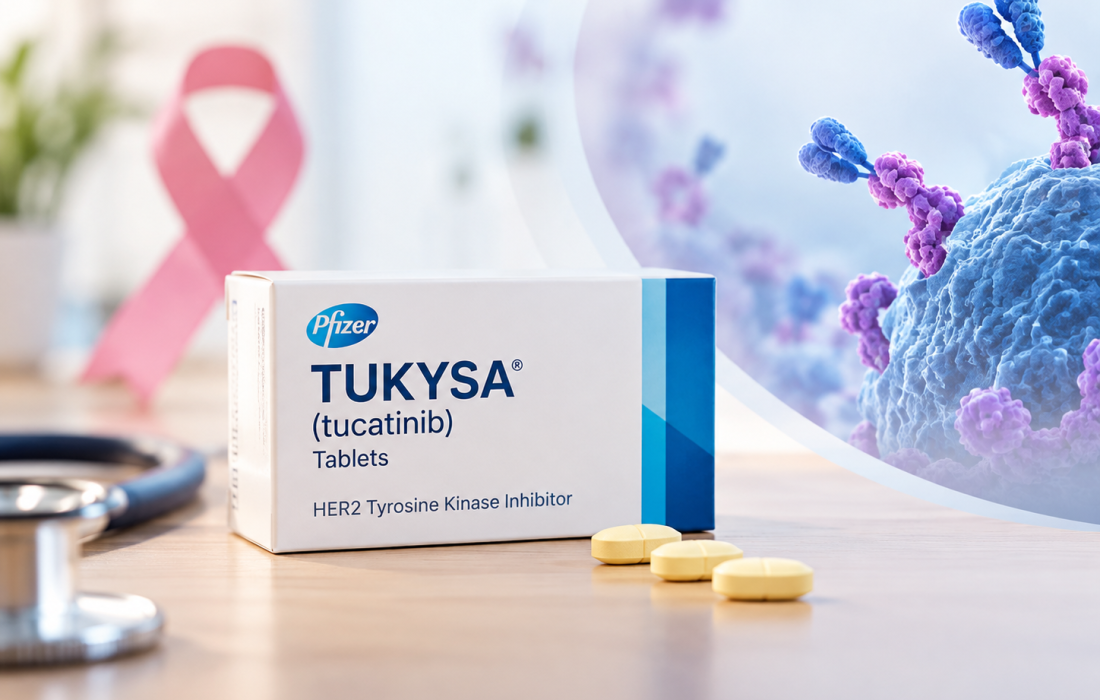
FDA approves Pfizer’s TUKYSA with trastuzumab and pertuzumab for first-line maintenance in HER2-positive metastatic breast cancer after induction therapy.
Written By: Kirti Kumbhar, M. Pharm (QA)
Reviewed By: Pharmacally Editorial Team
Pfizer announced that the U.S. Food and Drug Administration (FDA) has approved TUKYSA® (tucatinib) with trastuzumab and pertuzumab for the maintenance treatment of adults with unresectable locally advanced or metastatic HER2-positive breast cancer following induction treatment. The approval is based on the pivotal Phase 3 HER2CLIMB-05 trial, where the regimen reduced the risk of disease progression or death by 35.9% compared with placebo, trastuzumab and pertuzumab.
Median investigator-assessed progression-free survival (PFS) was 24.9 months with TUKYSA versus 16.3 months with placebo, an 8.6-month improvement. The approval moves tucatinib into the first-line maintenance setting after chemotherapy-based induction, providing a chemotherapy-free HER2-directed maintenance option.
HER2CLIMB-05 Demonstrates Significant PFS Benefit
HER2CLIMB-05 was a randomized, double-blind, placebo-controlled Phase 3 trial evaluating TUKYSA versus placebo, both combined with trastuzumab and pertuzumab, as maintenance therapy following first-line induction in patients with HER2-positive metastatic breast cancer.
The trial enrolled 654 patients, with 326 assigned to TUKYSA plus trastuzumab and pertuzumab and 328 to placebo plus trastuzumab and pertuzumab. Patients had completed 4–8 cycles of induction treatment with trastuzumab, pertuzumab and a taxane without disease progression. Patients with or without brain metastases were eligible.
The primary endpoint was investigator-assessed PFS. The primary analysis showed a hazard ratio of 0.64 (95% CI, 0.51–0.80; two-sided p<0.0001), corresponding to a 35.9% reduction in the risk of disease progression or death.
Median PFS was 24.9 months (95% CI, 21.3–not reached) with TUKYSA versus 16.3 months (95% CI, 12.6–18.7) with placebo. The PFS benefit was observed across prespecified subgroups, including patients with or without brain metastases.
Overall survival was a key secondary endpoint, but the OS data remained immature at the reported analysis. HER2CLIMB-05 results were previously published in the Journal of Clinical Oncology and presented at the 2025 San Antonio Breast Cancer Symposium.
Tucatinib Moves into Earlier-Line Maintenance
TUKYSA is an oral HER2 tyrosine kinase inhibitor. The new regimen combines tucatinib with the HER2-directed antibodies trastuzumab and pertuzumab, adding an oral HER2-targeted therapy to established antibody-based maintenance treatment.
TUKYSA was first approved in 2020 and is already used with trastuzumab and capecitabine for adults with HER2-positive unresectable locally advanced or metastatic breast cancer, including patients with brain metastases, who have received prior anti-HER2 treatment in the metastatic setting.
The new approval moves tucatinib into an earlier treatment setting. Following taxane-based induction with trastuzumab and pertuzumab, patients can transition to TUKYSA plus trastuzumab and pertuzumab maintenance without continuing chemotherapy.
This represents an important change in treatment sequencing, shifting tucatinib from its established later-line role into first-line maintenance.
Hepatotoxicity Remains an Important Safety Consideration
The safety profile in HER2CLIMB-05 was generally consistent with the known profile of TUKYSA, although increased severity of hepatotoxicity was observed. Most hepatotoxicity events were asymptomatic and reversible with dose modification or treatment discontinuation.
Among TUKYSA-treated patients, 18% experienced ALT increases greater than 5× the upper limit of normal (ULN), 10% had AST increases greater than 5× ULN, and 1.2% had bilirubin increases greater than 3× ULN at Grade ≥3 severity.
Five confirmed Hy’s Law cases were reported, including one fatal case. All occurred following rechallenge with TUKYSA. Hepatotoxicity led to dose reduction in 15% and treatment discontinuation in 8% of patients.
Diarrhea occurred in 73% of patients, including 6% Grade 3 events. Serious adverse reactions occurred in 17%, with hepatotoxicity reported in 3.9%. One patient experienced a fatal adverse reaction of drug-induced liver injury.
The most common adverse reactions occurring in ≥20% of patients were diarrhea, musculoskeletal pain, hepatotoxicity, nausea, fatigue, rash and vomiting.
TUKYSA carries a boxed warning for severe and fatal hepatotoxicity. Liver-function testing is required before treatment and during therapy.
A New First-Line Maintenance Role for Tucatinib
HER2CLIMB-05 establishes a new role for tucatinib earlier in the treatment course of HER2-positive metastatic breast cancer. The key finding was an 8.6-month improvement in median PFS, accompanied by a 35.9% reduction in the risk of progression or death.
The benefit across prespecified subgroups, including patients with and without brain metastases, further supports the broad applicability of the regimen. However, the hepatotoxicity findings highlight the need for continued liver-function monitoring.
The FDA approval therefore expands tucatinib from an established later-line therapy into first-line maintenance following trastuzumab, pertuzumab and taxane-based induction, offering a chemotherapy-free maintenance strategy while adding an important safety consideration around hepatic monitoring.
Reference
Pfizer’s TUKYSA Regimen Receives FDA Approval as Front-Line Maintenance Treatment for HER2+ Metastatic Breast Cancer, Pfizer, 07 October 2026
Veronique Dieras et al. HER2CLIMB-05: A Phase III Study of Tucatinib Versus Placebo in Combination with Trastuzumab and Pertuzumab as First-Line Maintenance Therapy for HER2+ Metastatic Breast Cancer. J Clin Oncol 44, 1597-1607(2026). DOI:10.1200/JCO-25-02600
A Study of Tucatinib or Placebo with Trastuzumab and Pertuzumab for Metastatic HER2+ Breast Cancer (HER2CLIMB-05), ClinicalTrials.gov ID NCT05132582

About the Writer
Kirti Kumbhar (LinkedIn) is an M.Pharm graduate with experience in Quality Assurance at Lupin Limited and a strong interest in clinical research, regulatory affairs, and Trial Master File (TMF) management. She has developed knowledge of regulatory documentation, quality systems, compliance, and healthcare research through her professional experience. Passionate about clinical development and continuous learning, Kirti is committed to supporting high-quality healthcare documentation, regulatory excellence, and research-driven healthcare advancements.