
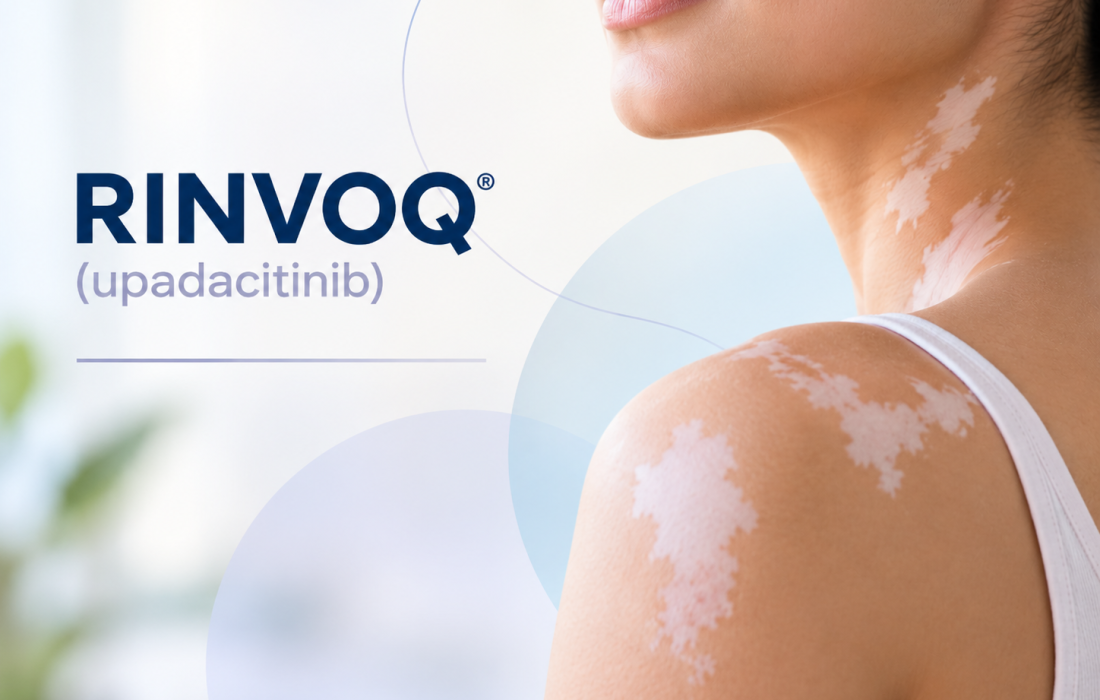
AbbVie reports Week 76 Viti-Up data showing continued repigmentation with RINVOQ in non-segmental vitiligo and findings from an NB-UVB sub study.
Written By: Charvi Kalal, PharmD
Reviewed By: Pharmacally Editorial Team
AbbVie has reported long-term results from the ongoing Phase 3 Viti-Up-1 and Viti-Up-2 studies (NCT06118411) evaluating RINVOQ (upadacitinib) 15 mg once daily in adults and adolescents with non-segmental vitiligo (NSV). The data, presented as a late-breaking oral presentation at the 2026 European Academy of Dermatology and Venereology (EADV) Congress in Vienna, include Week 76 results from the open-label extension and Week 28 findings from a narrowband ultraviolet B (NB-UVB) phototherapy sub study.
The findings showed that among patients who continued RINVOQ treatment in the open-label extension, the proportions achieving predefined facial and total-body re pigmentation responses increased from Week 48 to Week 76. The phototherapy sub study also showed numerically higher response rates when RINVOQ was combined with whole-body NB-UVB than with RINVOQ alone, although the sub study involved small groups.
A Chronic Disease with a Need for Systemic Treatment
Vitiligo is a chronic skin disorder characterized by loss of pigmentation that can affect multiple areas of the body. Because the disease can involve extensive skin areas, systemic treatment approaches may be considered for patients who are candidates for treatment beyond localized therapies.
According to AbbVie, the new findings provide additional long-term data for RINVOQ in NSV and an early basis for further investigation of its use in combination with NB-UVB phototherapy.
RINVOQ and Its Regulatory Status in Vitiligo
RINVOQ, or upadacitinib, is a selective and reversible Janus kinase (JAK) inhibitor. AbbVie states that, in human cellular assays, upadacitinib preferentially inhibits signaling mediated by JAK1 or JAK1/3, with functional selectivity over cytokine receptors that signal through JAK2-containing pairs.
RINVOQ is currently approved in the European Union for adults and adolescents aged 12 years and older with NSV who are candidates for systemic therapy. The EU approval was based on Week 48 results from the Phase 3 Viti-Up program. Its use in NSV remains under regulatory review by the U.S. Food and Drug Administration.
Design of the Phase 3 Viti-Up Program
Viti-Up consists of two replicate Phase 3 studies, Viti-Up-1 and Viti-Up-2, conducted under a single protocol but with independent randomization, sites, data collection, analysis and reporting.
Together, the studies randomized 614 participants aged 12 years and older with NSV across 90 sites worldwide.
During Period A, participants were randomized in a 2:1 ratio to receive RINVOQ 15 mg once daily or placebo for 48 weeks. Participants completing Period A could enter Period B, a 112-week open-label extension in which all patients, including those initially assigned to placebo, received RINVOQ 15 mg once daily. Periods A and B together span 160 weeks.
Continued Repigmentation Through Week 76
Among patients who continued RINVOQ 15 mg once daily in the open-label extension, the proportions achieving F-VASI 75 and T-VASI 50 increased from Week 48 to Week 76.
F-VASI 75 represents at least a 75% reduction from baseline in the Facial Vitiligo Area Scoring Index, while T-VASI 50 represents at least a 50% reduction from baseline in the Total Vitiligo Area Scoring Index.
Week 48 and Week 76 Repigmentation Results
Study | Endpoint | Week 48 | Week 76 |
Viti-Up-1 | F-VASI 75 | 33.1% (N=130) | 55.1% (N=127) |
T-VASI 50 | 29.2% | 42.5% | |
Viti-Up-2 | F-VASI 75 | 27.6% (N=145) | 47.4% (N=137) |
T-VASI 50 | 26.2% | 40.1% |
Data are observed-case analyses among patients continuing RINVOQ 15 mg once daily in the open-label extension. There was no placebo comparator during this extension period.
The results indicate that observed responder proportions increased over the additional 28 weeks of RINVOQ treatment in both studies. The pattern was seen for both facial and total-body repigmentation measures.
Because these were observed-case analyses in the open-label extension, the Week 76 findings should not be interpreted as a controlled comparison against placebo or as evidence that every individual patient experienced continuous improvement.
Findings With RINVOQ Plus NB-UVB Phototherapy
A separate phototherapy sub study evaluated whether adding whole-body NB-UVB phototherapy to RINVOQ could further improve repigmentation.
Following Period A, 84 adults who had not achieved T-VASI 90 at Week 48 and met additional eligibility criteria were re-randomized to receive RINVOQ 15 mg once daily alone or in combination with whole-body NB-UVB phototherapy twice weekly for 28 weeks.
All groups showed improvement from baseline. The combination groups had numerically higher response rates than the corresponding RINVOQ-alone groups.
Week 28 Results From the NB-UVB Substudy
Treatment received during Period A | Endpoint | RINVOQ alone | RINVOQ + NB-UVB |
Placebo | F-VASI 75 | 40.0% (N=15) | 46.7% (N=15) |
T-VASI 50 | 20.0% (N=15) | 33.3% (N=15) | |
RINVOQ | F-VASI 75 | 37.0% (N=27) | 59.3% (N=27) |
T-VASI 50 | 33.3% (N=27) | 63.0% (N=27) |
Week 28 analysis used non-responder imputation (NRI).
The numerical differences favored the combination groups for both facial and total-body repigmentation endpoints. However, the treatment groups were small, with 15 or 27 participants per group, and the reported findings do not establish a statistically confirmed advantage for adding NB-UVB.
The findings therefore provide an early basis for further investigation rather than definitive evidence of the superiority of combination treatment.
Safety Findings
AbbVie reported that safety results through Week 76 in Viti-Up-1 and Viti-Up-2 and through Week 28 in the phototherapy sub study were consistent with the known safety profile of upadacitinib and with the safety findings observed during the 48-week placebo-controlled period.
No new safety signals were reported.
The results presented in this announcement provide additional long-term safety and efficacy information, while the ongoing studies will continue to contribute data on the longer-term use of RINVOQ in NSV.
Path Forward
The Viti-Up studies remain ongoing, with further follow-up expected to provide additional information on the durability of repigmentation with continued RINVOQ treatment. The NB-UVB findings provide an early basis for further investigation of combination treatment, although the small sub study population limits definitive conclusions about the added benefit of phototherapy. The U.S. FDA review of RINVOQ for NSV also remains pending
Reference
AbbVie. AbbVie Presents Long-Term RINVOQ® (upadacitinib) Data Showing Continued Repigmentation in Non-Segmental Vitiligo. AbbVie News Center. October 1, 2026.
ClinicalTrials.gov. A Study to Assess Adverse Events and Change in Disease Activity of Oral Upadacitinib in Adult and Adolescent Participants with Non-Segmental Vitiligo (Viti-Up). NCT06118411

About the Writer
Charvi Kalal (LinkedIn) is a Pharm.D intern and aspiring medical writer with hands-on experience in medical writing, clinical research, pharmacovigilance, and clinical pharmacy. She has experience in medical content writing through CliMed, along with exposure to ADR monitoring, prescription analysis, patient counselling, literature review, and research documentation. Her research focuses on ADR monitoring and reporting in breast cancer patients receiving targeted therapy. With certifications in GCP, biomedical research, scientific writing, and clinical research, she is passionate about transforming scientific evidence into accurate, engaging, and accessible healthcare content.