
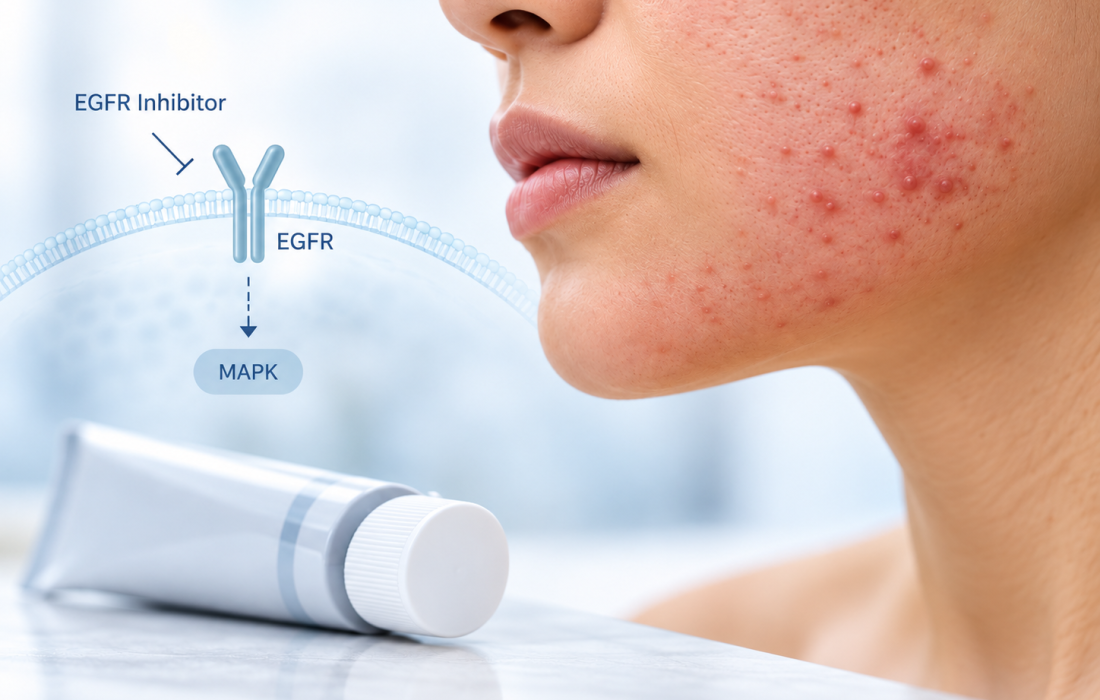
Lutris Pharma reports Phase 2 results showing LUT014 0.1% improved EGFR inhibitor-induced acneiform rash, with treatment success of 71.8% vs 38.5%.
Written By: Khushi Patel, PharmD
Reviewed By: Pharmacally Editorial Team
Lutris Pharma reported updated Phase 2 data showing that topical LUT014 0.1% gel significantly improved EGFR inhibitor-induced acneiform rash, with treatment success achieved in 71.8% of patients versus 38.5% with placebo. The benefit remained evident through Day 55 and was associated with lower non-adherence to EGFR inhibitor therapy.
Phase 2 Trial Shows Significant Treatment Success
The randomized, double-blind, placebo-controlled Phase 2 study evaluated LUT014 in patients with colorectal cancer who developed CTCAE Grade 2 or non-infected Grade 3 acneiform lesions following treatment with the EGFR inhibitors cetuximab or panitumumab.
Among patients receiving LUT014 0.1% gel, 71.8% achieved the composite treatment-success endpoint at Day 28, compared with 38.5% receiving placebo (p=0.003).
Treatment success required either at least a one-grade improvement in acneiform rash severity under CTCAE v5.0 or at least a five-point improvement in patient-reported skin symptoms, together with no treatment failure.
The clinician-assessed component showed a one-grade or greater improvement in 56.4% of patients receiving LUT014 0.1%, compared with 15.4% with placebo (p=0.0002). The patient-reported component improved by at least five points in 53.8% and 28.2% of patients, respectively (p=0.021).
Benefit Persisted After Treatment Period
LUT014 was applied once daily for 28 days, followed by a 28-day observation period. The treatment effect remained evident at Day 55, when 69.2% of patients receiving LUT014 0.1% met the composite treatment-success endpoint versus 31.8% of placebo-treated patients (p=0.005).
The sustained effect is clinically relevant because EGFR inhibitor-associated rash can persist during cancer treatment and may affect quality of life as well as adherence to anticancer therapy.
Non-adherence to EGFR inhibitor treatment because of rash occurred in 10.3% of patients in the LUT014 0.1% group compared with 28.2% in the placebo group (p=0.044). The company said the safety profile remained favorable, consistent with previously reported findings.
Mechanism Targets MAPK Signaling in Skin
LUT014 is a topical B-Raf inhibitor that exploits paradoxical MAPK pathway reactivation. EGFR inhibition suppresses MAPK signaling in both tumor and normal cells. In skin, this suppression can contribute to cellular injury and the development of papulopustular, or acneiform, rash.
LUT014 locally inhibits B-Raf in MAPK-suppressed skin cells, producing paradoxical pathway reactivation that may restore MAPK signaling and support recovery of affected skin cells. The topical formulation is intended to limit drug activity predominantly to the skin.
Study Design and Patient Population
The Phase 2 study enrolled 118 adults with colorectal cancer who developed CTCAE Grade 2 or non-infected Grade 3 EGFR inhibitor-induced acneiform lesions. Patients received LUT014 0.1% gel (n=39), LUT014 0.03% gel (n=40), or placebo (n=39) once daily for 28 days, followed by 28 days of observation.
Treatment failure included EGFR inhibitor dose reduction, delay or discontinuation because of rash, initiation or escalation of antibiotics, or discontinuation of study treatment because of worsening rash.
The updated findings will be presented at the 35th European Academy of Dermatology and Venereology Congress in Vienna on October 2, 2026.
Next Development Focuses on RAS Inhibitor-Associated Rash
Lutris plans to initiate a Phase 2 study of LUT014 0.1% gel in patients with pancreatic ductal adenocarcinoma who develop acneiform rash during treatment with daraxonrasib, a RAS-pathway inhibitor.
The company is also exploring development with additional MAPK-pathway inhibitors. The expansion could test whether the mechanism-directed approach can address dermatological toxicities associated with a broader group of targeted anticancer therapies
Reference
LUT014 for the Reduction of Dose-Limiting Acneiform Lesions Associated with EGFRI Treatment of mCRC, ClinicalTrials.gov ID NCT04759664
Lutris Pharma Announces Positive Updated Phase 2 Data Demonstrating Durable, Mechanism-Directed Benefit of LUT014 Gel for EGFRI-Induced Acneiform Rash at the EADV Congress, Lutris Pharma via PRNewswire, 01 October 2026

About the Writer
Khushi Patel is a Pharm.D (Linkedin) professional with a strong foundation in clinical pharmacy, patient-centered care, regulatory affairs, and pharmacovigilance, with published work on Brugada syndrome.
Her interests include regulatory affairs, pharmacovigilance, guideline integration, multimodal therapy, pharmacogenomics, and antibiogram utilization, with a focus on evidence-based clinical decision-making and medication safety.
As a Pharmacally healthcare writer, she translates clinical and scientific evidence into clear, accurate, and clinically relevant healthcare content, while continuously developing her expertise in evolving pharmacy practice.