
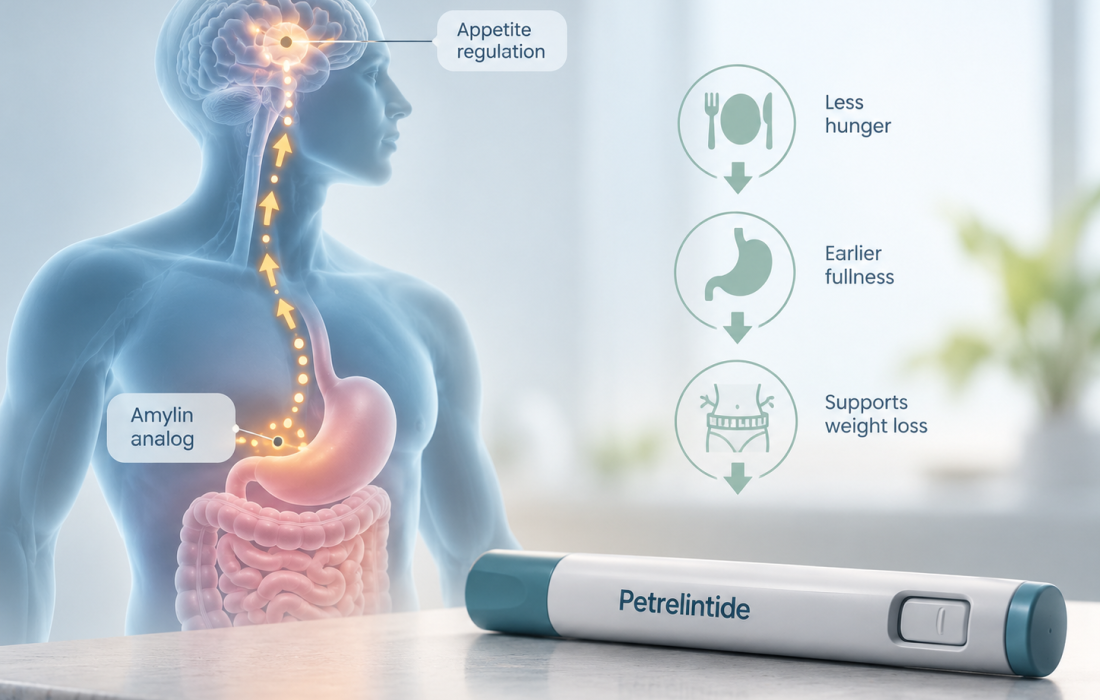
Zealand Pharma presents Phase 2 ZUPREME-1 results for amylin analog petrelintide in The Lancet Diabetes & Endocrinology and at EASD 2026, showing double-digit weight loss and placebo-like GI tolerability.
Written By: Siddhi Bhadekar, M. Pharm (QA)
Reviewed By: Pharmacally Editorial Team
Zealand Pharma A/S has announced that results from the Phase 2 ZUPREME-1 trial (NCT06662539) of its investigational amylin analog petrelintide have been published in The Lancet Diabetes & Endocrinology. Additional data are being presented in an oral session at the 62nd Annual Meeting of the European Association for the Study of Diabetes (EASD) on September 30, 2026, at 3:30 p.m. CEST. The company describes the findings as clinically meaningful, with double-digit weight loss and gastrointestinal tolerability comparable to placebo.
Petrelintide remains an investigational product and is currently being evaluated in a global Phase 3 registrational program for chronic weight management. Zealand reports that the Phase 3 ZUPREME program comprises three trials.
Design and Population of the ZUPREME-1 Trial
ZUPREME-1 was a randomized, double-blind, placebo-controlled, parallel-group, multinational, multicenter, dose-finding trial. It evaluated five once-weekly subcutaneous doses of petrelintide, 1.0, 2.5, 5.0, 7.0 and 9.0 mg, against placebo. Treatment was provided alongside a reduced-calorie diet and increased physical activity in adults with obesity or overweight and weight-related comorbidities.
According to the company, the publication reports 485 adults randomized in a 5:1 ratio to petrelintide or placebo. Baseline characteristics included a mean age of 47 years, 53% women, a mean body mass index of 36.7 kg/m² and a mean body weight of 107.1 kg.
The trial registry entry, as summarized by Zealand, lists 493 enrolled participants across 32 sites in the United States, Poland and Romania. The company announcement does not explain the difference between the enrolled and randomized participant counts.
Treatment continued through week 42. Dose escalation occurred over up to 16 weeks, with dose increases every fourth week, followed by a maintenance period through week 42 and safety follow-up through week 51.
The primary endpoint was percentage change in body weight from baseline to week 28. Secondary endpoints included weight change at week 42, waist circumference, HbA1c, high-sensitivity C-reactive protein (hsCRP), fasting lipids and fasting glucose.
Efficacy Outcomes: Body Weight Reduction at Week 42
Zealand reported mean body weight reductions of up to 10.7% with petrelintide versus 1.7% with placebo at week 42 under the efficacy estimand. Under the treatment policy estimand, which evaluates outcomes among randomized participants irrespective of treatment adherence, reductions were up to 10.2% versus 1.4% with placebo.
The company announcement does not provide the week 28 primary endpoint results or detailed dose-by-dose efficacy results. These additional data may provide further characterization of the dose-response relationship and the primary endpoint when reported through the full publication and EASD presentation.
Gastrointestinal Tolerability and Cardiometabolic Findings
Zealand reported that gastrointestinal adverse events were generally mild and occurred at rates similar to placebo. At the dose identified by the company as maximally effective, no vomiting was reported and no participant discontinued treatment because of gastrointestinal adverse events.
These findings are based on company-reported results, and the announcement does not provide detailed gastrointestinal adverse-event rates by dose or overall treatment discontinuation rates.
The trial also reported changes in several cardiometabolic measures compared with placebo. The largest reductions reported by Zealand included:
- Waist circumference: up to 10.8 cm reduction versus 4.3 cm with placebo
- hsCRP: up to 41% reduction versus 6% with placebo
- Triglycerides: up to 21% reduction versus 9% with placebo
- Pulse rate: mean reduction of up to 2.9 beats per minute versus a mean increase of 0.3 beats per minute with placebo
Zealand said the findings support the potential of petrelintide to address treatment persistence, durability, tolerability and acceptability in weight management. These remain potential benefits, and comparative or longer-term evidence has not yet been reported.
How Petrelintide Works as an Amylin Analog
Petrelintide is a long-acting human amylin analog being developed for once-weekly subcutaneous administration. Amylin is produced by pancreatic beta cells and co-secreted with insulin following nutrient intake.
According to Zealand, amylin receptor activation contributes to body-weight reduction by restoring sensitivity to the satiety hormone leptin and promoting earlier fullness. The company also reports that petrelintide was engineered for chemical and physical stability without fibrillation near neutral pH, characteristics intended to support co-formulation and co-administration with other peptides.
Development Plan and Collaboration with Roche
Zealand Pharma and Roche entered into an exclusive collaboration and licensing agreement in 2025 to co-develop and co-commercialize petrelintide for overweight and obesity.
Beyond monotherapy development, Zealand and Roche have planned a Phase 2 study evaluating petrelintide in combination with enicepatide, with initiation planned for the second half of 2026.
Petrelintide is also being advanced through the global Phase 3 ZUPREME registrational program for chronic weight management. The ongoing clinical development will provide additional data on its efficacy, safety, tolerability and durability of weight reduction.
Reference
Zealand Pharma to present additional data from Phase 2 ZUPREME-1 trial for petrelintide at EASD 2026 and announces publication of trial results in The Lancet Diabetes & Endocrinology, Zeland Pharma via Globenewswire, 29 September 2026
Once-weekly Petrelintide Versus Placebo for Obesity or Overweight with Co-morbidities (ZUPREME), ClinicalTrials.gov ID NCT06662539
Garvey W, Ard J, Connery L et al., Petrelintide, a human amylin analogue for the treatment of obesity (ZUPREME 1): a randomised, double-blind, placebo-controlled, phase 2 trial, The Lancet Diabetes & Endocrinology, September 29, 2026, https://doi.org/10.1016/S2213-8587(26)00213-5

About the Writer
Siddhi Rajendra Bhadekar (Linkedin) is an M.Pharm professional with expertise in medical and scientific writing, literature review, publication writing, and evidence synthesis, supported by four peer-reviewed publications.
She brings working knowledge of ICH-GCP, MedDRA, pharmacovigilance, ADR/AE reporting, clinical data management, and regulatory documentation.
With experience across pharmaceutical R&D, Quality Control, and Quality Assurance, she combines scientific research skills with strong attention to accuracy and detail.
Her background in manuscript development, publication planning, and scientific communication enables her to translate complex healthcare information into clear, reliable content.