
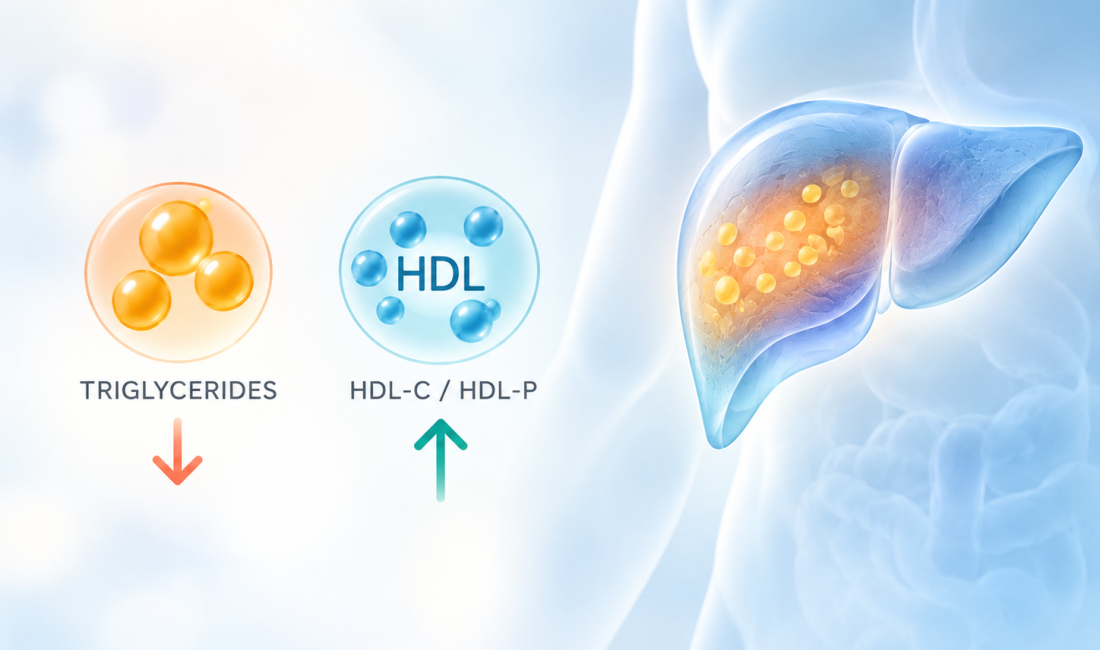
Tipelukast improved HDL-C and HDL-P in a Phase 2 trial, but Week 24 triglyceride and liver fat co-primary endpoints did not reach significance.
Written By: Anamika Koshti, PharmD
Reviewed By: Pharmacally Editorial Team
MediciNova reported topline results from its Phase 2 MN-001-NATG-202 trial (NCT05464784), evaluating MN-001 (tipelukast) in patients with nonalcoholic fatty liver disease (NAFLD), hypertriglyceridemia, and type 2 diabetes mellitus (T2DM). The 40-patient exploratory study found statistically significant improvements in HDL cholesterol (HDL-C) and HDL particle concentration (HDL-P), along with an early triglyceride reduction. However, neither of the prespecified Week 24 co-primary endpoints, triglycerides and liver fat, reached statistical significance.
A Proof-of-Concept Study Built on Earlier Signals
NAFLD commonly occurs alongside T2DM and dyslipidemia, while elevated triglycerides are frequent in people with T2DM. The NATG-202 study was designed to explore whether tipelukast could improve these metabolic abnormalities.
The randomized, double-blind, placebo-controlled Phase 2 study enrolled 40 patients who received MN-001 at 500 mg daily or placebo in a 1:1 ratio for 24 weeks. The co-primary endpoints were changes from baseline in liver fat, measured using the controlled attenuation parameter (CAP) on FibroScan, and fasting serum triglycerides at Week 24.
The study followed the earlier open-label MN-001-NATG-201 trial (NCT02681055), in which 12 weeks of treatment was associated with reductions in triglycerides and increases in HDL cholesterol among patients with NASH or NAFLD and hypertriglyceridemia. Larger lipid changes were reported among participants with T2DM or prediabetes.
Triglycerides Showed an Early Reduction
At Week 4, mean triglycerides declined by 54.7 mg/dL (26.05%) with MN-001 compared with 23.8 mg/dL (11.54%) with placebo. The between-group difference of 30.96 mg/dL was statistically significant (p=0.015).
By Week 24, triglycerides had decreased by 45.8 mg/dL (21.78%) with MN-001 and 14.4 mg/dL (6.97%) with placebo. Although the between-group difference remained 31.4 mg/dL in favor of MN-001, it did not reach statistical significance (p=0.113).
Thus, the early triglyceride signal did not translate into a statistically significant Week 24 result for the prespecified co-primary endpoint.
HDL-C and HDL-P Showed Significant Improvements
The strongest statistically significant lipid findings at Week 24 involved HDL measures.
Mean HDL-C increased by 3.3 mg/dL (8.39%) with MN-001, while it decreased by 2.4 mg/dL (6.23%) with placebo. The between-group difference was 5.7 mg/dL (p=0.0048).
HDL particle concentration also increased by 3.62 µmol/L (11.80%) with MN-001 and decreased by 0.9 µmol/L (3.00%) with placebo. The between-group difference was 4.52 µmol/L (p=0.018).
These findings demonstrate statistically significant changes in HDL-related biomarkers, but the trial was not designed to establish whether these changes translate into cardiovascular clinical benefit.
Liver Fat and Body Weight Trends Were Not Significant
Mean CAP, used as a measure of liver fat, decreased by 14.1 dB/m (4.24%) with MN-001 and by 4.3 dB/m (1.27%) with placebo. The between-group difference of 9.7 dB/m was not statistically significant (p=0.2438).
Body weight decreased by 4.91 lb (2.28%) with MN-001 compared with 0.55 lb (0.25%) with placebo. The 4.36-lb between-group difference also did not reach statistical significance (p=0.082).
Because liver fat was one of the study’s two Week 24 co-primary endpoints, the absence of statistical significance is important when interpreting the overall efficacy findings.
Tipelukast Has Multiple Proposed Mechanisms
MN-001 is an oral small molecule with several proposed pharmacological activities, including leukotriene receptor antagonism, phosphodiesterase inhibition, particularly PDE3 and PDE4, and 5-lipoxygenase inhibition.
Preclinical studies have also indicated that MN-001 can inhibit triglyceride synthesis in hepatocytes by reducing arachidonic acid uptake. Its main metabolite, MN-002, has been reported to enhance cholesterol efflux in macrophages through increased expression of the transport proteins ABCA1 and ABCG1.
These findings provide a proposed biological rationale for the lipid changes observed in NATG-202 and earlier studies. However, the preclinical mechanisms do not establish the mechanism responsible for the clinical findings in this trial.
Safety Findings Remain Limited to Topline Data
MN-001 was generally described as safe and well tolerated. Treatment-related adverse events were mild to moderate, and no drug-related serious adverse events were reported.
However, the topline disclosure did not provide detailed baseline characteristics, discontinuation rates, or complete adverse-event frequencies. A fuller safety assessment will therefore require additional clinical data.
Larger Study Planned to Evaluate the Findings
MediciNova characterized NATG-202 as an exploratory proof-of-concept study and indicated that the results warrant further evaluation in a larger clinical trial. The company plans additional analyses to determine the appropriate patient population, endpoints, and sample size for the next stage of development.
The results provide signals for further investigation, particularly the statistically significant HDL-C and HDL-P findings and the early triglyceride reduction. However, the small sample size and failure of both Week 24 co-primary endpoints to achieve statistical significance mean that the findings should be considered hypothesis-generating rather than confirmatory.
Reference
MediciNova Announces Topline Results from MN-001-NATG-202 Clinical Trial of MN-001 (Tipelukast), Medicinova, 28 September 2026
MN-001 in Non-alcoholic Fatty Liver Disease, Type 2 Diabetes Mellitus, and Hypertriglyceridemia, Medicinova, 28 September 2026
Open-Label Study To Evaluate MN-001 on HDL & Triglyceride in NASH & NAFLD Subjects, ClinicalTrials.gov ID NCT02681055

About the Writer
Anamika Koshti (LinkedIn) is a PharmD professional and healthcare writer with interests in clinical research, pharmacovigilance, and evidence-based medicine. She has authored peer-reviewed publications on Alzheimer’s disease and PCOS, presented research at national conferences, and gained hands-on experience in medical content development and clinical data interpretation. She is committed to translating complex medical research into accurate, accessible content for healthcare professionals and patients.