
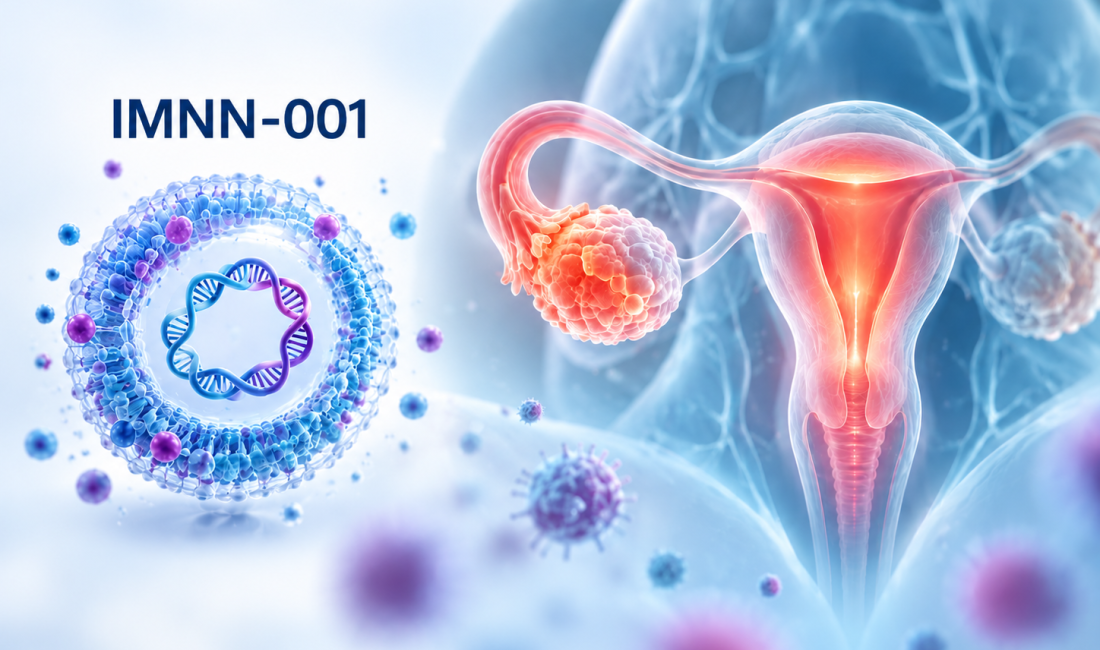
IMUNON’s IMNN-001 showed a 14.7-month median overall survival difference in Phase 2 OVATION 2 for advanced ovarian cancer, supporting Phase 3 testing.
Written By: Creola Gonsalves, MS Biotech
Reviewed By: Pharmacally Editorial Team
IMUNON reported final overall survival results from the randomized Phase 2 OVATION 2 study showing a median overall survival of 45.1 months with IMNN-001 plus chemotherapy versus 30.4 months with chemotherapy alone in women with newly diagnosed advanced ovarian cancer. The company is advancing the locally delivered IL-12 immunotherapy into the pivotal Phase 3 OVATION 3 trial, where overall survival is the primary endpoint.
OVATION 2 Shows Longer Overall Survival
The randomized, 112-patient OVATION 2 study evaluated intraperitoneal IMNN-001 in combination with neoadjuvant and adjuvant chemotherapy versus standard-of-care chemotherapy alone. Median overall survival reached 45.1 months in the IMNN-001 arm compared with 30.4 months in the control arm, representing a 14.7-month difference.
The survival difference increased as the dataset matured, from 11.1 months at the July 2024 readout to 14.7 months in the December 2025 final analysis. However, the study was not powered to establish overall survival as a definitive efficacy endpoint, making confirmation in Phase 3 essential.
PARP Maintenance Subgroup Shows 24.2-Month Difference
Among patients receiving PARP inhibitor maintenance, median overall survival was 65.6 months with IMNN-001 versus 41.4 months with standard treatment, a 24.2-month difference.
These figures apply specifically to the PARP inhibitor maintenance subgroup and should not be interpreted as the overall survival result for the full OVATION 2 population.
Local IL-12 Delivery Targets the Peritoneal Tumor Environment
IMNN-001 uses IMUNON’s proprietary TheraPlas nanoparticle platform to deliver an IL-12 DNA plasmid directly into the peritoneal cavity. Unlike recombinant IL-12 administered systemically, the approach enables patient cells to produce IL-12 locally.
IL-12 promotes antitumor immunity through activation of T lymphocytes and natural killer cells. Biomarker analyses from OVATION 1 and OVATION 2 showed increased recruitment of CD8+ T cells, myeloid dendritic cells and M1 macrophages, together with reductions in immunosuppressive markers. These findings support local remodeling of the tumor microenvironment.
Safety Profile Supports Continued Development
Earlier systemic IL-12 programs were limited by dose-limiting systemic toxicity. IMUNON reported that OVATION 2 did not show cytokine release syndrome or serious systemic immune-related adverse events of the type that historically halted earlier IL-12 programs.
The reported safety profile was dominated by gastrointestinal events, including abdominal pain in a minority of patients associated with intraperitoneal administration. Independent data monitoring committees recommended continuation of both OVATION 3 and the MRD study without modification.
Preliminary MRD Findings Show Biological Activity
A separate Phase 2 minimal residual disease study, conducted with Break Through Cancer and led by investigators at The University of Texas MD Anderson Cancer Center, is evaluating clinical and translational effects of IMNN-001.
Among patients who had reached second-look laparoscopy, MRD positivity was 44.4% (4/9) with IMNN-001 versus 66.7% (6/9) with control. ctDNA clearance occurred in 87.5% (7/8) of patients receiving IMNN-001 compared with 62.5% (5/8) in the control arm.
All 9 of 9 evaluable patients in the experimental arm had no evidence of disease after frontline therapy compared with 5 of 9 controls. The company emphasized that these findings are preliminary and that the study is not yet large enough to evaluate efficacy.
OVATION 3 Moves IMNN-001 Into Pivotal Testing
The randomized 1:1 OVATION 3 trial is enrolling approximately 500 patients with newly diagnosed Stage IIIB/C or IV epithelial ovarian, fallopian tube or primary peritoneal cancer recommended for neoadjuvant chemotherapy.
The trial evaluates intraperitoneal IMNN-001 at 100 mg/m² combined with standard-of-care neoadjuvant and adjuvant chemotherapy versus chemotherapy alone. Overall survival is the primary endpoint. Secondary endpoints include chemotherapy response score, surgical response score at interval debulking surgery, time to second-line treatment or death, and objective response rate. The study includes both homologous recombination-deficient and homologous recombination-proficient patients.
Enrollment has progressed at approximately 0.5 patients per site per month, above the original planning assumption of 0.3. IMUNON is targeting completion of enrollment in the first quarter of 2029. Two pre-planned, event-driven interim analyses could support an earlier submission for full approval if the predefined survival threshold is reached.
The Phase 3 results will determine whether the overall survival signal observed in the 112-patient Phase 2 study can be confirmed in a larger randomized population.
Reference
IMUNON Makes the Frontline Case for Phase 3 IMNN-001 Study: 14.7-Month OS Signal, Historical IL-12 Safety Barriers Overcome, Enrolling Ahead of Plan, Imunon, 24 September 2026
Study of IMNN-001 (Also Known as GEN-1) With NACT for Treatment of Ovarian Cancer (OVATION 2) (OVATION 2), ClinicalTrials.gov ID NCT03393884

About the Writer
Creola Gonsalves (Linkedin) is an M.S. Biotechnology postgraduate with a strong interest in clinical research, evidence interpretation, and healthcare writing, with a focus on translating life-science knowledge into meaningful real-world insights.
She is trained in Good Clinical Practice (GCP), clinical research principles, and critical interpretation of randomized clinical trials, with certifications from NIH and Stanford University.
Her research background in biotechnological applications and microbial research strengthens her ability to understand scientific evidence and develop clear, accurate, and research-driven healthcare content.