
Beacon Therapeutics’ laru-zova met the VISTA primary endpoint in XLRP, with significant Month 12 LLVA responses and plans for regulatory submission.
Written By: Charvi Kalal, PharmD
Reviewed By: Pharmacally Editorial Team
Beacon Therapeutics reported statistically significant Month 12 improvements in low-luminance visual acuity (LLVA) in the pivotal VISTA trial of laruparetigene zovaparvovec (laru-zova) in males with X-linked retinitis pigmentosa (XLRP). The result advances the investigational gene therapy toward regulatory submission for a disease with no approved treatment options.
VISTA Delivers Statistically Significant LLVA Response
VISTA (NCT04850118) is a randomized, controlled Phase 2/3 pivotal study evaluating laru-zova in 85 male patients aged 12 to 48 years with XLRP caused by mutations in the retinitis pigmentosa GTPase regulator (RPGR) gene. Patients received either a high dose of 6.8 × 10¹¹ vector genomes (vg)/eye, a low dose of 3.7 × 10¹¹ vg/eye, or remained untreated as a control.
At Month 12, 31.0% of patients in the high-dose group achieved at least a 15-letter improvement in LLVA compared with no responders in the untreated control group (p=0.0019). The low-dose group also showed a statistically significant response, with 24.1% achieving the same threshold (p=0.0106).
LLVA is clinically relevant in XLRP because progressive photoreceptor dysfunction can impair vision under low-light conditions. Additional measures supported the primary finding. Mean macular sensitivity measured by microperimetry improved versus untreated controls, with least-squares mean differences of 1.201 dB for the high-dose group (p=0.0614) and 1.312 dB for the low-dose group (p=0.0405).
Safety Profile Remained Consistent
Laru-zova showed a favorable safety and tolerability profile, with mostly mild-to-moderate ocular treatment-emergent adverse events. Events were balanced across groups and were largely associated with the surgical procedure used to administer the therapy.
Laru-zova-related treatment-emergent adverse events occurred in 25% of patients in the high-dose group and 38% in the low-dose group. Two ocular serious adverse events occurred in the low-dose group, both attributed to the surgical procedure. Across the broader development program, the therapy now has five years of clinical experience in 110 treated participants.
X-linked Retinitis Pigmentosa: An Inherited Disease with No Approved Treatment
X-linked retinitis pigmentosa is an inherited retinal disease that predominantly affects males and is caused by mutations in the RPGR gene. It affects roughly 1 in 25,000 males in the United States, Europe, and Australia. The disease causes progressive loss of photoreceptor cells beginning in childhood and can eventually lead to severe visual impairment and blindness. There are currently no approved treatments for XLRP.
Gene Therapy Targets RPGR-Associated Retinal Dysfunction
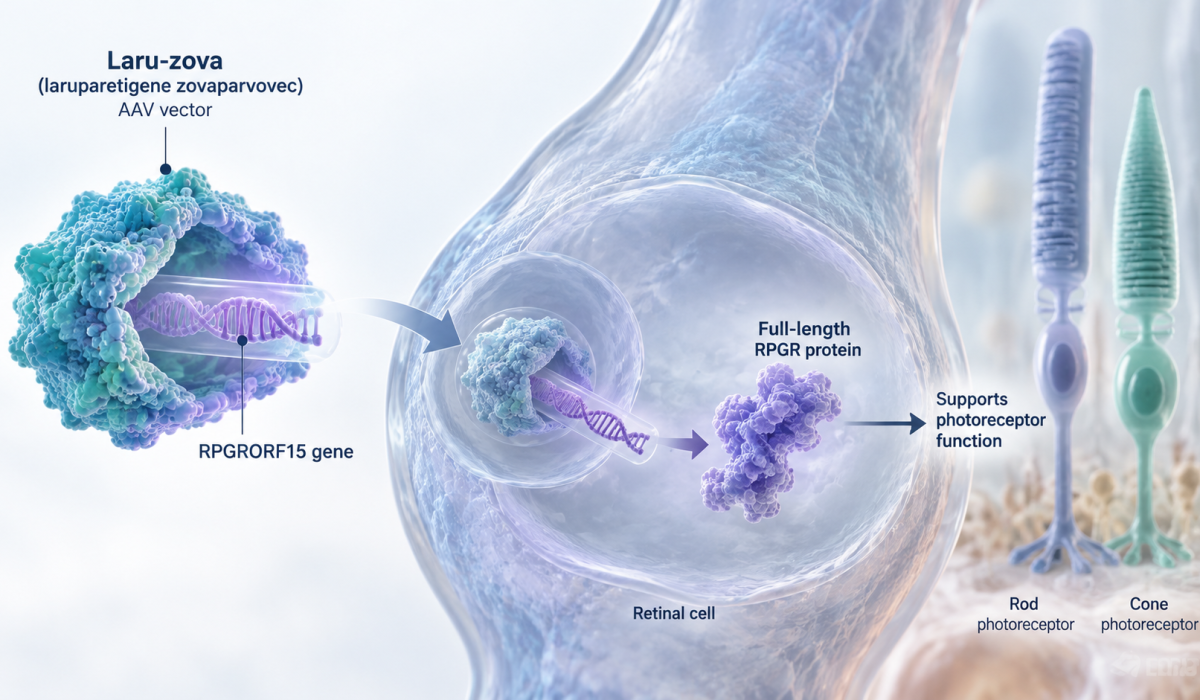
Laru-zova uses an adeno-associated virus (AAV) vector to deliver the RPGRORF15 gene to affected retinal cells. The approach is intended to restore production of the full-length RPGR protein in affected retinal cells, supporting the function of both rod and cone photoreceptors.
Regulatory Pathway Moves Forward
Beacon plans to begin discussions with global regulatory authorities following the VISTA results and expects to initiate a rolling Biologics License Application (BLA) submission later in 2026. Laru-zova remains investigational and has not been approved by the FDA.
Additional VISTA data are scheduled for presentation at Retina Subspecialty Day during the American Academy of Ophthalmology Annual Meeting in New Orleans on October 10, 2026.
The VISTA findings build on earlier HORIZON, SKYLINE, and DAWN studies evaluating laru-zova across different clinical settings and dosing strategies. Together, these studies form the clinical evidence base supporting Beacon’s planned regulatory discussions.
Reference
Beacon Therapeutics Reports Positive Topline Data from the Pivotal VISTA Trial of Laru-zova for the Treatment of X-linked Retinitis Pigmentosa (XLRP), Beacon Therapeutics, 21 September 2026
A Clinical Trial Evaluating the Safety and Efficacy of a Single Subretinal Injection of AGTC-501 in Participants With XLRP, ClinicalTrials.gov ID NCT04850118

About the Writer
Charvi Kalal (LinkedIn) is a Pharm.D intern and aspiring medical writer with hands-on experience in medical writing, clinical research, pharmacovigilance, and clinical pharmacy. She has experience in medical content writing through CliMed, along with exposure to ADR monitoring, prescription analysis, patient counselling, literature review, and research documentation. Her research focuses on ADR monitoring and reporting in breast cancer patients receiving targeted therapy. With certifications in GCP, biomedical research, scientific writing, and clinical research, she is passionate about transforming scientific evidence into accurate, engaging, and accessible healthcare content.