
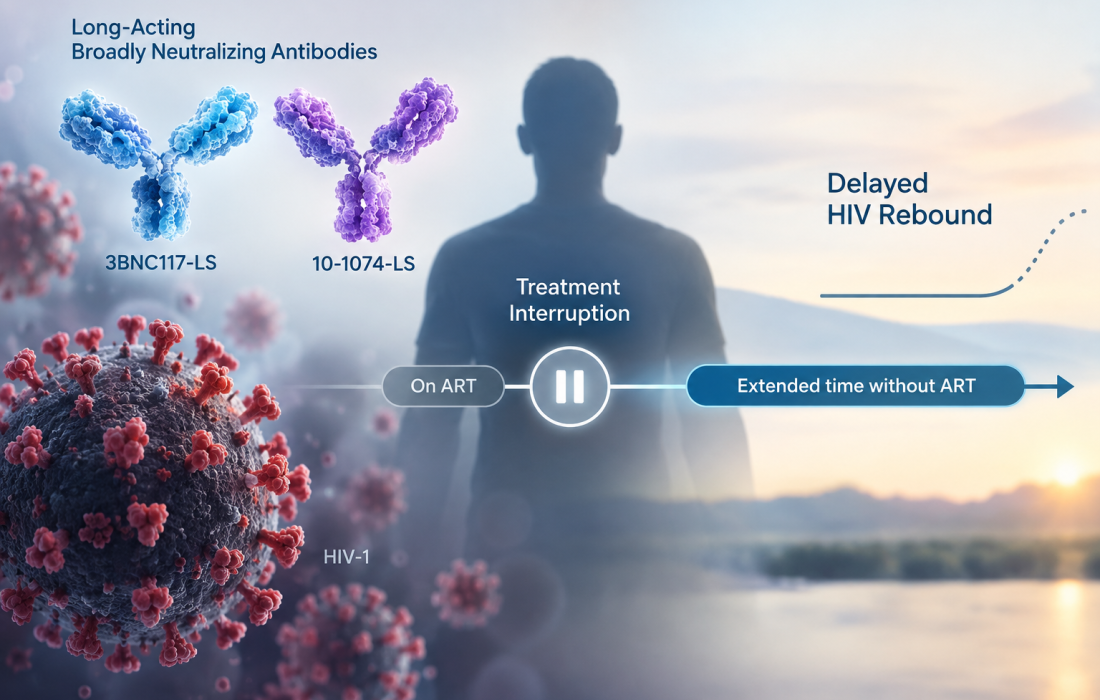
Phase II RIO trial findings show long-acting bNAbs delayed HIV rebound after ART interruption, while 10-1074 resistance emerged during viral rebound.
Written By: Anamika Koshti, PharmD
Reviewed By: Pharmacally Editorial Team
Researchers from The Rockefeller University and collaborating sites reported secondary and exploratory findings from the phase II RIO trial in Nature Medicine, showing that long-acting broadly neutralizing antibodies (bNAbs) 3BNC117-LS and 10-1074-LS delayed HIV-1 viral rebound after antiretroviral therapy (ART) interruption. The analysis also identified selective resistance to 10-1074-LS and an association between baseline autologous antibody activity and longer ART-free viral control.
The randomized, double-blind, placebo-controlled trial enrolled 68 adult men living with HIV who had started ART during primary or early infection. Participants were randomized 1:1 to receive 3BNC117-LS plus 10-1074-LS or saline two days before analytical treatment interruption (ATI). The cohort had relatively small circulating HIV-1 reservoirs, consistent with early ART initiation.
Published in Nature Medicine, the analysis examined viral rebound, antibody sensitivity, proviral reservoir dynamics and the evolution of rebound viruses. The bNAb infusions were generally well tolerated, with no study-related serious adverse events reported. Fatigue, lethargy and somnolence were the most common treatment-related adverse events.
bNAbs Delayed ART Restart
The primary RIO analysis had previously demonstrated delayed viral rebound with bNAb therapy. In the current report, early rebound before week 20 occurred in 8 of 34 participants in the bNAb arm compared with 30 of 34 receiving placebo (P<0.001).
Median time to ART restart reached 45.4 weeks in the bNAb arm versus 4.6 weeks in the placebo arm. At 96 weeks, 7 of 29 evaluable bNAb-treated participants remained off ART compared with 2 of 32 controls.
10-1074 Resistance Dominated Viral Escape
Rebound viruses from bNAb-treated participants showed marked selection for resistance to 10-1074-LS. The geometric mean IC80 increased from 0.09 µg/ml in reservoir-derived viruses to 14.7 µg/ml in rebound viruses (P<0.001), with most rebound viruses showing complete resistance.
Resistance to 3BNC117-LS was substantially less pronounced. Its geometric mean IC80 increased from 0.48 to 0.98 µg/ml, but the difference was not statistically significant (P=0.53). Only 3 of 19 bNAb-treated participants showed rebound viruses uniformly resistant to 3BNC117.
The investigators suggest that 3BNC117-LS exposure may have become insufficient to maintain effective suppression at rebound. The median estimated 3BNC117-LS concentration at rebound was 52.4 µg/ml, compared with a median viral IC80 of 41.8 µg/ml.
Pre-existing Antibodies Correlated with Longer Control
Among bNAb-treated participants with detectable baseline autologous neutralizing activity against reservoir-derived viruses, mean time to ART restart was 108 weeks compared with 27.5 weeks among those without detectable activity (P=0.008). Baseline autologous antibody activity also correlated with time to ART restart (r = -0.69, P=0.004), as did reservoir sensitivity to 10-1074 (r=-0.79, P<0.001).
No comparable association was observed in the placebo group. These findings suggest that autologous antibodies alone were insufficient to explain delayed rebound. The authors propose that pre-existing antibody activity may have worked alongside infused bNAbs, although the analysis does not establish a causal mechanism.
Intact HIV Reservoir Declined After bNAb Therapy
Paired measurements from 22 bNAb-treated participants showed a significant decline in the intact HIV-1 proviral reservoir over approximately 52 weeks, with an estimated half-life of 36 weeks. The defective reservoir did not significantly change, while no measurable reservoir decline occurred in the placebo arm.
However, the reservoir decline did not correlate with time to ART restart, indicating that the reduction alone could not explain prolonged viral control.
Fluctuating Viremia Emerged as a Distinct Pattern
Among 29 bNAb-treated participants remaining in protocol-defined follow-up, 11 (38%) experienced fluctuating viremia for 16 to more than 58 weeks without meeting criteria for ART restart. Some rebound viruses showed complete or partial bNAb resistance during this period.
The findings suggest that prolonged post-treatment control involves multiple factors, including viral susceptibility, antibody exposure and pre-existing host immunity. However, reservoir sequence information was available for only 35 of the 68 participants, and analyses were largely restricted to circulating blood rather than tissue reservoirs. The authors therefore emphasize that the observed associations require validation in larger studies.
Reference
Fumagalli, M.J., Kaczynska, A., Allombert, M. et al. Broadly neutralizing antibodies in adult males living with HIV undergoing analytical treatment interruption: secondary and exploratory outcomes of the phase II randomized controlled RIO trial. Nat Med (2026). https://doi.org/10.1038/s41591-026-04644-8
A Randomised Placebo Controlled Trial of ART Plus Dual Long-acting HIV-specific Broadly Neutralising Antibodies (bNAbs). (RIO), ClinicalTrials.gov ID NCT04319367

About the Writer
Anamika Koshti (LinkedIn) is a PharmD professional and healthcare writer with interests in clinical research, pharmacovigilance, and evidence-based medicine. She has authored peer-reviewed publications on Alzheimer’s disease and PCOS, presented research at national conferences, and gained hands-on experience in medical content development and clinical data interpretation. She is committed to translating complex medical research into accurate, accessible content for healthcare professionals and patients.