
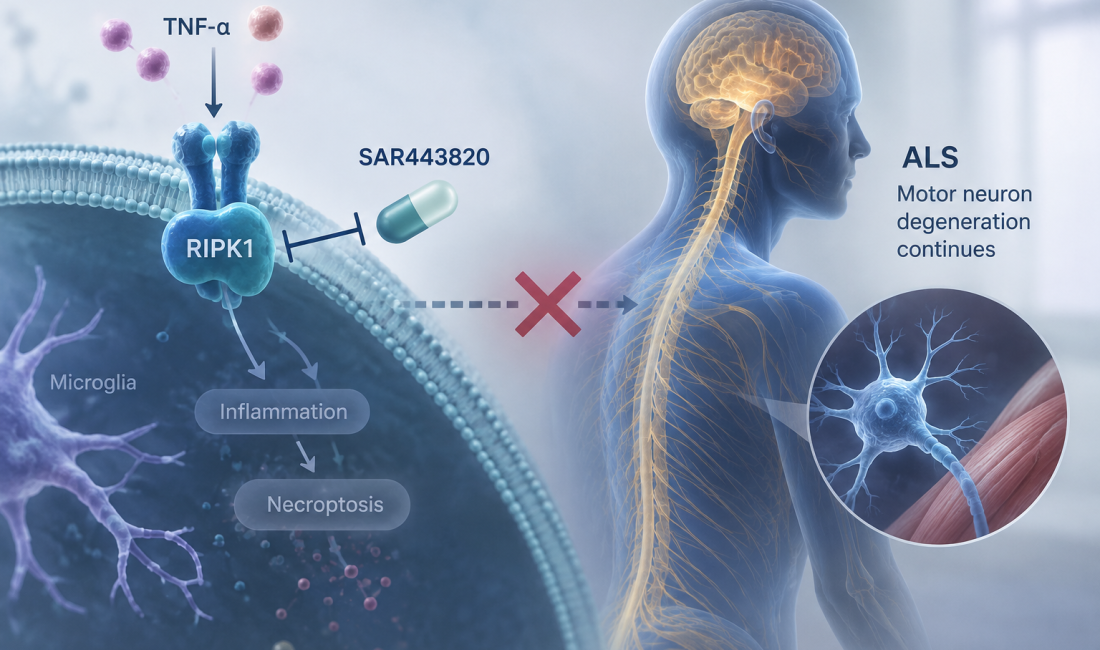
Sanofi’s SAR443820 failed the phase 2 HIMALAYA trial in ALS, showing no significant functional benefit and higher hepatic enzyme elevations than placebo.
Written By: Saniya Katakdhond, PharmD
Reviewed By: Pharmacally Editorial Team
Sanofi’s oral, CNS-penetrant RIPK1 inhibitor SAR443820 failed to slow functional decline in amyotrophic lateral sclerosis (ALS) in the phase 2 HIMALAYA trial. The drug produced no significant improvement in ALS Functional Rating Scale-Revised (ALSFRS-R) scores and was associated with more hepatic enzyme elevations and treatment discontinuations than placebo.
SAR443820 Misses the Primary Endpoint
HIMALAYA enrolled 305 adults with ALS across 63 sites in 13 countries and evaluated SAR443820 at 20 mg twice daily versus placebo for 24 weeks. Participants had possible, probable, probable laboratory-supported, or definite ALS under revised El Escorial criteria.
At week 24, the least-squares mean change in ALSFRS-R was −6.73 points with SAR443820 and −6.32 points with placebo. The least-squares mean treatment difference was −0.41 points (95% CI, −1.71 to 0.88), showing no statistically significant benefit.
The trial was terminated early, and the findings indicate that RIPK1 inhibition with SAR443820 did not alter the rate of functional decline in this ALS population.
RIPK1 Targeted Neuroinflammation and Cell Death
RIPK1 is an intracellular kinase involved in inflammatory signalling and regulated cell death, including necroptosis. Its activation downstream of tumour necrosis factor-α can promote inflammatory responses and cell-death pathways.
Preclinical studies provided a rationale for targeting RIPK1 in ALS. Increased RIPK1 activity has been reported in ALS models and post-mortem spinal cord tissue, while RIPK1 inhibition delayed disease onset and motor impairment in SOD1G93A mouse models.
SAR443820, also known as DNL788, is a selective, reversible RIPK1 inhibitor that crosses the blood-brain barrier. Earlier phase 1 studies in healthy participants showed substantial peripheral RIPK1 target engagement and CNS penetration, supporting clinical testing in ALS.
Safety Findings Raise Additional Concerns
Safety results further limited the drug’s development prospects.
Adverse events occurred in 171 of 202 participants (85%) receiving SAR443820 compared with 80 of 102 (78%) receiving placebo. Treatment discontinuation was also more frequent with SAR443820, occurring in 28 participants (14%) versus five (5%) with placebo.
Elevated hepatic enzymes were the most common reason for treatment discontinuation in the SAR443820 group.
Nine deaths occurred during the double-blind period: seven (3%) among SAR443820-treated participants and two (2%) among placebo recipients. None was attributed to SAR443820.
HIMALAYA Highlights a Translational Challenge
The results underscore the difficulty of translating promising neuroinflammatory targets from ALS models into meaningful clinical benefit.
The HIMALAYA investigators concluded that SAR443820 provided no clinical benefit and was associated with greater hepatic enzyme increases. Based on these findings, they determined that further clinical development of SAR443820 in ALS is not warranted.
The study also points to a broader challenge in ALS drug development: confirming target engagement and biological activity within the CNS. The investigators highlighted the potential value of CNS-accessible pharmacodynamic biomarkers that could demonstrate whether a drug is reaching and modulating its intended target in the human nervous system.
Implications for ALS Drug Development
ALS continues to have limited disease-modifying treatment options, with riluzole providing only a modest survival benefit and edaravone failing to demonstrate statistically significant functional or survival benefits in a recent phase 3 study. Tofersen provides a targeted option for the small subset of patients with SOD1-mutation-associated ALS.
For SAR443820, however, the combination of an ineffective primary endpoint and a less favourable hepatic safety profile closes the clinical path forward in ALS. The HIMALAYA experience adds to evidence that stronger human biomarkers and better validation of therapeutic targets will be important for advancing the next generation of ALS treatments.
Reference
Merit E Cudkowicz et al, Safety, tolerability, and efficacy of RIPK1 inhibitor, SAR443820, in amyotrophic lateral sclerosis (HIMALAYA): a multicentre, randomised, double-blind, placebo-controlled, phase 2 trial, The Lancet Neurology, Volume 25, Issue 10, 2026, Pages 900-910, https://doi.org/10.1016/S1474-4422(26)00277-2
Phase 2 Study for SAR443820 in Participants With Amyotrophic Lateral Sclerosis (ALS) (HIMALAYA), ClinicalTrials.gov ID NCT05237284

About the Writer
Saniya Sanjay Katakdhond (Linkedin) is a Doctor of Pharmacy professional with hands-on experience in patient case review, clinical documentation, medical record analysis, and patient care.
Her hospital experience has strengthened her understanding of clinical conditions, treatment approaches, and multidisciplinary healthcare practices.
With ICH-GCP certification and a research-oriented approach, she brings clinical insight and attention to detail to healthcare content development.
As a healthcare writer, Saniya focuses on translating clinical knowledge and patient-care experience into clear, accurate, and evidence-informed medical content.