
Novo Nordisk’s Sogroya (somapacitan) receives a positive CHMP opinion for children with idiopathic short stature, supported by REAL8 phase 3 data.
Written By: Charvi Kalal, PharmD
Reviewed By: Pharmacally Editorial Team
The Committee for Medicinal Products for Human Use (CHMP) of the European Medicines Agency recommended extending Sogroya’s indication to children with idiopathic short stature (ISS) and persistent growth disturbance. The September 2026 opinion follows a re-examination of the medicine’s earlier regulatory review and forms part of a broader paediatric indication expansion for Sogroya.
If the European Commission grants marketing authorisation, Sogroya would become the first and only growth hormone treatment specifically approved for ISS in the EU, according to Novo Nordisk. The Commission’s decision is expected later in 2026.
Sogroya is already authorised in the EU for growth hormone deficiency in adults and children aged 3 years and older. In May 2026, CHMP also recommended extensions covering growth disturbance in children born small for gestational age (SGA) without adequate catch-up growth and children with Noonan syndrome.
REAL8 supports once-weekly somapacitan
The ISS recommendation is supported by REAL8, a global, randomised, open-label, active-controlled phase 3 basket trial evaluating once-weekly somapacitan across several paediatric short-stature populations. The main treatment period lasted 52 weeks, followed by a 104-week extension.
In the ISS cohort, 88 prepubertal, growth-hormone-treatment-naïve children were randomised 2:1 to somapacitan 0.24 mg/kg once weekly or daily growth hormone at 0.050 mg/kg/day. Eighty-five participants completed the 52-week main period.
At Week 52, mean annualised height velocity was 10.2 cm/year with somapacitan and 10.6 cm/year with daily growth hormone. The estimated treatment difference was −0.3 cm/year, with a 95% confidence interval of −1.00 to 0.42 cm/year, meeting the prespecified criterion for non-inferiority. Safety profiles were similar, and most adverse events were mild and considered unlikely to be related to study treatment.
Long-acting growth hormone reduces injection frequency
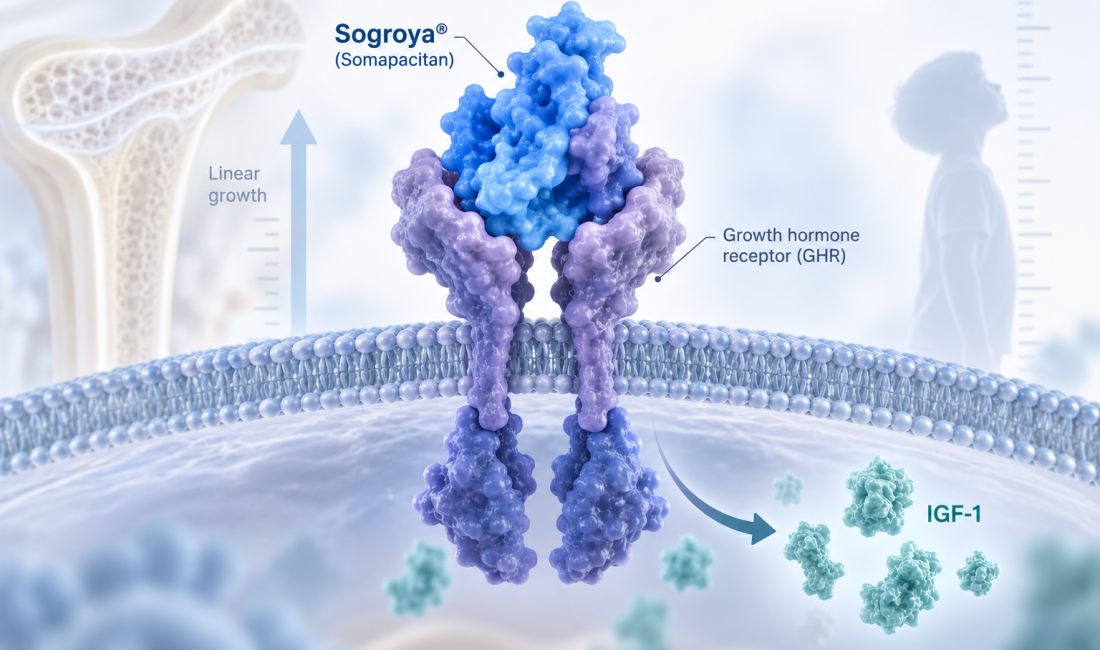
Somapacitan is a long-acting analogue of human growth hormone (GH) that binds to the growth hormone receptor and activates the same downstream signalling pathway as endogenous GH. Receptor activation promotes production of insulin-like growth factor 1 (IGF-1), a key mediator of GH-dependent effects on bone and other tissues involved in linear growth.
Sogroya extends GH activity by attaching to albumin, a naturally abundant protein in the bloodstream. This albumin-binding mechanism reduces the rate at which somapacitan is cleared from circulation, allowing sustained GH receptor activity and enabling subcutaneous administration once weekly rather than the daily injections required with conventional recombinant growth hormone.
For children requiring prolonged growth hormone treatment, the reduced injection frequency may lessen treatment burden and simplify long-term administration, although treatment decisions remain dependent on the individual growth pattern, diagnosis, safety profile and applicable clinical guidance.
ISS remains a diagnosis of exclusion
Idiopathic short stature describes children whose height is substantially below the expected range without an identifiable underlying medical cause. Diagnosis requires evaluation to exclude other causes of impaired growth, including endocrine, genetic and systemic disorders.
Novo Nordisk estimates that ISS affects up to 3% of children worldwide. Treatment access varies substantially between regions, with growth hormone approved for ISS in some jurisdictions but not others.
The regulatory significance of the CHMP opinion therefore extends beyond dosing convenience. If confirmed by the European Commission, the decision would establish a specific EU-approved growth hormone option for children with ISS while expanding Sogroya’s paediatric use across multiple non-growth-hormone-deficiency indications.
European Commission decision next
The CHMP opinion now moves to the European Commission for a final decision on marketing authorisation. If approved, the expanded Sogroya authorisation would cover ISS alongside the previously recommended SGA and Noonan syndrome indications.
Novo Nordisk’s latest development also comes as additional REAL8 analyses are being presented at the 2026 European Society for Paediatric Endocrinology meeting, including two-year data in children with ISS, SGA and Noonan syndrome.
Reference
Novo’s once-weekly Sogroya® (somapacitan) receives positive CHMP opinion in Europe for children with idiopathic short stature (unexplained shortness), Novo Nordisk, 18 September 2026
A Research Study to Compare Somapacitan Once a Week With Norditropin® Once a Day in Children Who Need Help to Grow (REAL 8), ClinicalTrials.gov ID NCT05330325

About the Writer
Charvi Kalal (LinkedIn) is a Pharm.D intern and aspiring medical writer with hands-on experience in medical writing, clinical research, pharmacovigilance, and clinical pharmacy. She has experience in medical content writing through CliMed, along with exposure to ADR monitoring, prescription analysis, patient counselling, literature review, and research documentation. Her research focuses on ADR monitoring and reporting in breast cancer patients receiving targeted therapy. With certifications in GCP, biomedical research, scientific writing, and clinical research, she is passionate about transforming scientific evidence into accurate, engaging, and accessible healthcare content.