
Novartis discontinued lifonebart (VHB937) development in ALS after the ASTRALS Phase 2 trial missed its primary and secondary endpoints.
Written By: Mayuresh Salvi, PharmD
Reviewed By: Pharmacally Editorial Team
Novartis has discontinued development of VHB937 (lifonebart) for amyotrophic lateral sclerosis (ALS) after the global ASTRALS Phase 2 trial failed to meet its primary and secondary endpoints. The study enrolled 251 participants, and detailed findings are expected at the 37th International Symposium on ALS/MND in December 2026.
ASTRALS Trial Misses Primary and Secondary Endpoints
ASTRALS was a randomized, double-blind, placebo-controlled Phase 2 study evaluating VHB937 in people with ALS. Recruitment was completed in 2025, with 251 participants enrolled across international sites. Novartis has now confirmed that the trial failed to meet both its primary and secondary endpoints and has ended further development of lifonebart in ALS.
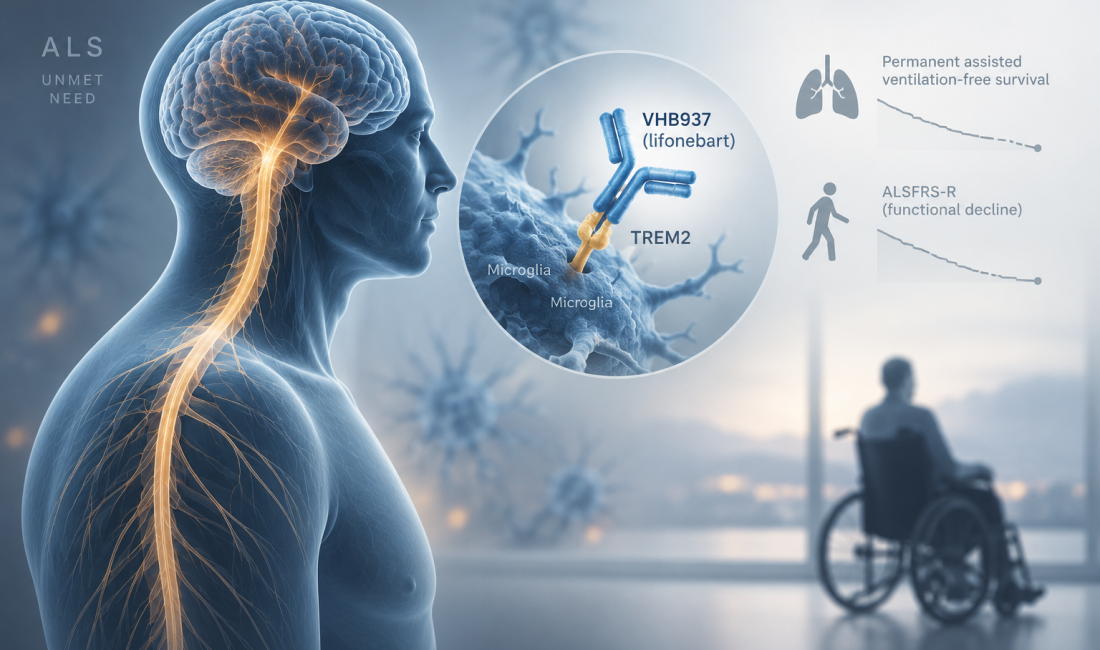
The primary endpoint was a composite of permanent assisted ventilation (PAV)-free survival and change in the ALS Functional Rating Scale-Revised (ALSFRS-R) over the 40-week treatment period. The trial used the Combined Assessment of Function and Survival (CAFS) to analyze these outcomes.
Novartis has not yet released the numerical efficacy results, treatment differences, statistical values, or detailed safety findings. These data will be important for determining the magnitude and clinical characteristics of the treatment effect.
Lifonebart Targeted TREM2 on Microglia
VHB937, also known as lifonebart, is an investigational monoclonal antibody that acts as a TREM2 stabilizer and activator. TREM2 is a receptor expressed on microglia, the resident immune cells of the central nervous system.
Activating TREM2 can influence microglial functions involved in cellular debris clearance and responses to neuronal injury. Preclinical research indicated that VHB937 could increase TREM2 activity on microglia and support functions associated with neuronal protection. However, the ASTRALS outcome did not establish a clinical benefit for this approach in ALS.
ALS progressively damages motor neurons, causing worsening muscle weakness and loss of motor function. Respiratory impairment and the eventual need for assisted ventilation are major clinical consequences, making preservation of function and survival important treatment goals.
ALS Development Ends as Alzheimer’s Program Continues
The ALS failure does not currently represent the end of the lifonebart development program. Novartis continues to evaluate VHB937 in a Phase 2 study in early Alzheimer’s disease.
The ongoing randomized, placebo-controlled study is evaluating two VHB937 dose levels against placebo in 407 participants with early Alzheimer’s disease. The 72-week study uses change from baseline in the Clinical Dementia Rating-Sum of Boxes (CDR-SB) as its primary efficacy measure and is scheduled to continue into 2030.
This distinction is important because the biological rationale for TREM2 modulation extends across neurodegenerative diseases, but clinical outcomes can differ substantially between diseases, populations and trial designs.
Another Setback for TREM2-Targeted Neurodegeneration
The ASTRALS result adds to recent clinical challenges for TREM2-targeted therapies. In a separate Phase 2 Alzheimer’s disease study, the TREM2 agonistic antibody AL002 failed to meet its primary endpoint despite demonstrating sustained target engagement and pharmacodynamic effects in the central nervous system.
These results do not establish that TREM2 is an ineffective therapeutic target. However, they highlight the gap between demonstrating biological activity at TREM2 and translating that activity into measurable clinical benefit in neurodegenerative disease.
Full ASTRALS Data Due in December
Novartis will continue supporting ASTRALS participants as they complete their involvement in the study. The company plans to present detailed findings at the 37th International Symposium on ALS/MND, taking place in Amsterdam from December 9–11, 2026.
The forthcoming dataset should clarify the treatment effect on functional decline and survival, along with safety findings and other secondary measures. Those results will also help researchers assess what the ASTRALS experience contributes to the broader development of TREM2-directed therapies in neurodegenerative disease.
Reference
Community Update: ASTRALS Phase 2 Trial Results in Amyotrophic Lateral Sclerosis, EUPPALS, 25 August 2026
A Clinical Trial to Learn About the Effects of VHB937 in People with Amyotrophic Lateral Sclerosis (ALS) (ASTRALS), ClinicalTrials.gov ID NCT06643481

About the Writer
Mayuresh Sunil Salvi (Linkedin) is a PharmD professional and healthcare writer with a strong interest in pharmacovigilance, drug safety, and emerging medical research. He is passionate about exploring new drug discoveries, clinical research, and advances in evidence-based medicine. His interests also include ward rounds, prescription audits, and treatment analysis to support rational pharmacotherapy and improved patient care.