
FDA grants Fast Track Designation to OncoC4’s cesalatamig, a PD-1/VEGF bispecific antibody, for PD-(L)1-refractory non-small cell lung cancer.
Written By: Creola Gonsalves, MS Biotech
Reviewed By: Pharmacally Editorial Team
The U.S. FDA has granted Fast Track Designation to cesalatamig (AI-081), an investigational PD-1/VEGF bispecific antibody from OncoC4, for patients with non-small cell lung cancer (NSCLC) whose disease progresses after PD-(L)1-targeted immunotherapy and platinum-based chemotherapy.
Fast Track Targets a Major Treatment Gap in NSCLC
The designation covers NSCLC that has progressed following concurrent or sequential treatment with PD-(L)1-targeted immunotherapy and platinum-based chemotherapy. This population includes patients whose tumors develop resistance to commonly used immunotherapy-based regimens, leaving limited treatment options.
Cesalatamig is currently being evaluated in global Phase 1/2 studies under the BiPAVE-001 program. The U.S. study is registered as NCT06635785, while the China study is registered as CTR20253261.
Fast Track Designation provides regulatory support intended to facilitate development and review of therapies addressing serious conditions with unmet medical needs. It can enable closer interaction with the FDA during clinical development and may support expedited review pathways when relevant criteria are met.
Dual Targeting of PD-1 and VEGF
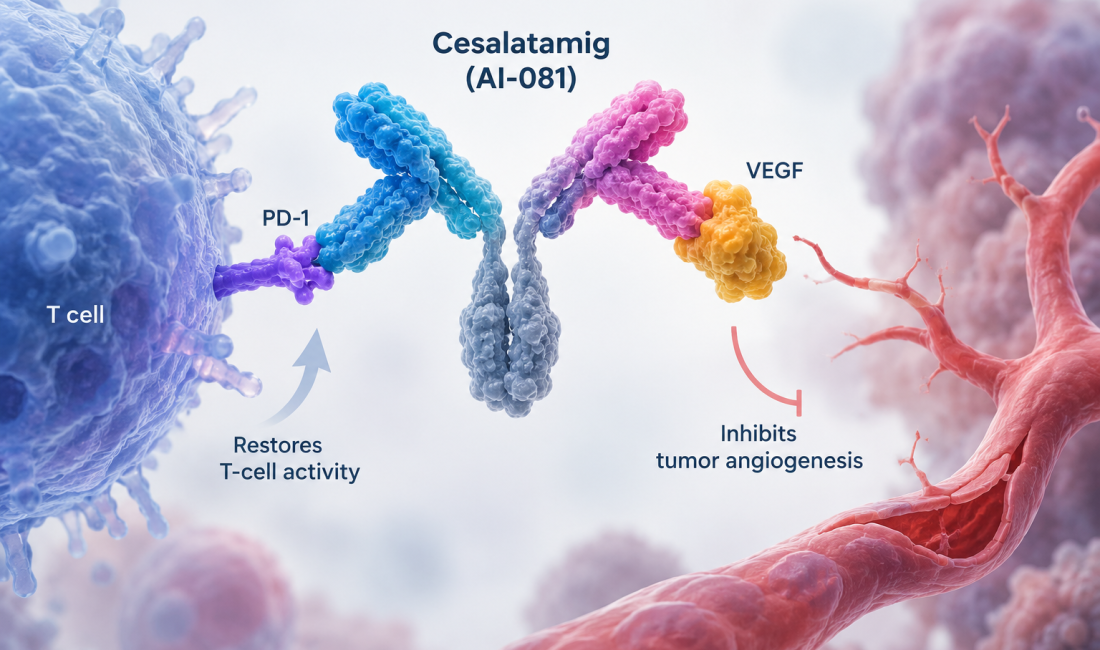
Cesalatamig combines inhibition of PD-1 and vascular endothelial growth factor (VEGF) within a single bispecific antibody.
PD-1 blockade can restore antitumor T-cell activity, while VEGF inhibition can interfere with tumor-associated angiogenesis and the immunosuppressive tumor microenvironment. The rationale for targeting both pathways is particularly relevant because VEGF signaling can contribute to an environment that limits effective antitumor immunity.
According to OncoC4, cesalatamig binds PD-1 with high affinity and has more than 40-fold higher affinity for VEGF than bevacizumab-based PD-(L)1/VEGF bispecific inhibitors. The company is also evaluating Fc-silencing modifications intended to reduce depletion of PD-1-positive effector T cells.
These properties remain investigational, and comparative clinical benefit has not yet been established.
BiPAVE-001 Advances Through Phase 1/2 Development
The global BiPAVE-001 program is evaluating cesalatamig’s safety, efficacy and pharmacokinetics in patients with advanced cancers.
Part A consists of Phase 1 dose escalation and expansion. Part B comprises Phase 2 dose-optimization cohorts evaluating cesalatamig as monotherapy and in combination with standard-of-care or investigational agents.
The studies are being conducted at more than 50 clinical sites across the United States and China, with most enrolled patients coming from the United States.
The company cited clinical safety and efficacy signals from the ongoing studies as the basis for advancing the program. However, the announcement did not provide detailed response rates, progression-free survival, overall survival, statistical analyses or a comprehensive safety dataset. Those results will be needed to determine the clinical activity and benefit-risk profile of cesalatamig in PD-(L)1-refractory or resistant NSCLC.
OncoC4 Plans Registrational Development
OncoC4 CEO and Chief Scientific Officer Yang Liu said the company is advancing cesalatamig toward Phase 3 development in PD-(L)1-refractory or resistant NSCLC, while also evaluating additional indications.
The Fast Track designation marks a regulatory development as the program moves beyond early-stage clinical testing. The next major milestones will include completion of dose optimization, further characterization of efficacy and safety, and progression into registrational studies.
For NSCLC patients whose disease progresses despite immunotherapy and platinum-based chemotherapy, the clinical development of dual PD-1/VEGF blockade will determine whether cesalatamig can provide a meaningful treatment option in a setting where resistance remains a significant challenge.
Reference
OncoC4 Receives FDA Fast Track Designation for Cesalatamig, an Investigational PD-1/VEGF Bispecific Antibody, OncoC4, 16 September 2026
Safety, Pharmacokinetics, and Efficacy of AI-081, a Bispecific Antibody for PD-1 And VEGF in Advanced Solid Tumors (BiPAVE-001), ClinicalTrials.gov ID NCT06635785

About the Writer
Creola Gonsalves (Linkedin) is an M.S. Biotechnology postgraduate with a strong interest in clinical research, evidence interpretation, and healthcare writing, with a focus on translating life-science knowledge into meaningful real-world insights.
She is trained in Good Clinical Practice (GCP), clinical research principles, and critical interpretation of randomized clinical trials, with certifications from NIH and Stanford University.
Her research background in biotechnological applications and microbial research strengthens her ability to understand scientific evidence and develop clear, accurate, and research-driven healthcare content.