
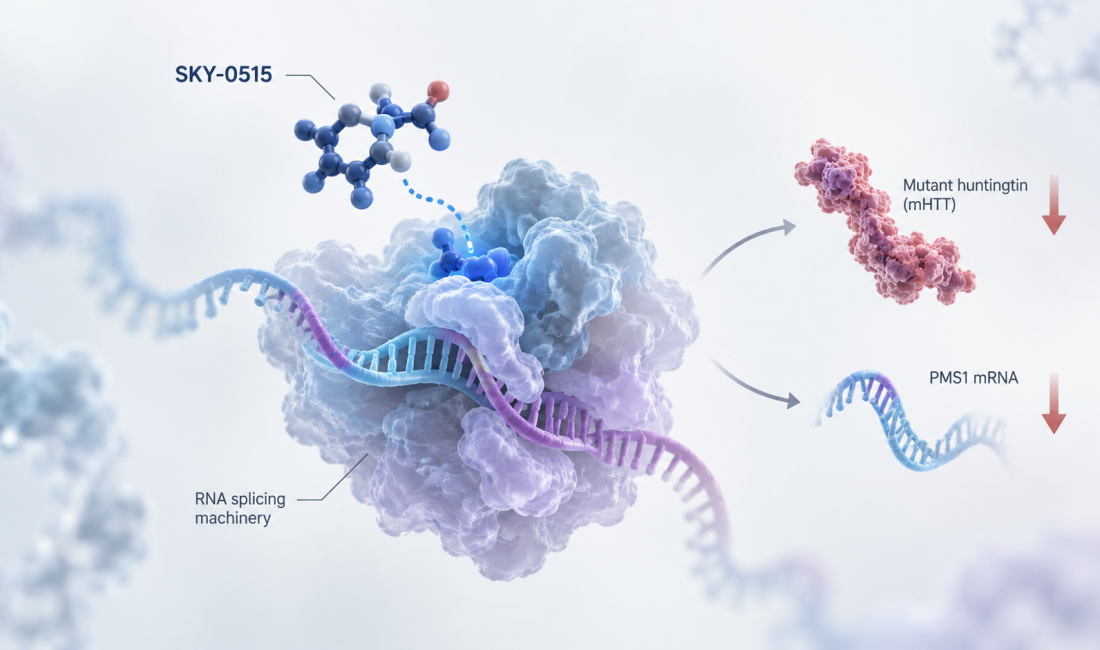
Skyhawk’s SKY-0515 showed a 1.59-point cUHDRS benefit at Month 15 in Huntington’s disease, with reductions in mutant huntingtin and PMS1.
Written By: Charvi Kalal, PharmD
Reviewed By: Pharmacally Editorial Team
Skyhawk Therapeutics’ oral investigational RNA-splicing modifier SKY-0515 produced a statistically significant 1.59-point difference in Composite Unified Huntington’s Disease Rating Scale (cUHDRS) change versus an overlap-weighted external natural history control at Month 15. The Phase 1/2 final analysis also showed sustained reductions in mutant huntingtin (mHTT) and PMS1, supporting continued development in the global Phase 2/3 FALCON-HD program.
SKY-0515 Improves Composite Measure of Disease Progression
At the Month 15 primary timepoint, patients treated with SKY-0515 improved their mean cUHDRS score by 0.94 points from baseline, while untreated patients in the Enroll-HD natural history database declined by 0.65 points. This produced a between-group difference of 1.59 points (95% CI, 1.09–2.09; p<0.001).
The treatment difference extended across all four components of the cUHDRS. SKY-0515 improved Total Functional Capacity by 0.38 points from baseline, compared with a 0.60-point decline in the external control, producing a 0.98-point between-group difference. Total Motor Score showed a 9.38-point between-group difference, while the Symbol Digit Modalities Test and Stroop Word Reading Test showed differences of 4.15 and 4.18 points, respectively. All four differences were statistically significant.
The pattern remained consistent throughout the study. The cUHDRS difference between SKY-0515 and the external control was 0.66 points at Month 3, 0.78 at Month 6, 1.04 at Month 9, 0.79 at Month 12 and 1.59 at Month 15. Statistical significance emerged from Month 9 onward.
Dual Molecular Effects on Huntington’s Disease Biology
SKY-0515 is an orally administered small-molecule RNA-splicing modifier developed using Skyhawk’s SKYSTAR platform. The therapy is intended to reduce both mutant huntingtin and PMS1, targeting two biological processes associated with Huntington’s disease.
At the 9 mg dose, patients showed consistent average reductions of more than 60% in mHTT and more than 25% in PMS1 mRNA throughout the study. Mutant huntingtin is the disease-associated protein central to Huntington’s pathology, while PMS1 contributes to somatic CAG-repeat expansion associated with disease progression.
Phase 1/2 Study Shows Favorable Tolerability
The randomized, double-blind, placebo-controlled Phase 1/2 study evaluated two dose levels of SKY-0515 during an initial 12-week treatment period, followed by a 12-month blinded extension in which participants received active treatment at 4 mg or 9 mg. Most participants received the 9 mg dose during the extension.
The study evaluated safety, tolerability, pharmacokinetics and pharmacodynamics in healthy volunteers and patients with early-stage Huntington’s disease. Assessments included mHTT, PMS1 mRNA and cUHDRS. The company reported strong central nervous system exposure and no treatment-related serious adverse events through 15 months.
The Month 15 analysis compared SKY-0515 with an external control constructed using overlap-weighted propensity scores from the Enroll-HD, 2CARE and CREST-E datasets. Fifteen SKY-0515-treated participants had an available Month 15 cUHDRS assessment, compared with 1,337 participants contributing to the external-control dataset.
The source also notes that the Month 15 analysis is influenced by the study design. Participants who initially received placebo had only 12 months of SKY-0515 exposure during the extension period. A small number of participant-timepoints were excluded after qualifying intercurrent events that could affect assessment of treatment effect.
Global Phase 2/3 FALCON-HD Program Advances
The FALCON-HD pivotal program is evaluating once-daily oral SKY-0515 at three dose levels versus placebo in patients with Stage 2 and Stage 3 Huntington’s disease. The program includes FALCON-HD 004-ANZ and 004-WW.
FALCON-HD 004-ANZ has completed enrollment with 144 participants across Australia and New Zealand. FALCON-HD 004-WW is actively recruiting approximately 600 participants across more than 40 sites worldwide.
Across the Phase 1/2 and FALCON-HD programs, more than 200 participants have been enrolled across 20 clinical sites in 10 countries. The ongoing placebo-controlled pivotal studies will determine whether the clinical signal observed against external natural-history controls is reproduced in a larger controlled population.
The Phase 1/2 trial and its 15-month analysis are now complete, while the FALCON-HD program continues to generate the clinical data needed to assess SKY-0515’s potential as a disease-modifying treatment for Huntington’s disease.
Reference
Skyhawk Therapeutics Announces Final Fifteen-Month Results from Phase 1/2 Clinical Trial of SKY-0515 in Huntington’s Disease Patients, Skyhawk Therapeutics, 15 September 2026
Study of SKY-0515 for Safety, Efficacy, and Pharmacodynamics in Participants With Huntington’s Disease (Falcon-HD), ClinicalTrials.gov ID NCT06873334
Study to Evaluate the Pharmacodynamics, Safety and Efficacy of SKY-0515 in Participants With Huntington’s Disease (FALCON-HD), ClinicalTrials.gov ID NCT07378644

About the Writer
Charvi Kalal (LinkedIn) is a Pharm.D intern and aspiring medical writer with hands-on experience in medical writing, clinical research, pharmacovigilance, and clinical pharmacy. She has experience in medical content writing through CliMed, along with exposure to ADR monitoring, prescription analysis, patient counselling, literature review, and research documentation. Her research focuses on ADR monitoring and reporting in breast cancer patients receiving targeted therapy. With certifications in GCP, biomedical research, scientific writing, and clinical research, she is passionate about transforming scientific evidence into accurate, engaging, and accessible healthcare content.