
Imvax’s IGV-001 showed a 4.2-month overall survival benefit in uMGMT glioblastoma. FDA aligned on key Phase 3 design elements targeting OS.
Written By: Mayuri Vaja, PharmD
Reviewed BY: Pharmacally Editorial Team
Imvax has secured FDA alignment on key elements of a proposed Phase 3 trial of IGV-001 in patients with newly diagnosed glioblastoma (ndGBM) whose tumors have an unmethylated MGMT promoter (uMGMT), following a prespecified Phase 2b analysis showing a clinically meaningful overall-survival signal in this high-risk population.
IGV-001 Shows Benefit in uMGMT Glioblastoma
In 48 patients with uMGMT tumors from the randomized Phase 2b study, median overall survival reached 14.8 months with IGV-001 versus 10.6 months with placebo, a 4.2-month, or 40%, difference. The hazard ratio for death was 0.60, although the result did not reach conventional statistical significance (P=0.0808).
The survival signal was accompanied by delayed deterioration in Karnofsky Performance Status, favorable quality-of-life measures, lower rates of severe toxicities and a reduced burden of serious adverse events in the IGV-001 group.
The findings will be presented as a rapid oral and poster presentation at the 2026 Annual Meeting of the Society for Neuro-Oncology (SNO) in Philadelphia on November 12-15.
Targeting a Major Unmet Need
uMGMT tumors account for an estimated 55% to 60% of newly diagnosed glioblastoma cases and represent a biologically high-risk subgroup. MGMT promoter methylation is associated with greater sensitivity to temozolomide, while patients with unmethylated tumors generally derive less benefit from the chemotherapy and have poorer outcomes.
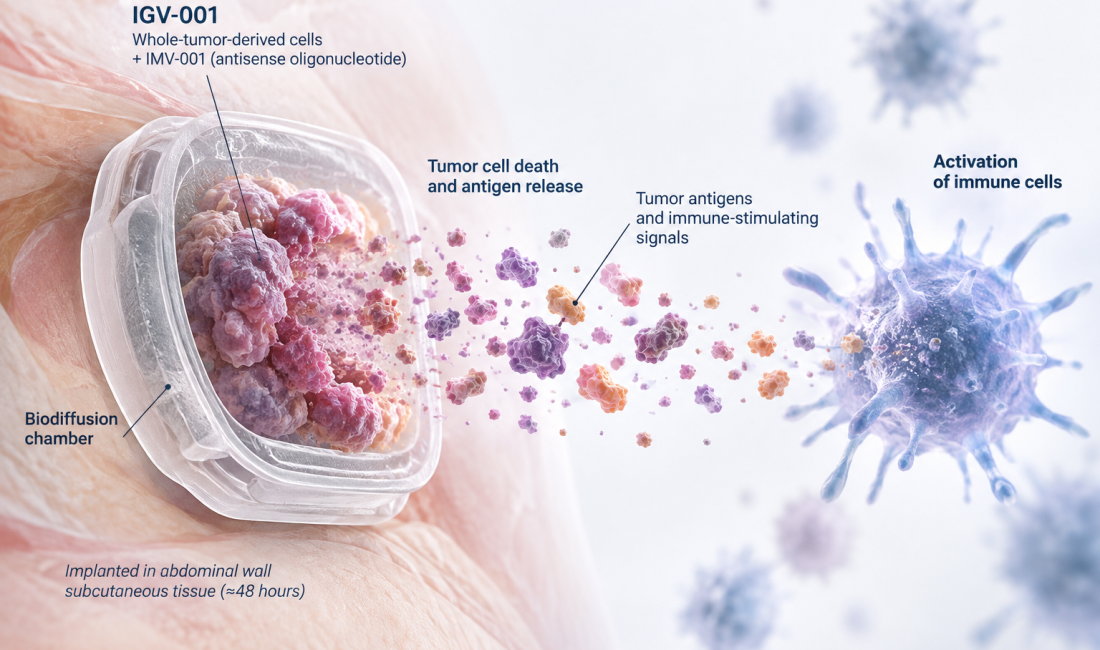
IGV-001 uses Imvax’s Goldspire platform to generate a patient-specific immune response against a broad range of tumor antigens. The autologous biologic-device combination uses a patient’s own whole-tumor-derived cells together with IMV-001, an antisense oligonucleotide.
Following tumor resection, the material is placed inside biodiffusion chambers that are implanted in the abdominal wall subcutaneous tissue for approximately 48 hours. Rather than delivering therapy directly into the brain, the temporary implant provides a site for tumor-cell death and release of tumor antigens and immune-stimulating signals that can initiate a systemic antitumor immune response. The chambers are then removed before patients continue standard treatment.
Phase 2b Provides the Basis for Pivotal Development
The NCT04485949 Phase 2b trial randomized 99 patients 2:1 across 19 U.S. sites to IGV-001 plus standard of care or placebo plus standard of care. The study evaluated PFS, overall survival and safety.
Across the full study population, median overall survival was 20.3 months with IGV-001 versus 14.0 months with placebo, a 6.3-month difference. The earlier trial did not achieve statistical significance on its primary PFS endpoint, making the subsequent uMGMT analysis particularly important to the program’s development strategy.
The September analysis now identifies a specific population in which Imvax intends to test IGV-001 prospectively in a pivotal study.
FDA Alignment Sets Phase 3 Path
Imvax met with FDA earlier in 2026 to discuss the Phase 2b results and regulatory pathway, followed by a July meeting focused on the proposed Phase 3 design. The agency aligned with key elements of a randomized, open-label study expected to enroll approximately 375 patients with uMGMT ndGBM in the United States.
The planned Phase 3 trial will use overall survival as its primary endpoint and include an interim analysis after a specified number of deaths. Imvax has incorporated FDA feedback into the proposed final protocol and expects to submit it to the agency in the coming months.
The company is pursuing financing to support initiation of the Phase 3 program in 2027.
The Next Test for IGV-001
The regulatory strategy marks a significant shift from the exploratory Phase 2b findings to a prospectively defined survival study in the population with the greatest unmet need. The Phase 3 trial will determine whether the survival and functional benefits observed in the uMGMT subgroup can be reproduced with sufficient rigor to support registration.
IGV-001 has received FDA Fast Track and Orphan Drug designations for ndGBM but remains investigational. The upcoming SNO presentation and submission of the Phase 3 protocol will provide the next major updates as Imvax moves the program toward pivotal testing.
Reference
Imvax Announces Additional Data from Phase 2b Clinical Trial of IGV-001 in Newly Diagnosed GBM and Provides Update on Planned Clinical Development, Imvax, 15 September 2026
A Phase 2b Clinical Study With a Combination Immunotherapy in Newly Diagnosed Patients With Glioblastoma, ClinicalTrials.gov ID NCT04485949

About the Writer
Mayuri Vaja (Linkedin) is a Pharm.D professional with a strong interest in clinical research, pharmacovigilance, and medical writing, supported by certifications in pharmacovigilance and academic projects exploring AI in healthcare and drug safety.
With a growing focus on evidence-based healthcare and scientific communication, she is developing expertise in clinical research and translating healthcare evidence into clear, meaningful content.
As a Pharmacally healthcare writer, Mayuri is committed to creating accurate, research-driven, and clinically relevant healthcare content while continuously strengthening her professional skills.