
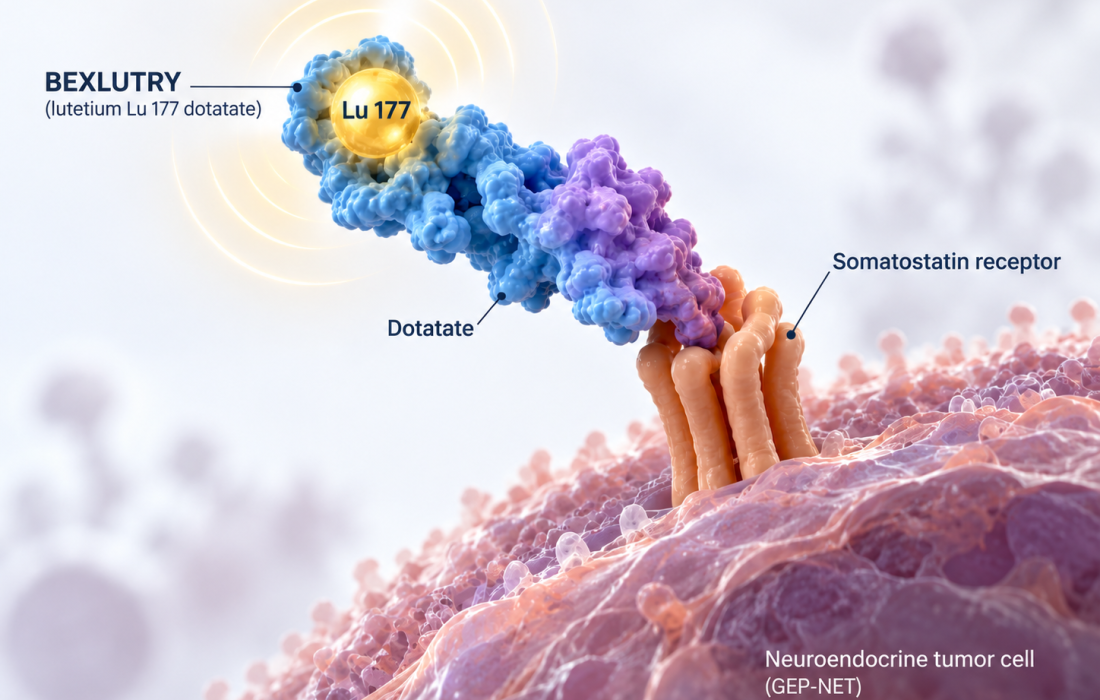
FDA approves Curium’s BEXLUTRY, a lutetium Lu 177 dotatate radioligand equivalent to LUTATHERA, for adults with somatostatin receptor-positive GEP-NETs.
Written By: Umesh Hanumante,
M.Pharm (Reg. Affairs)
Reviewed By: Pharmacally Editorial Team
The U.S. Food and Drug Administration has approved Curium’s BEXLUTRY (lutetium Lu 177 dotatate injection) for adults with somatostatin receptor-positive gastroenteropancreatic neuroendocrine tumors (GEP-NETs), including foregut, midgut, and hindgut neuroendocrine tumors. The approval makes BEXLUTRY the first radioligand equivalent to receive full FDA approval in the U.S., creating a new commercial option for lutetium-177 dotatate therapy.
505(b)(2) Approval Builds on Established Lutetium-177 Evidence
BEXLUTRY targets somatostatin receptors expressed on neuroendocrine tumor cells. The therapy combines the receptor-binding peptide dotatate with lutetium-177, a radioactive isotope that delivers targeted beta-particle radiation to receptor-positive tumor tissue.
GEP-NETs account for an estimated 60% to 70% of neuroendocrine tumors and can arise throughout the gastrointestinal tract and pancreas because neuroendocrine cells are widely distributed across these tissues.
Curium developed BEXLUTRY under the FDA’s 505(b)(2) pathway, targeting LUTATHERA (lutetium Lu 177 dotatate), the established reference product. The application relied on published evidence together with bridging data that demonstrated similar biological and chemical characteristics to the previously approved radiopharmaceutical.
The clinical evidence underlying the lutetium Lu 177 dotatate reference product includes the Phase 3 NETTER-1 trial (NCT01578239) and the large ERASMUS clinical experience. NETTER-1 established the efficacy of lutetium Lu 177 dotatate in advanced, somatostatin receptor-positive midgut neuroendocrine tumors, while ERASMUS provided extensive clinical experience across neuroendocrine tumor populations. These studies form part of the established evidence base supporting the reference therapy rather than representing BEXLUTRY-specific clinical trials.
Administration and Key Safety Considerations
BEXLUTRY follows the established lutetium Lu 177 dotatate treatment schedule of 7.4 GBq (200 mCi) administered intravenously every eight weeks for four doses.
Because the treatment delivers ionizing radiation, administration requires appropriate radiation-safety precautions. The prescribing information also highlights risks including myelosuppression and renal toxicity, requiring monitoring of blood counts and renal function during treatment.
An amino acid solution is administered with lutetium Lu 177 dotatate to reduce renal radiation exposure. Concomitant somatostatin analog therapy also requires dose-timing management because these agents can compete for somatostatin receptor binding. The prescribing information specifies different timing requirements for long-acting and short-acting somatostatin analogs before and after treatment.
Curium Expands into Oncology Radiopharmaceuticals
The approval marks Curium’s expansion from its established nuclear medicine business into oncology therapeutics. The company said its vertically integrated lutetium-based manufacturing infrastructure will support commercial production and supply of BEXLUTRY.
Renaud Dehareng, Curium’s Group Chief Executive Officer, said the approval strengthens the company’s ability to provide both diagnostic and therapeutic capabilities as the use of theranostics expands.
Mike Patterson, Curium’s North American CEO, highlighted the company’s manufacturing and nuclear medicine infrastructure, with an emphasis on reliable supply and scheduling support for treatment centers administering radioligand therapy.
Path Forward
BEXLUTRY is now available for prescribing physicians and patient use in the U.S. Its approval adds another commercially available lutetium Lu 177 dotatate product for adults with somatostatin receptor-positive GEP-NETs.
The near-term focus will be commercial rollout, manufacturing scale-up, and distribution to treatment centers. More broadly, the approval could increase competition within the lutetium-177 dotatate market while reinforcing the role of radioligand therapy in the treatment landscape for somatostatin receptor-positive neuroendocrine tumors.
Reference
Curium™ announces FDA approval of BEXLUTRY lutetium Lu 177 dotatate injection for adults with SSTR-positive GEP-NETs, Curium, 14 September 2026
A Study Comparing Treatment With 177Lu-DOTA0-Tyr3-Octreotate to Octreotide LAR in Patients With Inoperable, Progressive, Somatostatin Receptor Positive Midgut Carcinoid Tumours (NETTER-1), ClinicalTrials.gov ID NCT01578239

About the Writer
Umesh Hanumante (M.Pharm) (LinkedIn) is a pharmacy professional and healthcare writer with a background in Regulatory Affairs, pharmaceutical innovation, and clinical research. He has around two years of industry experience as an Executive PMT at Troikaa Pharmaceuticals Ltd and qualified GPAT 2024. His areas of interest include regulatory compliance, dossier preparation, clinical trials, emerging therapies, and advancements in the global pharmaceutical and healthcare sector.