
Amgen’s Phase III DeLLphi-305 trial showed IMDELLTRA plus Imfinzi improved overall survival, PFS and response in extensive-stage small cell lung cancer.
Written By: Rishabh Sonanwane, BPharm
Reviewed By: Pharmacally Editorial Team
In Amgen’s Phase III DeLLphi-305 trial (NCT06211036), conducted in collaboration with AstraZeneca, IMDELLTRA (tarlatamab) plus Imfinzi (durvalumab) significantly improved overall survival (OS) compared with Imfinzi alone in patients with extensive-stage small cell lung cancer (ES-SCLC) whose disease had not progressed following first-line induction therapy. The combination also significantly improved progression-free survival (PFS) and objective response rate, providing evidence for a more active maintenance strategy in a disease characterized by rapid progression and limited long-term survival.
A Maintenance Strategy Built on Two Immune Mechanisms
ES-SCLC is an aggressive form of lung cancer marked by rapid tumor growth and early metastatic spread, including to the brain and liver. About two-thirds of patients with SCLC are diagnosed with extensive-stage disease, and only 3.6% of patients with ES-SCLC remain alive five years after diagnosis. Despite advances from immune checkpoint inhibitors, many patients still progress after initial treatment.
Imfinzi, AstraZeneca’s PD-L1 inhibitor, blocks interactions between PD-L1 and the immune receptors PD-1 and CD80. This removes an inhibitory signal that tumors can exploit to suppress antitumor immune activity.
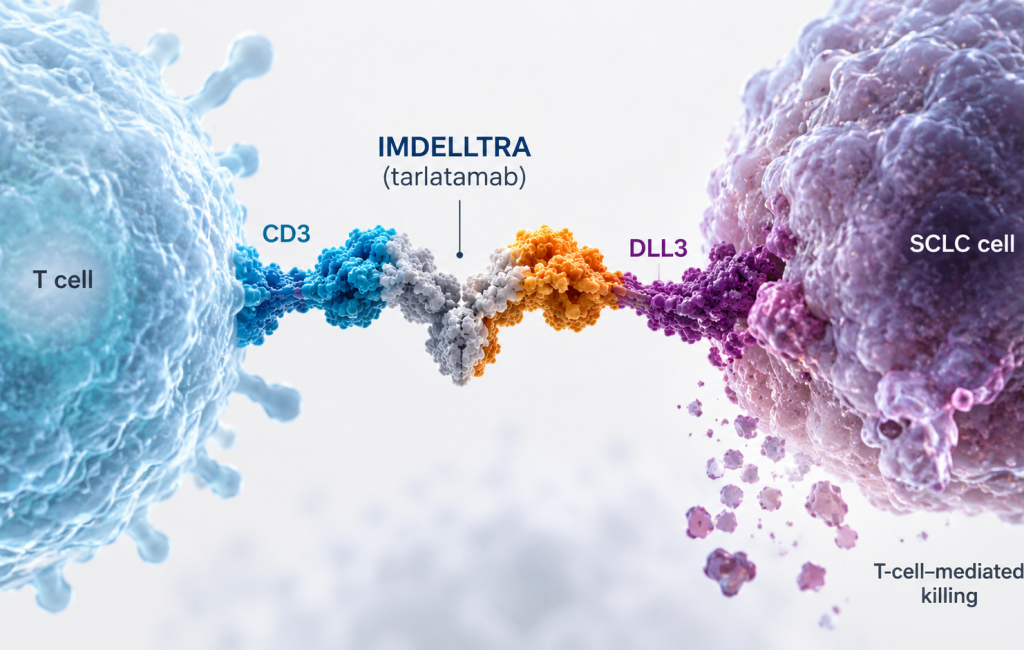
IMDELLTRA (tarlatamab) uses a complementary immune-engagement mechanism. It is a DLL3-targeted bispecific T-cell engager (BiTE® molecule) that binds DLL3 on SCLC cells and CD3 on T cells, bringing T cells into direct contact with tumor cells and activating T-cell-mediated killing. DLL3 is expressed on approximately 85% to 96% of SCLC cells but minimally on healthy cells.
The combination therefore brings together checkpoint blockade through Imfinzi with direct T-cell redirection through IMDELLTRA.
DeLLphi-305 Shows a Significant Overall Survival Benefit
DeLLphi-305 is a global, randomized, open-label Phase III study sponsored by Amgen, with AstraZeneca providing Imfinzi and partial funding. The trial enrolled 563 patients who had completed induction treatment with Imfinzi plus platinum chemotherapy and etoposide without disease progression. Patients were randomized 1:1 to receive either IMDELLTRA plus Imfinzi or Imfinzi alone as maintenance therapy until progression or unacceptable toxicity.
The primary endpoint was OS, with PFS designated as a key secondary endpoint. At the planned interim analysis, IMDELLTRA plus Imfinzi produced a statistically significant and clinically meaningful improvement in OS compared with Imfinzi alone. The combination also significantly improved PFS and objective response rate.
The study included patients with both treated and untreated asymptomatic brain metastases at baseline, broadening the clinical relevance of the findings to a population that reflects an important feature of extensive-stage SCLC.
The supplied high-level results do not disclose the median OS, hazard ratio, median PFS, or numerical objective response rates. Those details are expected with the full dataset at a forthcoming medical meeting.
Safety Profile Shows No New Signals
The safety and tolerability profile of IMDELLTRA plus Imfinzi was consistent with the known safety profiles of the individual treatments, and the interim analysis identified no new safety signals. The detailed safety dataset has not yet been provided in the supplied announcement.
For Imfinzi, established immune-mediated risks include pneumonitis, colitis, hepatitis, endocrinopathies, nephritis, dermatologic reactions, pancreatitis, and other inflammatory toxicities. These risks reflect the broader safety considerations associated with PD-L1 blockade and require monitoring during treatment.
Extending Disease Control After First-Line Induction
The clinical importance of DeLLphi-305 lies in its maintenance setting. ES-SCLC can progress rapidly after initial therapy, and some patients deteriorate before they can receive second-line treatment. Extending survival after successful induction could therefore offer a meaningful benefit in a population with few opportunities for prolonged disease control.
Imfinzi already provides an established treatment backbone in SCLC. It is approved with etoposide and either carboplatin or cisplatin for first-line ES-SCLC and as a single agent for patients with LS-SCLC whose disease has not progressed following concurrent platinum-based chemoradiotherapy. These roles are supported by the Phase III CASPIAN and ADRIATIC trials, respectively.
DeLLphi-305 now tests whether adding DLL3-directed T-cell engagement to that established immunotherapy backbone can produce deeper or more durable disease control.
From Positive Interim Results to Regulatory Review
Amgen and AstraZeneca plan to present the detailed DeLLphi-305 results at a forthcoming medical meeting and share the findings with global regulatory authorities.
The full dataset will be important for assessing the magnitude and durability of the OS benefit, the extent of PFS improvement, response outcomes, and the detailed safety profile of the combination. If the interim survival benefit is confirmed, IMDELLTRA plus Imfinzi could establish a new maintenance-treatment option after first-line induction for patients with ES-SCLC, extending Amgen’s DLL3-directed approach into an earlier stage of treatment while building on AstraZeneca’s established immunotherapy backbone.
Reference
IMDELLTRA® IN COMBINATION WITH IMFINZI® DEMONSTRATED LANDMARK IMPROVEMENT IN OVERALL SURVIVAL IN FIRST-LINE EXTENSIVE STAGE SMALL CELL LUNG CANCER, AMGEN, 08 SEP 2026
IMFINZI® (durvalumab) plus tarlatamab demonstrated a statistically significant and highly clinically meaningful improvement in overall survival and progression-free survival in 1st-line extensive-stage small cell lung cancer, Astra Zeneca, 08 SEP 2026

About the Writer
Rishabha Sonawane, B.Pharm (LinkedIn) is healthcare writer with a strong interest in medical writing, regulatory affairs, clinical research, and AI-driven drug discovery. He has completed specialized training from the NIH and ICMR in clinical pharmacology, clinical research, and scientific writing. Passionate about evidence-based healthcare communication, he focuses on translating complex scientific research into clear, accurate, and engaging medical content.