
Roivant’s mosliciguat cut pulmonary vascular resistance 56.3% versus placebo in the Phase 2 PHocus trial of PH-ILD and advanced to Phase 3.
Written By: Mansi Nakum, PharmD
Reviewed By: Pharmacally Editorial Team
Roivant’s once-daily inhaled sGC activator mosliciguat significantly reduced pulmonary vascular resistance in patients with pulmonary hypertension associated with interstitial lung disease, while also improving exercise capacity and lowering NT-proBNP. The Phase 2 PHocus results support continued development, with a global Phase 3 trial now underway.
PHocus Delivers Strong Hemodynamic Results
The randomized, double-blind, placebo-controlled Phase 2 PHocus trial (NCT06635850) met its primary endpoint at Week 16, showing a 56.3% placebo-adjusted reduction in pulmonary vascular resistance. Pulmonary vascular resistance fell 51.3% from baseline with mosliciguat compared with a 6.6% increase with placebo, resulting in a highly significant treatment effect with a p-value of less than 0.0001. Roivant described this as the largest reduction in pulmonary vascular resistance reported in a randomized controlled pulmonary hypertension trial.
The study also met both key secondary endpoints at Week 16. Six-Minute Walk Distance improved by 35.2 meters versus placebo at Week 16, driven by a 20.3-meter increase in the mosliciguat group compared with a 14.9-meter decline in the placebo group, yielding a p-value of 0.0027. NT-proBNP, a key biomarker of cardiac strain, decreased by 357.7 pg/mL on a placebo-adjusted basis, corresponding to a 53.2% placebo-adjusted reduction with a p-value of 0.0002.
Week 24 Results Remain Exploratory
Pre-specified exploratory results at Week 24 showed continued, progressive improvement during the placebo-controlled period. The placebo-adjusted gain in Six-Minute Walk Distance reached 52.7 meters with a nominal p-value of less than 0.0001. NT-proBNP showed a placebo-adjusted decline of 487.1 pg/mL, corresponding to a 75.9% reduction from baseline versus placebo with a nominal p-value of less than 0.0001.
These Week 24 findings extend the core Week 16 efficacy signal but remain exploratory and should be interpreted separately from the trial’s primary and secondary endpoint results.
Targeting the NO-cGMP Pathway
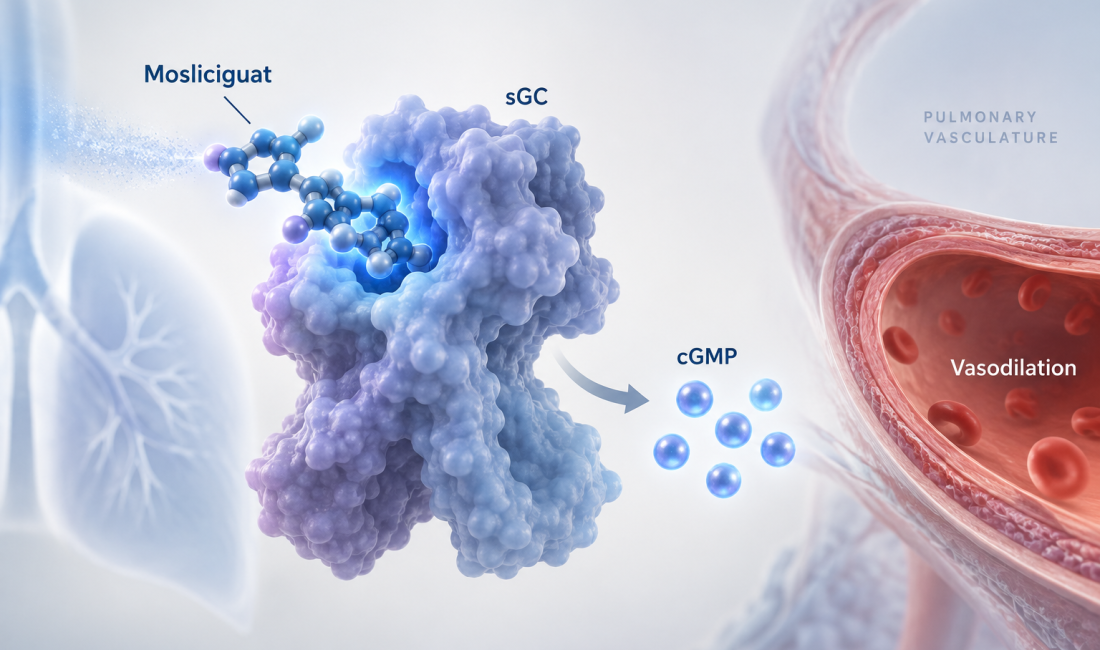
Mosliciguat is a once-daily inhaled soluble guanylate cyclase activator that targets the nitric oxide and cyclic guanosine monophosphate signaling pathway. Activating soluble guanylate cyclase increases cyclic guanosine monophosphate levels, which directly promotes pulmonary vasodilation and may also favourably influence fibrosis, inflammation, apoptosis, and vascular remodeling.
Unlike traditional soluble guanylate cyclase stimulators, mosliciguat is reported to activate soluble guanylate cyclase independently of native nitric oxide levels and oxidation or heme status. This mechanistic distinction is particularly relevant in pulmonary hypertension associated with interstitial lung disease, where systemic oxidative stress frequently impairs native signaling and limits the efficacy of nitric oxide dependent therapies.
Safety Profile and Cough Findings
Mosliciguat was well tolerated in PHocus, with adverse events described as consistent with the underlying patient population. Cough occurred in only 12.1% of patients receiving mosliciguat versus 18.2% with placebo. This finding is clinically significant because cough is a primary tolerability barrier and cause of treatment discontinuation associated with established inhaled prostacyclin therapies. Overall, the PHocus study enrolled 135 adults across 87 trial sites in 20 countries.
Phase 3 PHrontier Trial Underway
The company has initiated the global Phase 3 PHrontier trial, a randomized 1 to 1, double-blind, placebo-controlled study evaluating mosliciguat in adults with pulmonary hypertension associated with interstitial lung disease. The trial is planned to enroll approximately 375 patients worldwide.
Pulmonary hypertension associated with interstitial lung disease is a severe Group 3 form of pulmonary hypertension arising from progressive underlying lung diseases that scar tissue and impair oxygen exchange. Roivant estimates that up to 200,000 patients across the United States and Europe live with this condition, where targeted treatment options remain strictly limited.
The Phase 3 study will determine whether the substantial hemodynamic and functional improvements observed in PHocus can translate into durable clinical outcomes in a larger controlled population to support future regulatory filings.
Reference
Roivant Announces Positive Results from PHocus Study of Mosliciguat in Patients with Pulmonary Hypertension Associated with Interstitial Lung Disease (PH-ILD) and Unveils Ongoing Phase 3 PHrontier Study | Roivant Sciences Ltd. 08 Sep 20-26

About the Writer
Mansi Nakum (Linkedin) is a Pharm.D professional with a strong foundation in clinical pharmacy, evidence-based healthcare writing, and clinical data interpretation.
She has published work on Brugada syndrome and has a keen interest in guideline integration, multimodal therapy, pharmacogenomics, and antibiogram utilization.
As a healthcare writer, she focuses on translating clinical evidence into clear, accurate, and clinically relevant content, while continuously developing her expertise in evolving pharmacy practice.