
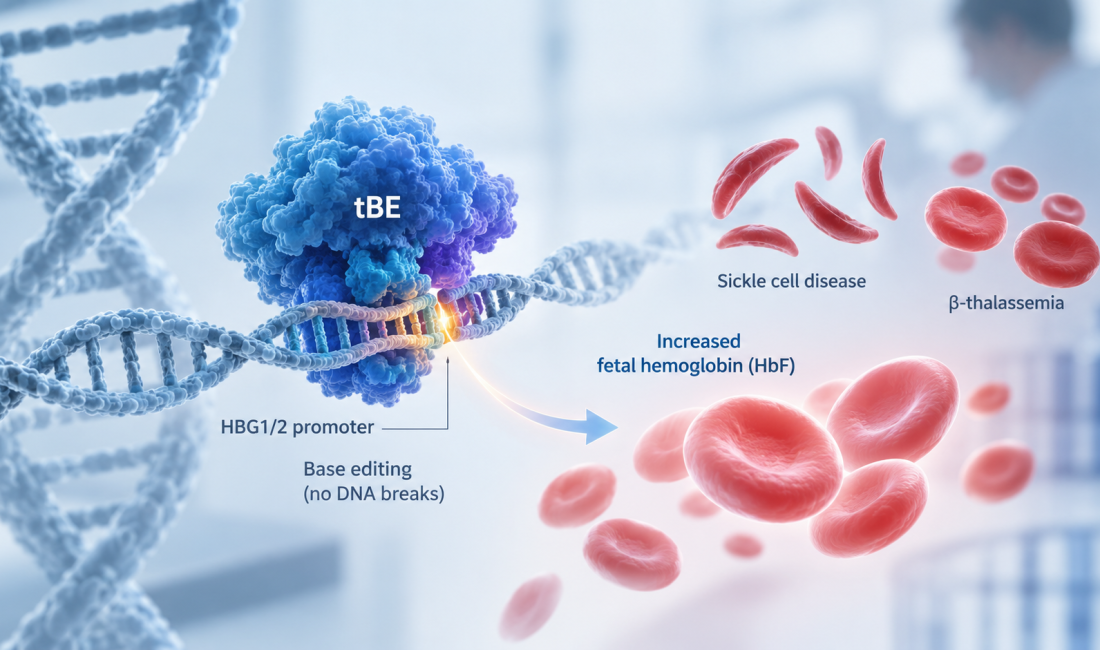
CorrectSequence’s CS-101 and CS-206 base-editing therapies achieved durable HbF induction, transfusion independence, and no VOCs across diverse SCD and β-thalassemia patients
Written By: Anshu Gupta, PharmD
Reviewed By: Pharmacally Editorial Team
CS-101 and CS-206 use autologous hematopoietic stem and progenitor cells (HSPCs) edited ex vivo with the transformer Base Editor (tBE) platform. The system targets a BCL11A binding site within the HBG1/2 promoter region. Disrupting this regulatory interaction reactivates γ-globin production and increases fetal hemoglobin (HbF), providing functional hemoglobin to compensate for deficient or abnormal adult hemoglobin.
Unlike nuclease-based editing approaches such as Cas9 and Cas12a, base editing enables targeted nucleotide conversion without generating DNA double-strand breaks (DSBs). The tBE system also uses a dual-guide, “lock-and-key” configuration intended to reduce off-target editing by limiting enzyme activity at unintended genomic sites.
Clinical Outcomes
Sickle Cell Disease
A 21-year-old woman from Nigeria with SCD, who had experienced more than four vaso-occlusive crises (VOCs) during the year before enrollment, received the edited autologous cells.
Neutrophil engraftment occurred on day 13 and platelet engraftment on day 21. Total hemoglobin increased from 7.7 g/dL at baseline to 12.9 g/dL at month 3 and remained above 11 g/dL during follow-up. HbF increased from 3.5% to 62.2%, while HbS declined from 76.1% to 31.6%.
At 15.5 months of follow-up, she had experienced no VOCs.
Transfusion-Dependent β-Thalassemia
Three patients with TDT, aged 3 to 29 years and from Laos, Malaysia, and Pakistan, achieved median neutrophil engraftment at day 13 and platelet engraftment at day 27.
Mean total hemoglobin reached 11.6 ± 1.2 g/dL at month 3, while mean HbF concentration reached 9.8 g/dL. At a median follow-up of 17.5 months, all three patients remained transfusion-independent.
Safety
No off-target edits or product-related adverse events were detected across the four patients in the study.
Development Status and Outlook
The findings come from small, early-stage clinical studies rather than randomized trials. ClinicalTrials.gov lists both CS-101 in β-thalassemia and CS-206 in SCD as Phase 1 programs. CorrectSequence reports that CS-101 has completed Phase 1 and is advancing into pivotal trials, with more than 30 patients treated with CS-101 or CS-206 across China, Africa, Southeast Asia, and South Asia.
Cross-trial comparisons with Cas9- and Cas12a-based therapies should be interpreted cautiously because of differences in study design, conditioning regimens, patient populations, and follow-up. Nevertheless, the reported engraftment timelines and HbF levels add to the emerging clinical evidence for base editing as an alternative to nuclease-based gene editing.
The Cell Stem Cell findings extend clinical evidence for HBG1/2 promoter editing across distinct ethnic backgrounds and disease-associated genotypes. Larger studies with longer follow-up will be needed to establish the durability of HbF induction and assess the long-term safety and clinical benefit of the approach across broader SCD and TDT populations.
Reference
Cell Stem Cell: tBE-mediated Base Editing Therapy Achieves Durable Clinical Remission in Sickle Cell Disease and β-Thalassemia Across Different Genetic Backgrounds, Correct Sequence 07 September 2026
Rongrong Liu et al, Clinical base editing for β-hemoglobinopathies across different genetic backgrounds, Cell Stem Cell, 2026, https://doi.org/10.1016/j.stem.2026.08.009
About the Writer
Anshu Gupta (LinkedIn) is a PharmD professional and healthcare writer with interests in clinical research, pharmacovigilance, regulatory affairs, and medical writing. She has presented research at academic conferences and completed certifications in Good Clinical Practice (GCP), ICH-GCP, and drug safety. Passionate about clinical trials and evidence-based medicine, she is committed to translating scientific evidence into accurate, reliable, and accessible healthcare content.