
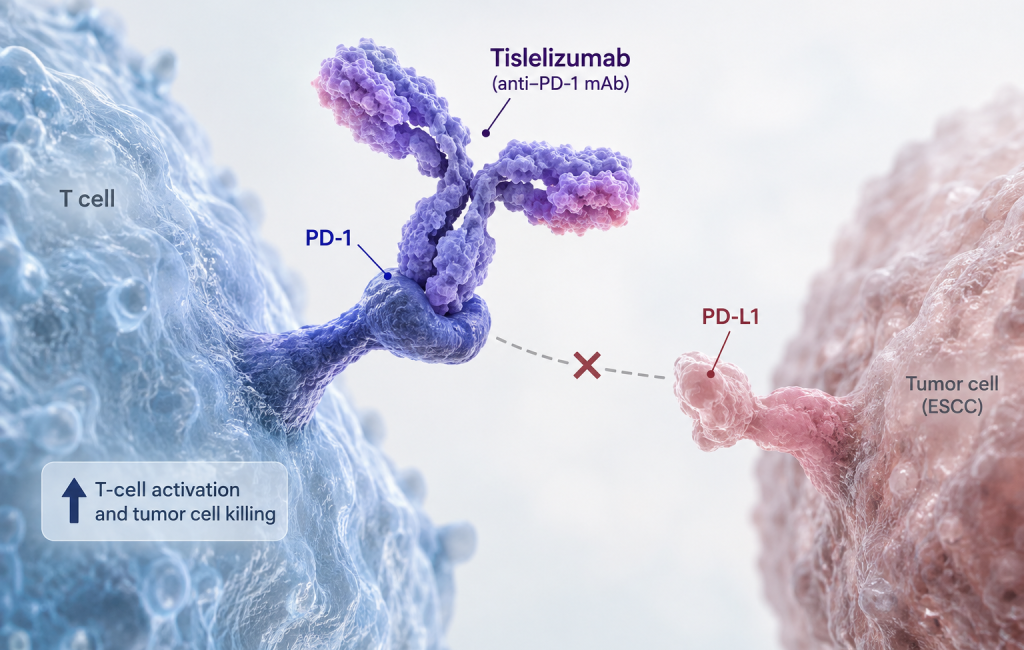
Long-term RATIONALE-306 data show sustained overall survival, progression-free survival and response benefits with tislelizumab plus chemotherapy in PD-L1 TAP ≥5% ESCC.
Written By: Anamika Koshti, PharmD
Reviewed By: Pharmacally Editorial Team
A post hoc, exploratory long-term analysis of the phase III RATIONALE-306 study found that first-line tislelizumab plus chemotherapy continued to provide clinically meaningful efficacy in patients with advanced or metastatic esophageal squamous-cell carcinoma (ESCC) whose tumors had a programmed death ligand 1 (PD-L1) tumor area positivity (TAP) score of at least 5%. At a minimum follow-up of 45.2 months, the benefit was maintained across overall survival (OS), progression-free survival (PFS) and tumor response.
Why the PD-L1 TAP ≥5% population matters
PD-L1 TAP measures the proportion of tumor area covered by PD-L1-positive tumor cells and tumor-associated immune cells. The long-term analysis specifically examined the TAP ≥5% population, building on earlier RATIONALE-306 findings that supported the use of tislelizumab with chemotherapy in previously untreated advanced or metastatic ESCC. The current analysis provides a longer view of whether the initial efficacy advantage persists beyond the earlier follow-up periods.
Study population and treatment
RATIONALE-306 was a global, randomized, double-blind, placebo-controlled phase III study (NCT03783442). Adults with previously untreated unresectable locally advanced, recurrent or metastatic ESCC were randomized 1:1 to tislelizumab 200 mg or placebo every 3 weeks, each combined with investigator-selected platinum-based chemotherapy. Of 649 randomized patients, 358 had PD-L1 TAP ≥5%: 172 received tislelizumab and 186 received placebo. Most patients in this subgroup were enrolled in Asia (78.2%), an important consideration when interpreting generalizability.
Durable survival benefit
In the PD-L1 TAP ≥5% population, median OS was 19.1 months with tislelizumab plus chemotherapy versus 10.0 months with placebo plus chemotherapy, corresponding to a hazard ratio (HR) of 0.61. Landmark OS rates also favored tislelizumab, with 24-month survival of 42.7% versus 23.4% and 36-month survival of 24.4% versus 15.4%.
Median PFS was 8.2 versus 5.5 months (HR, 0.50). At 24 months, 24.0% of patients receiving tislelizumab remained progression-free compared with 7.1% in the placebo arm; at 36 months, the rates were 19.6% and 4.0%, respectively.
Response remained durable
The objective response rate was 71.5% with tislelizumab plus chemotherapy versus 41.4% with placebo plus chemotherapy. Complete response occurred in 7.0% versus 1.6%, while partial response occurred in 64.5% versus 39.8%. Median duration of response was 7.1 versus 5.4 months. Among responders, the proportion remaining in response at 24 months was 24.4% with tislelizumab compared with 14.3% with placebo.
Subsequent therapy and quality of life
Subsequent systemic therapy was received by 55.2% of patients in the tislelizumab arm and 61.3% in the placebo arm. Radiotherapy was used in 21.5% and 25.3%, respectively, while subsequent immunotherapy was reported in 15.7% and 23.7%.
Quality-of-life measures were broadly similar between groups over time. At cycle 6/week 15, global health status/quality of life and physical functioning favored tislelizumab, although later between-group differences were less consistent. Dysphagia and fatigue did not show a consistent long-term advantage for tislelizumab.
Safety and limitations
Safety remained consistent with earlier RATIONALE-306 analyses, with no new safety signals identified. Treatment-related adverse events (TRAEs) occurred in 97.7% and 98.4% of patients, respectively; grade ≥3 TRAEs occurred in 70.2% and 66.5%. TRAEs led to treatment discontinuation in 32.2% of the tislelizumab group versus 18.4% of the placebo group. No immune-mediated adverse-event deaths were reported.
The analysis was post hoc, exploratory and descriptive rather than prespecified. Smaller patient numbers at later landmark time points limit interpretation of long-term estimates, and the high proportion of Asian participants may limit applicability to other populations.
What the long-term data add
Overall, the findings reinforce that the efficacy advantage observed with tislelizumab plus chemotherapy in PD-L1 TAP ≥5% ESCC was sustained through extended follow-up. The combination produced longer OS and PFS, higher response rates and durable disease control compared with placebo plus chemotherapy, while its safety profile remained consistent with earlier analyses.
Reference

About the Writer
Anamika Koshti (LinkedIn) is a PharmD professional and healthcare writer with interests in clinical research, pharmacovigilance, and evidence-based medicine. She has authored peer-reviewed publications on Alzheimer’s disease and PCOS, presented research at national conferences, and gained hands-on experience in medical content development and clinical data interpretation. She is committed to translating complex medical research into accurate, accessible content for healthcare professionals and patients.