
Argo Biopharma’s BW-20805 reduced hereditary angioedema attack rates by up to 96% and sustained PKK suppression through Day 169 in Phase II.
Written By: Shaik Yasmeen, PharmD
Reviewed By: Pharmacally Editorial Team
Updated Phase II clinical data presented at the Bradykinin Symposium 2026 in Berlin highlight the clinical activity of BW-20805, Argo Biopharma’s investigational small interfering RNA (siRNA) therapy for hereditary angioedema (HAE). The candidate produced sustained plasma prekallikrein (PKK) suppression and substantial reductions in HAE attack rates through Day 169 across three long-interval dosing regimens.
Durable Attack Reduction Across Dosing Regimens
The open-label, global, multicenter Phase II trial (NCT06846398) enrolled adults with HAE type 1 or 2 to evaluate three subcutaneous dosing regimens:
- 600 mg every 24 weeks (Q24W)
- 300 mg Q24W
- 300 mg every 12 weeks (Q12W)
As of the June 2026 data cutoff, 25 participants had been randomized and treated. In the primary endpoint analysis population, mean time-normalized monthly HAE attack rates from Day 29 through Day 169 fell across all three groups:
- 300 mg Q24W: 96% reduction
- 300 mg Q12W: 93% reduction
- 600 mg Q24W: 83% reduction
During the same observation period, 75% (6/8) of patients in the 300 mg Q24W group, 62.5% (5/8) in the 300 mg Q12W group, and 50% (4/8) in the 600 mg Q24W group remained completely attack-free.
Among patients who experienced attacks after treatment, episodes were reported as less frequent and milder.
Sustained PKK Suppression Supports the Mechanism
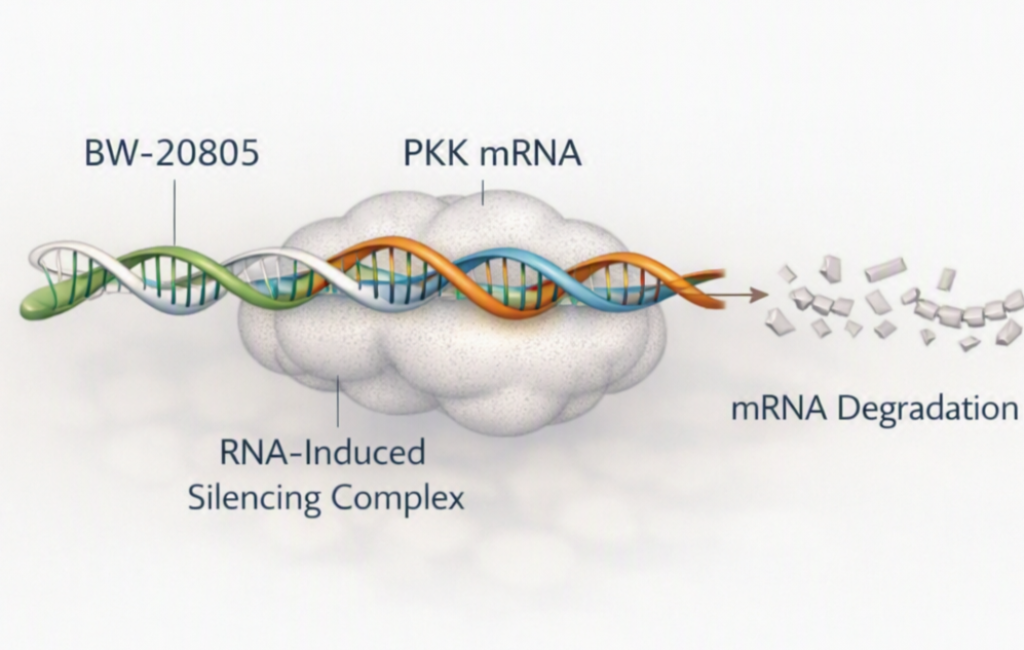
BW-20805 uses RNA interference to silence hepatic PKK messenger RNA. Prekallikrein is a key component of the kallikrein-kinin pathway involved in HAE, in which excessive bradykinin signaling increases vascular permeability and drives recurrent swelling attacks.
By lowering PKK production, BW-20805 is intended to suppress this pathway over an extended period, supporting a preventive treatment approach that does not require frequent administration.
Pharmacodynamic findings were consistent with this mechanism. In the PKK-evaluable population, mean plasma PKK levels at Day 169 fell by:
- 94% with 300 mg Q12W
- 86% with 600 mg Q24W
- 85% with 300 mg Q24W
The sustained PKK suppression supports the candidate’s long-interval dosing strategy, although comparative studies will be needed to determine how BW-20805 performs against established HAE prophylactic therapies.
Well-Tolerated Safety Profile
BW-20805 was generally well tolerated across the 25-patient safety population. Treatment-emergent adverse events were predominantly mild, with transient injection-site reactions reported as the most frequent adverse event of special interest.
No treatment-emergent adverse events led to treatment discontinuation, study withdrawal, or death. No participant met protocol-defined criteria for hepatic laboratory abnormalities.
Outlook and Path Forward
Argo Biopharma CEO Dr. Dongxu Shu said the magnitude and durability of attack-rate reductions through Day 169, together with sustained PKK suppression and the observed safety profile, support continued advancement of BW-20805 as a less frequently dosed prophylactic option for HAE.
The findings come from a small, open-label Phase II study without a comparative control group, with eight patients assigned to each dosing cohort. Larger controlled studies will therefore be needed to establish the consistency, durability, and safety of the treatment effect across a broader HAE population.
Argo Biopharma has not disclosed a specific regulatory filing timeline for BW-20805. Further clinical development will determine whether sustained PKK suppression can translate into durable HAE attack prevention with a dosing interval that offers a meaningful advantage over current prophylactic options.
Reference

About the Writer
Shaik Yasmeen (LinkedIn) is a Pharm.D graduate with interests in clinical pharmacy, pharmacovigilance, and medical writing. She has gained experience through hospital clinical postings, patient case reviews, case presentations, and literature evaluation. Passionate about evidence-based healthcare, she is committed to creating accurate and engaging medical content while continuously expanding her professional knowledge.