
Ultragenyx’s apazunersen failed the Phase 3 Aspire trial in Angelman syndrome, missing Bayley-4 cognition and MDRI endpoints.
Written By: Kirti Kumbhar, M. Pharm (QA)
Reviewed By: Pharmacally Editorial Team
Ultragenyx Pharmaceutical reported that the Phase 3 Aspire study (NCT06617429) of apazunersen (GTX-102) in Angelman syndrome failed to meet its primary endpoint, change from baseline in the Bayley-4 cognitive raw score. The study also missed its key secondary endpoint, net response on the Multidomain Responder Index (MDRI).
The company reported no differences between apazunersen and control that supported efficacy on Bayley cognitive raw scores or MDRI net response. Mean changes across the five individual MDRI domains also failed to distinguish the treatment and control groups.
The outcome represents a major setback for a program that had advanced into late-stage development after encouraging findings from earlier Phase 1/2 studies (NCT04259281).
Reactivating the Silenced UBE3A Allele
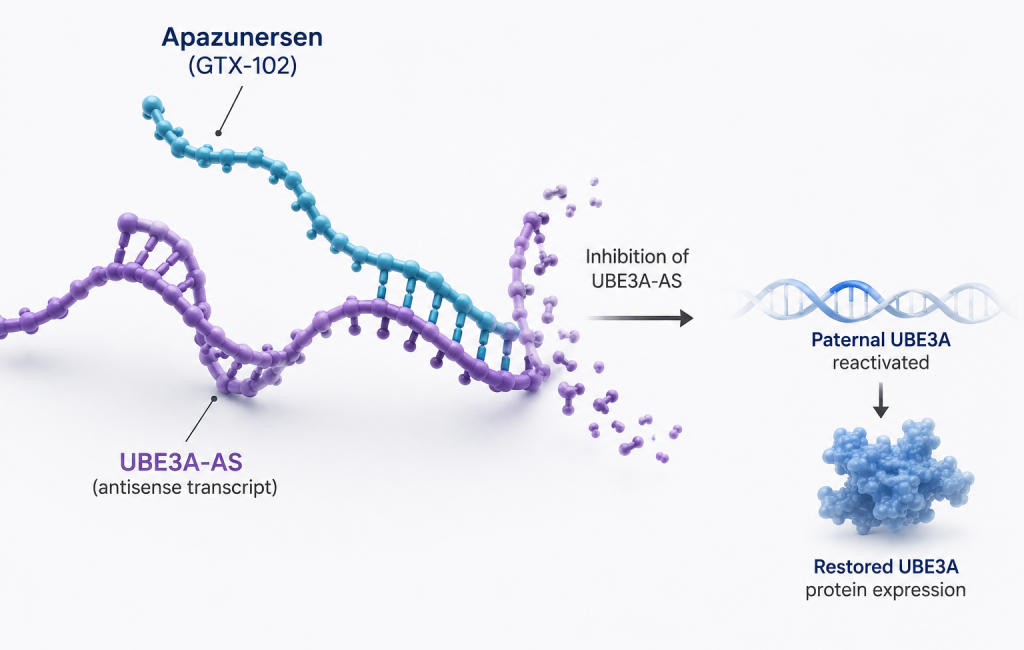
Apazunersen is an investigational antisense oligonucleotide (ASO) administered by intrathecal injection. It targets UBE3A-AS, the antisense transcript responsible for maintaining silencing of the paternal UBE3A allele in neurons.
Angelman syndrome typically results from loss of function of the maternally inherited UBE3A allele. Because genomic imprinting normally prevents expression of the paternal allele in neurons, loss or mutation of the maternal allele leaves affected neurons with little or no UBE3A protein.
By inhibiting UBE3A-AS, apazunersen was intended to reactivate the paternal UBE3A allele and restore UBE3A expression.
Angelman syndrome is a lifelong neurodevelopmental disorder characterized by cognitive and motor impairment, balance problems, seizures, sleep disturbances and severe limitations in speech. No therapy is currently approved specifically for the underlying disorder.
Phase 3 Tested Intrathecal Loading and Maintenance Doses
Aspire enrolled 129 patients with a full maternal UBE3A gene deletion, with participants randomized 1:1 to apazunersen or sham treatment. The 48-week study used intrathecal administration through lumbar puncture.
Patients receiving apazunersen received three monthly 8-mg loading doses, followed by quarterly maintenance dosing that could increase to a maximum of 14 mg. The MDRI assessed five domains: cognition, receptive communication, behaviour, gross motor function and sleep.
Ultragenyx said the randomized groups were comparable at baseline and consistent with patients studied in Phase 2. Despite that comparability, Aspire produced no efficacy difference capable of supporting the program’s primary or key secondary endpoints.
Safety Remained Consistent with Earlier Development
The safety profile in Aspire was consistent with the Phase 1/2 program, according to Ultragenyx.
Earlier development had identified transient lower-extremity weakness at higher exposures, prompting dosing and protocol adjustments. By March 2026, Ultragenyx reported that long-term Phase 1/2 patients had generally been receiving the 14-mg quarterly maintenance dose, with no new cases of transient lower-extremity weakness or recurring drug-related serious adverse events reported in that update.
These safety findings do not establish why the Phase 3 efficacy results differed from earlier studies, and the topline disclosure does not provide enough information to attribute the failure to dose, patient selection or another factor.
Ultragenyx Reassesses Apazunersen
Ultragenyx CEO and President Emil Kakkis said the company was disappointed by the Aspire result after the earlier Phase 1/2 and long-term extension findings.
The company will now evaluate the apazunersen program and decide its future. It also plans significant expense reductions while prioritizing its commercial business.
That portfolio includes Genglycos (pariglasgene brecaparvovec-opnr; DTX401), which received FDA accelerated approval in August 2026 to reduce daily cornstarch intake as an adjunct to nutritional management in adults and children aged 8 years and older with glycogen storage disease type Ia (GSDIa).
Outlook for the Angelman Syndrome Program
The Aspire failure leaves the regulatory path for apazunersen unresolved. Ultragenyx has not yet provided a timeline for its disposition decision or indicated whether additional development will proceed.
The result also highlights the challenge of translating biological evidence for UBE3A reactivation and earlier clinical observations into reproducible benefits on standardized neurodevelopmental measures in a pivotal study. Further detailed Aspire data will be important to determine whether treatment effects differed across individual MDRI domains or patient subgroups.
Reference
Ultragenyx Announces Phase 3 Aspire results in Angelman Syndrome—Ultragenyx Pharmaceutical Inc.

About the Writer
Kirti Kumbhar (LinkedIn) is an M.Pharm graduate with experience in Quality Assurance at Lupin Limited and a strong interest in clinical research, regulatory affairs, and Trial Master File (TMF) management. She has developed knowledge of regulatory documentation, quality systems, compliance, and healthcare research through her professional experience. Passionate about clinical development and continuous learning, Kirti is committed to supporting high-quality healthcare documentation, regulatory excellence, and research-driven healthcare advancements.