
Medera’s SRD-002 gene therapy showed sustained improvements in cardiac filling pressures and symptoms through 12 months in HFpEF.
Written By: Mansi Nakum, PharmD
Reviewed By: Pharmacally Editorial Team
Medera’s SRD-002 gene therapy produced sustained improvements in cardiac filling pressures through 12 months in patients with heart failure with preserved ejection fraction (HFpEF), with reductions continuing to improve between six and 12 months after a single intracoronary dose.
Data from the ongoing MUSIC-HFpEF Phase 1/2a trial (NCT06061549), presented as a Late-Breaking Clinical Trial at ESC Congress 2026 in Munich, showed that 8 of 10 treated patients met the prespecified threshold for normalization of cardiac filling pressures at 12 months. Mean peak exercise pulmonary capillary wedge pressure (PCWP) fell by approximately 30%, while improvements in symptoms, quality of life, and functional capacity accompanied the hemodynamic changes.
Targeting impaired calcium handling in HFpEF
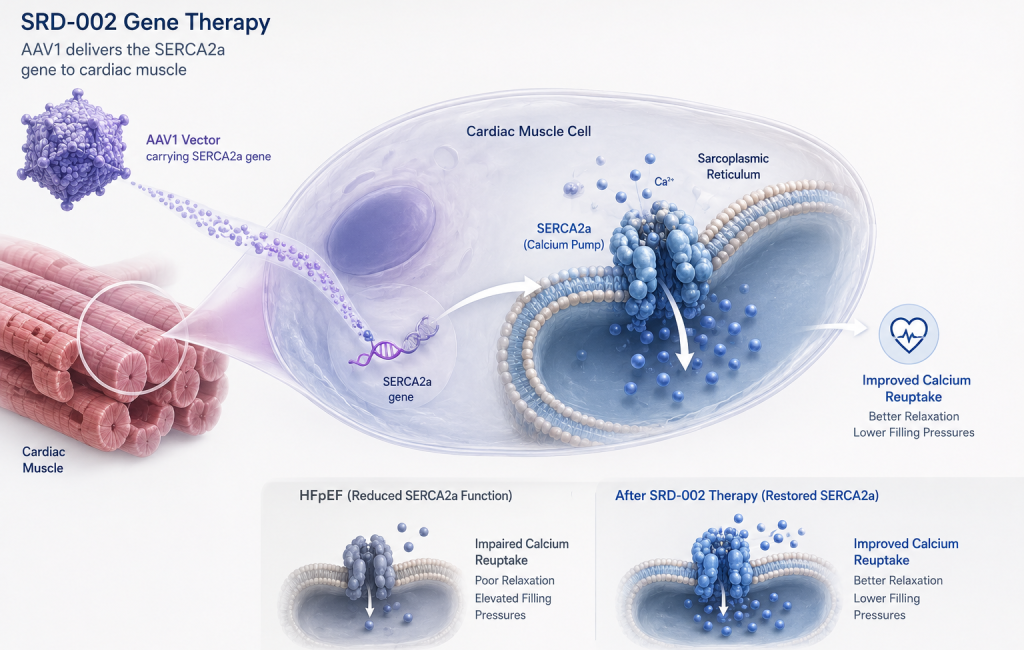
The open-label, dose-escalation study is evaluating SRD-002, an adeno-associated virus serotype 1 (AAV1) gene therapy that delivers the SERCA2a gene to cardiac muscle.
SERCA2a encodes a sarcoplasmic reticulum calcium pump that plays a central role in cardiac relaxation. Its activity is reduced in heart failure, contributing to impaired calcium reuptake and abnormal diastolic function. By restoring SERCA2a expression in the myocardium, SRD-002 is intended to address a biological mechanism underlying impaired cardiac relaxation and elevated filling pressures.
HFpEF accounts for roughly half of heart failure cases and remains difficult to treat because many available therapies primarily address symptoms and cardiovascular risk rather than the myocardial abnormalities driving the disease.
12-month MUSIC-HFpEF findings
The trial enrolled 10 adults with symptomatic HFpEF. Five patients received a low dose of SRD-002 at 3 × 10¹³ vector genomes (vg), while five received a high dose of 4.5 × 10¹³ vg.
Across both cohorts, 80% of patients achieved the prespecified threshold for normalization of cardiac filling pressures at 12 months. Mean peak exercise PCWP declined by about 30%. The reduction continued to deepen from six to 12 months and was generally greater at the higher dose, indicating both durability and a dose-response pattern.
Clinical measures moved in the same direction. Five of six patients who entered the study with New York Heart Association class III symptoms improved to class II. Mean Kansas City Cardiomyopathy Questionnaire scores increased by 17.8 points, while functional capacity either stabilized or improved in all treated patients.
The findings remain early and are based on only 10 patients in an open-label study, so randomized evaluation will be needed to determine the magnitude and durability of the treatment effect.
Safety remained favorable
No treatment-related serious adverse events, dose-limiting toxicities, or treatment discontinuations were reported through 12 months. No patient experienced a Grade 3 or higher liver enzyme elevation.
The intracoronary delivery approach also limits systemic vector exposure. According to Medera, the procedure produced approximately 100- to 300-fold lower vector exposure than systemic intravenous AAV administration while enabling targeted myocardial delivery without routine immunosuppression.
Marat Fudim, MD, MHS, of Duke University Medical Center, said the sustained invasive hemodynamic improvements, together with changes in symptoms and quality of life, support further investigation of impaired calcium handling as a therapeutic target in HFpEF.
Next step: randomized Phase 2b development
Ronald Li, PhD, Medera’s co-founder and CEO, highlighted the continued improvement in filling pressures after a single administration as a key finding from the 12-month analysis.
The company plans to advance SRD-002 into a randomized Phase 2b trial to further assess efficacy and safety. The next-stage study will be important for determining whether the hemodynamic and functional improvements observed in MUSIC-HFpEF can be reproduced in a controlled setting and ultimately support development of SRD-002 as a potential one-time therapy for HFpEF.
Reference

About the Writer
Mansi Nakum (Linkedin) is a Pharm.D professional with a strong foundation in clinical pharmacy, evidence-based healthcare writing, and clinical data interpretation.
She has published work on Brugada syndrome and has a keen interest in guideline integration, multimodal therapy, pharmacogenomics, and antibiogram utilization.
As a healthcare writer, she focuses on translating clinical evidence into clear, accurate, and clinically relevant content, while continuously developing her expertise in evolving pharmacy practice.