
AskBio completes enrollment in GenePHIT, a Phase 2 trial of umiposgene parvec in non-ischemic HFrEF, with results expected in 2027.
Written By: Creola Gonsalves, MS Biotech
Reviewed By: Pharmacally Editorial Team
AskBio has completed randomization of more than 170 patients in GenePHIT, one of the largest randomized gene therapy trials conducted in heart failure to date. The Phase 2 study is evaluating a one-time intracoronary infusion of investigational umiposgene parvec (AB-1002) in patients with non-ischemic heart failure with reduced ejection fraction (HFrEF), with initial efficacy and safety results expected in the first half of 2027.
Multinational Study Reaches Enrollment Milestone
The randomized, double-blind, placebo-controlled trial enrolled participants across 64 sites in 12 countries, including the United States, Canada, the United Kingdom, and several European countries. The scale of the study supports the feasibility of conducting large, multinational randomized gene therapy trials in patients with advanced heart failure.
GenePHIT enrolled adults with non-ischemic cardiomyopathy, New York Heart Association (NYHA) Class III heart failure symptoms, and reduced left ventricular ejection fraction. Participants received contemporary guideline-directed medical therapy (GDMT), including beta-blockers, angiotensin receptor-neprilysin inhibitors (ARNIs), sodium-glucose cotransporter 2 (SGLT2) inhibitors, and mineralocorticoid receptor antagonists (MRAs).
Baseline characteristics presented at the 2026 European Society of Cardiology (ESC) Congress showed a substantial disease burden in the study population. Nearly half of participants had a history of atrial fibrillation, while almost 45% had an implantable cardioverter-defibrillator (ICD).
Gene Therapy Targets Cardiac Contractility
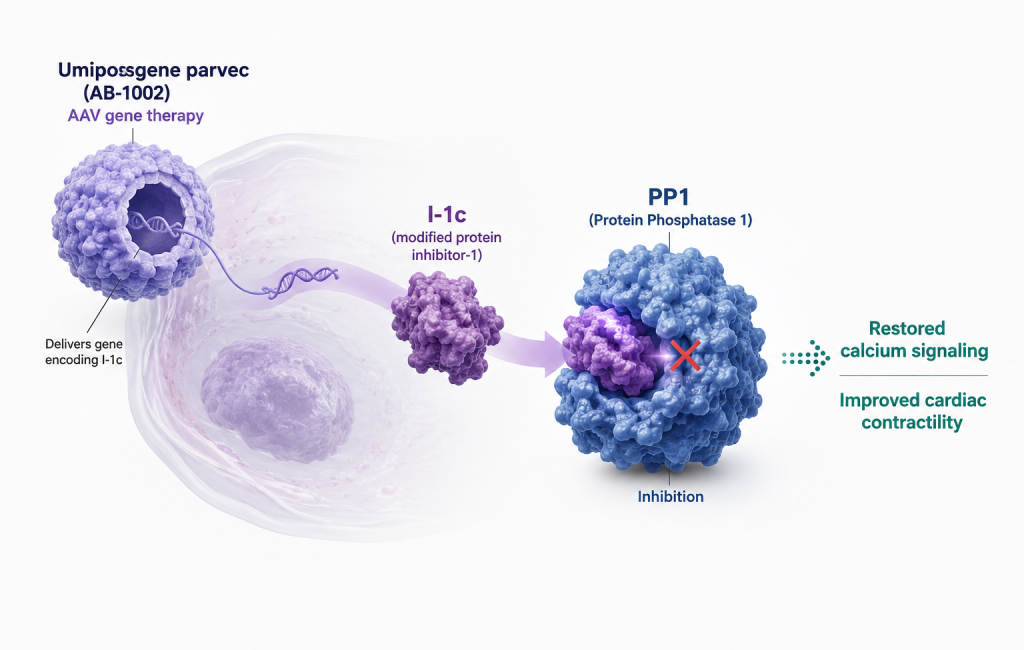
Umiposgene parvec is an investigational one-time gene therapy administered directly to the heart through antegrade intracoronary artery infusion. The therapy delivers a gene encoding I-1c, a modified form of the naturally occurring protein inhibitor-1.
I-1c is intended to inhibit protein phosphatase 1 (PP1), an enzyme implicated in heart failure and cardiac calcium signaling. By modulating this pathway, umiposgene parvec is intended to restore intracellular calcium signaling and improve cardiac contractility.
GenePHIT administers the therapy through standard cardiac catheterization without immune suppression, an approach that could simplify delivery compared with gene therapy strategies requiring immunosuppressive treatment.
Clinical Endpoints Will Test Therapeutic Potential
GenePHIT is evaluating the efficacy, safety, and tolerability of a single administration of umiposgene parvec compared with placebo. Key measures include cardiovascular-related deaths, changes in NYHA functional class, left ventricular ejection fraction (LVEF), and six-minute walking distance (6MWD).
The study is evaluating the therapy in patients receiving established heart failure treatment, providing a clinically relevant setting to determine whether umiposgene parvec can deliver additional benefit beyond contemporary GDMT.
Timothy D. Henry, MD, MSCAI, GenePHIT principal investigator and steering committee member, said the enrollment milestone demonstrates that large multinational randomized gene therapy trials can be conducted in heart failure. He also highlighted the importance of evaluating the investigational therapy in a population receiving current standard of care.
GenePHIT Results Expected in H1 2027
Initial efficacy and safety outcomes are expected in the first half of 2027. The results will provide the first major randomized assessment of whether umiposgene parvec can improve cardiac function and clinical outcomes in patients with non-ischemic HFrEF despite established medical therapy.
The findings will also determine the next stage of development for the one-time gene therapy and whether its biological approach can translate into meaningful clinical benefit in advanced heart failure.
Umiposgene parvec (AB-1002) is investigational and has not been approved by any regulatory authority. Its safety and efficacy have not been established.
Reference

About the Writer
Creola Gonsalves (Linkedin) is an M.S. Biotechnology postgraduate with a strong interest in clinical research, evidence interpretation, and healthcare writing, with a focus on translating life-science knowledge into meaningful real-world insights.
She is trained in Good Clinical Practice (GCP), clinical research principles, and critical interpretation of randomized clinical trials, with certifications from NIH and Stanford University.
Her research background in biotechnological applications and microbial research strengthens her ability to understand scientific evidence and develop clear, accurate, and research-driven healthcare content.