
Taltz and Zepbound sustained or improved psoriasis, psoriatic arthritis, weight loss and metabolic outcomes through 52 weeks.
Written By: Saniya Katakdhond, PharmD
Reviewed By: Pharmacally Editorial Team
Eli Lilly’s Taltz (ixekizumab) and Zepbound (tirzepatide) combination maintained or further improved clinical outcomes through 52 weeks in adults with moderate-to-severe plaque psoriasis or active psoriatic arthritis who also had obesity or overweight with a weight-related comorbidity.
The Phase 3b TOGETHER-PsO and TOGETHER-PsA studies showed continued gains in skin clearance, joint disease activity, weight loss, systemic inflammation and metabolic measures compared with Taltz alone.
One-Year Results Extend Earlier Phase 3b Findings
The new findings build on the Week 36 primary results, when the combination demonstrated statistically superior improvements in disease activity and metabolic outcomes versus Taltz monotherapy. At Week 52, the multi-component primary outcomes continued to improve in both trials, although the one-year analyses were prespecified exploratory assessments without multiplicity control.
In TOGETHER-PsO (NCT06588283), 30.6% of patients receiving Taltz plus Zepbound achieved complete skin clearance, defined as PASI 100, together with at least 10% weight loss at Week 52, compared with 4.4% receiving Taltz alone. Complete skin clearance alone was maintained in 40.5% of combination-treated patients versus 29.1% with Taltz monotherapy.
In TOGETHER-PsA (NCT06588296), 39.2% of patients receiving both medicines achieved an ACR50 response plus at least 10% weight loss at Week 52, compared with 1.7% on Taltz alone. The proportion achieving ACR50 alone reached 43.7% with combination treatment versus 15.7% with Taltz monotherapy. Improvements in ACR50 had emerged as early as Week 4, before clinically meaningful weight loss occurred.
Targeting Psoriatic Disease and Metabolic Dysfunction
Psoriasis and psoriatic arthritis are immune-mediated diseases frequently associated with obesity and broader metabolic dysfunction. Lilly cited U.S. estimates indicating that about 61% of people with psoriasis and 65% of those with psoriatic arthritis have obesity or overweight with at least one weight-related comorbidity. Baseline mean BMI was 39.2 in TOGETHER-PsO and 37.6 in TOGETHER-PsA.
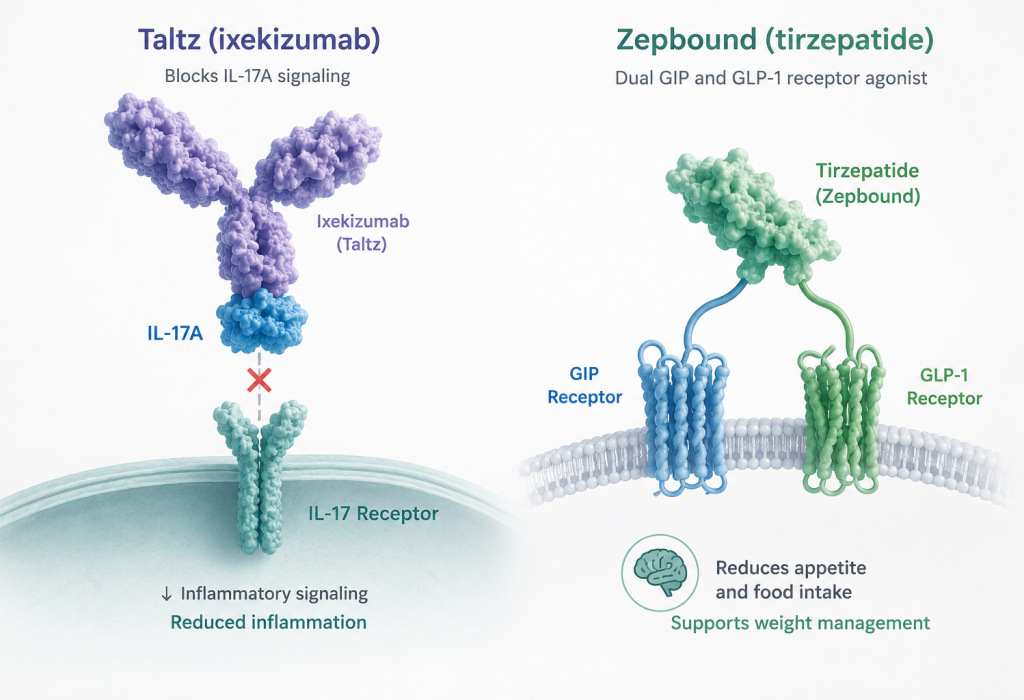
Taltz is an IL-17A monoclonal antibody that blocks IL-17A interaction with its receptor, reducing downstream inflammatory signaling. Zepbound is a dual GIP and GLP-1 receptor agonist that reduces appetite and food intake and is approved for chronic weight management in eligible adults.
Beyond disease-specific endpoints, combination therapy produced deeper improvements in hsCRP, a marker of systemic inflammation. BMI, blood pressure, glucose, HbA1c, triglycerides and total cholesterol also remained improved or improved further through one year compared with Taltz alone.
Trial Design and Safety
TOGETHER-PsO enrolled 274 adults with moderate-to-severe plaque psoriasis, while TOGETHER-PsA enrolled 271 adults with active psoriatic arthritis. Both were randomized, multicenter, assessor-blinded, open-label Phase 3b studies. Participants received subcutaneous Taltz alone or Taltz plus Zepbound and also received counselling on reduced-calorie diet and increased physical activity.
Adverse events with combination treatment were generally mild to moderate and consistent with the known safety profiles of the individual medicines. Events reported in at least 5% of participants included nausea, diarrhea, constipation, injection-site reactions, vomiting, dizziness and headache. No new safety concerns emerged at one year.
Implications for Immunometabolic Care
Lilly’s immunology development leadership said the one-year findings support evaluating psoriatic disease and obesity together rather than treating the conditions as disconnected problems. External expert Joseph Merola noted that the early PsA improvements preceded clinically meaningful weight loss and that sustained PASI 100 responses in psoriasis point to durable skin benefits alongside metabolic improvements.
The findings add clinical evidence to the emerging concept of immunometabolic management, but the Week 52 analyses remain exploratory and descriptive. Detailed results from both trials are expected at future medical meetings and in peer-reviewed publications.
Reference

About the Writer
Saniya Sanjay Katakdhond (Linkedin) is a Doctor of Pharmacy professional with hands-on experience in patient case review, clinical documentation, medical record analysis, and patient care.
Her hospital experience has strengthened her understanding of clinical conditions, treatment approaches, and multidisciplinary healthcare practices.
With ICH-GCP certification and a research-oriented approach, she brings clinical insight and attention to detail to healthcare content development.
As a healthcare writer, Saniya focuses on translating clinical knowledge and patient-care experience into clear, accurate, and evidence-informed medical content.