
Alnylam’s ESC 2026 data show consistent vutrisiran benefit in ATTR-CM regardless of baseline tafamidis use, alongside new zilebesiran findings
Written By: Siddhi Bhadekar, M. Pharm (QA)
Reviewed By: Pharmacally Editorial Team
New data presented by Alnylam Pharmaceuticals at the European Society of Cardiology (ESC) Congress 2026 on August 30 highlight the clinical profile of AMVUTTRA® (vutrisiran) across transthyretin amyloidosis with cardiomyopathy (ATTR-CM), while additional findings support continued development of zilebesiran for uncontrolled hypertension.
HELIOS-B Analysis Shows Consistent Vutrisiran Benefit with or Without Tafamidis
A late-breaking, prespecified subgroup analysis of the Phase 3 HELIOS-B trial (NCT04153149) evaluated vutrisiran’s treatment effect according to baseline tafamidis use. Results were simultaneously published in the Journal of the American College of Cardiology.
Among 654 randomized and treated patients, 259 (40%) were receiving tafamidis at baseline. Vutrisiran’s effect on the primary composite endpoint of all-cause mortality and recurrent cardiovascular events through 33-36 months was consistent regardless of baseline tafamidis use. However, HELIOS-B was not powered to establish benefit specifically in patients receiving tafamidis.
Vutrisiran also preserved functional capacity, measured by the Six-Minute Walk Test, in both populations. Health status improved with vutrisiran in both groups, although the effect was attenuated among patients receiving tafamidis at baseline. Safety outcomes were generally similar between combination vutrisiran plus tafamidis and tafamidis alone, and between vutrisiran monotherapy and placebo.
Additional Analyses Highlight Multisystemic ATTR-CM Burden
Real-world data from the French National Health Data System showed that patients with ATTR-CM had a significantly greater burden of extra-cardiac manifestations across multiple organ systems than matched controls. Multiple manifestations were recorded years before ATTR-CM identification and tended to accumulate over time, suggesting a prolonged pre-diagnostic phase.
A post hoc HELIOS-B analysis found that vutrisiran-treated patients experienced 25% less decline in intrinsic capacity from baseline and a 52% reduction in the risk of decline versus placebo. The measure incorporates locomotion, cognition, vitality, psychological well-being, and sensory function.
A separate post hoc safety analysis found fewer adverse events overall with vutrisiran. Gastrointestinal and nervous system disorders occurred at 42% and 41% lower rates, respectively, while eye disorders occurred at a 46% lower rate versus placebo.
Pooled Analysis Shows Consistent Effects Across Sexes
A pooled analysis of 1,402 patients across four Phase 3 studies of vutrisiran and patisiran, including 203 females and 1,199 males, found consistent treatment effects between females and males across ATTR-CM and hereditary ATTR polyneuropathy. Benefits were observed across clinical, biomarker, functional, health-status, and echocardiographic measures despite sex-specific baseline differences.
KARDIA-3 Findings Support Further Zilebesiran Evaluation
A subgroup analysis from the Phase 2 KARDIA-3 study (NCT06272487) evaluated zilebesiran in patients with uncontrolled hypertension and high cardiovascular risk receiving at least two background antihypertensives.
Among patients receiving a background diuretic with baseline office systolic blood pressure of at least 140 mmHg, zilebesiran produced greater reductions in office and 24-hour ambulatory systolic blood pressure than in the overall study population. Reductions extended across the diurnal cycle, including nighttime blood pressure, with similar findings among patients with impaired nocturnal dipping.
The findings further support evaluation of zilebesiran in the ongoing global Phase 3 ZENITH cardiovascular outcomes trial (NCT07181109).
RNAi Approach Targets Disease Drivers
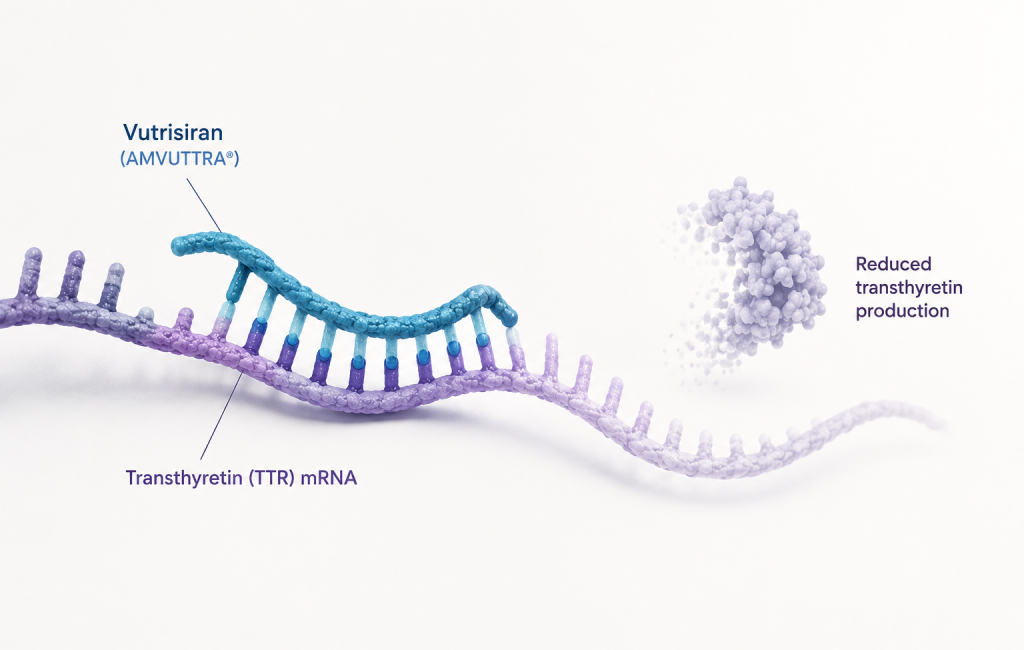
AMVUTTRA silences hepatic production of transthyretin at the mRNA level, reducing the protein that forms amyloid deposits in organs including the nerves, heart, and gastrointestinal tract. It is administered subcutaneously once every three months and is approved for both hATTR-PN and ATTR-CM in countries globally.
Zilebesiran targets angiotensinogen, the most upstream precursor in the renin-angiotensin-aldosterone system, with the potential to provide continuous blood pressure control with biannual dosing.
In the EU, AMVUTTRA is indicated for adults with stage 1 or 2 hATTR-PN and for wild-type or hereditary ATTR-CM. Vutrisiran can lower serum vitamin A levels, and supplementation of approximately 2,500 to 3,000 IU daily is advised. Zilebesiran remains investigational, with its safety and efficacy not yet established by regulatory authorities.
Reference

About the Writer
Siddhi Rajendra Bhadekar (Linkedin) is an M.Pharm professional with expertise in medical and scientific writing, literature review, publication writing, and evidence synthesis, supported by four peer-reviewed publications.
She brings working knowledge of ICH-GCP, MedDRA, pharmacovigilance, ADR/AE reporting, clinical data management, and regulatory documentation.
With experience across pharmaceutical R&D, Quality Control, and Quality Assurance, she combines scientific research skills with strong attention to accuracy and detail.
Her background in manuscript development, publication planning, and scientific communication enables her to translate complex healthcare information into clear, reliable content.