
Quoin reports positive interim results for QRX003 in Netherton Syndrome, with significant improvements in IGA and Global Impression of Change.
Written By – Anshu Gupta PharmD
Reviewed By – Pharmacally Editorial Team
Quoin Pharmaceuticals Ltd. has reported positive interim results from the ongoing Phase 2/3 study (NCT07538583) CL-QRX003-004 evaluating QRX003 4% lotion in patients with Netherton Syndrome. The interim analysis included the first six participants to complete 12 weeks of treatment. Both the primary endpoint and key secondary endpoint reached statistical significance against the pre-specified interim threshold.
Disease and Mechanism Context
Netherton Syndrome is a rare, serious genetic skin disease caused by mutations in the SPINK5 gene. It is characterized by impaired skin barrier function, persistent inflammation, and increased serine protease activity in the skin. Quoin states that there are currently no approved therapies in the United States specifically indicated for Netherton Syndrome.
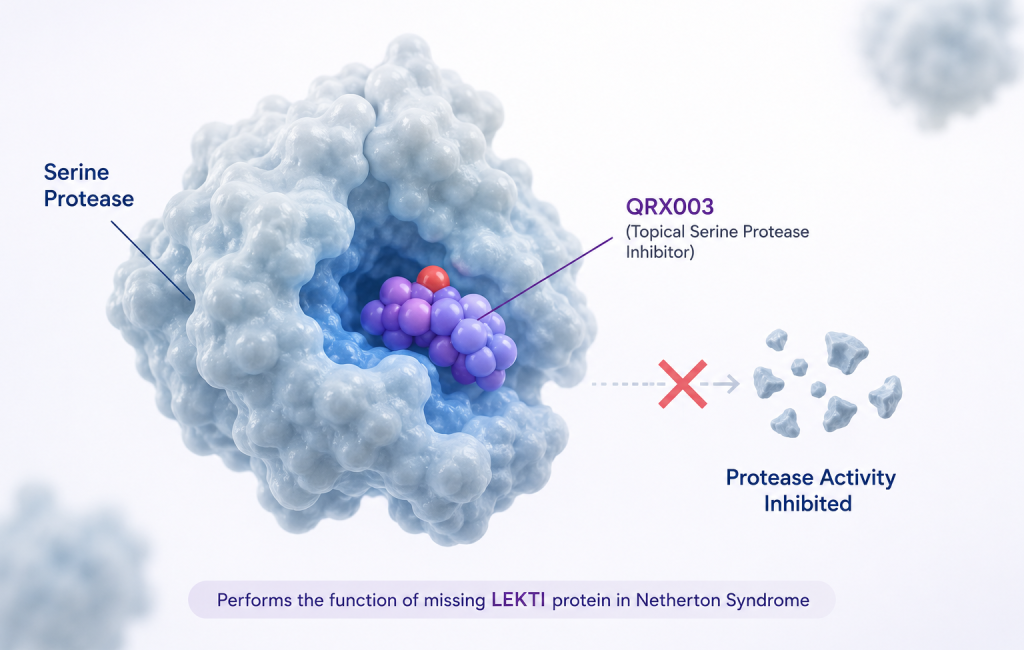
QRX003 is an investigational topical broad-spectrum serine protease inhibitor designed to perform the function of the missing LEKTI protein associated with SPINK5 mutations in Netherton Syndrome. By downregulating excessive kallikrein activity, the treatment is intended to help normalize the skin-shedding process and strengthen the skin barrier.
Primary Endpoint Met at Week 12
The primary endpoint assessed the proportion of participants achieving a one-grade or greater improvement from baseline in Investigator Global Assessment (IGA) across the entire treatment area at Week 12.
Four of six participants, or 66.67%, achieved the target. The result had a p = 0.0087 compared with the pre-specified interim alpha of 0.0215. The 95% confidence interval was 22.28% to 95.67%. Among the four participants who met the endpoint, two achieved a two-grade or greater improvement in IGA.
Global Impression of Change (Global Statistical Test)
The key secondary endpoint, the Global Statistical Test of Global Impression of Change, also reached statistical significance at Week 12. The six participants recorded a mean change of -1.5, with a standard deviation of 0.82 and a 95% confidence interval of -2.3 to -0.6. The p = 0.0070, below the pre-specified interim alpha of 0.0215.
Improvements in Disease Severity and Pruritus
Disease severity was also assessed using the Ichthyosis Area and Severity Index (IASI). After 12 weeks of treatment, reductions in severity ranging from 31% to 87% from baseline were recorded. Four of six participants achieved a greater than 25% reduction in IASI severity. These were the same four participants who met the primary IGA endpoint.
Pruritus was assessed using the Worst Itch Numeric Rating Scale (WI-NRS). Three of six participants achieved a three-grade or greater improvement from baseline at Week 12, representing 50% of the interim cohort. The responder analysis had a p = 0.0623.
All three participants who had moderate-to-severe pruritus at baseline achieved a clinically meaningful three-grade or greater improvement after 12 weeks of treatment. One participant recorded an improvement of greater than six grades.
Safety Profile
QRX003 4% lotion, applied twice daily, was reported to be well tolerated. No deaths or treatment-related serious adverse events were reported, and no clinically significant abnormalities in electrocardiograms, clinical laboratory assessments, or vital signs were identified.
Study Design and Next Steps
CL-QRX003-004 is a multicenter, baseline-controlled, open-label Phase 2/3 study evaluating the safety, tolerability, and efficacy of QRX003 4% lotion. The treatment is applied twice daily to the body excluding the scalp. The study is designed to enroll approximately 20 evaluable participants aged four years and older across sites in the United States and United Kingdom.
Participants receive treatment for 12 weeks, followed by a four-week post-treatment End of Study visit. The study requires participants to discontinue standard-of-care topical and systemic prescription therapies during treatment. The interim cohort comprised three male and three female participants aged 11 to 52 years.
Quoin expects to complete recruitment by the end of 2026 and report topline data in the second quarter of 2027. These findings remain interim and are based on the first six participants to complete 12 weeks of treatment.
Regulatory Status and Path Forward
QRX003 is in late-stage development for Netherton Syndrome and other orphan skin diseases. The program has received Orphan Drug, Rare Pediatric Disease, and Fast Track designations from the U.S. FDA, as well as Orphan Drug Designation in the European Union and Japan.
If approved, QRX003 could become the first FDA-approved treatment specifically for Netherton Syndrome.
Reference
About the Writer
Anshu Gupta (LinkedIn) is a PharmD professional and healthcare writer with interests in clinical research, pharmacovigilance, regulatory affairs, and medical writing. She has presented research at academic conferences and completed certifications in Good Clinical Practice (GCP), ICH-GCP, and drug safety. Passionate about clinical trials and evidence-based medicine, she is committed to translating scientific evidence into accurate, reliable, and accessible healthcare content.