
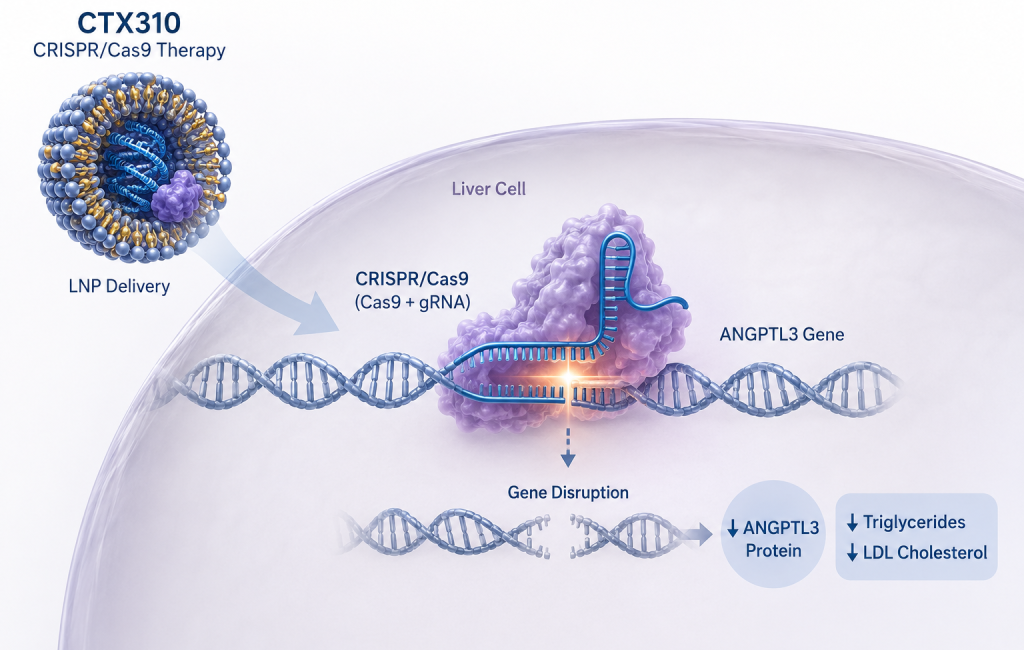
CRISPR Therapeutics’ CTX310 showed durable ANGPTL3 editing and sustained triglyceride and LDL-C reductions through one year in Phase 1a.
Written By: Mayuresh Salvi, PharmD
Reviewed By: Pharmacally Editorial Team
CRISPR Therapeutics’ investigational in vivo CRISPR/Cas9 therapy CTX310 produced sustained reductions in ANGPTL3, triglycerides, and LDL cholesterol through one year after a single intravenous infusion, supporting continued development of a one-time gene-editing approach for dyslipidemia.
One-Year Data Strengthen CTX310’s Durability Signal
CRISPR Therapeutics presented one-year Phase 1a data (NCT07491172) for CTX310 at the 2026 European Society of Cardiology (ESC) Congress, showing that a single infusion continued to suppress circulating ANGPTL3 and lower key lipid measures through 12 months.
At the highest dose of 0.8 mg/kg, mean ANGPTL3 levels fell 79% from baseline, with a maximum reduction of 89%. Mean triglyceride levels declined 48%, reaching a maximum reduction of 78%, while LDL cholesterol fell 53%, with a maximum reduction of 84%.
The findings were published simultaneously in The New England Journal of Medicine in an article titled “Durability of CRISPR-Cas9 Gene Editing Targeting ANGPTL3 with CTX310.”
Targeting ANGPTL3 With In Vivo Gene Editing
CTX310 uses CRISPR/Cas9 gene editing delivered through a proprietary lipid nanoparticle (LNP) platform to disrupt the ANGPTL3 gene in the liver.
ANGPTL3 regulates lipid metabolism, making it an attractive target for therapies intended to produce sustained reductions in circulating triglycerides and LDL cholesterol. Unlike conventional lipid-lowering medicines that require ongoing administration, gene editing could potentially produce a lasting biological effect after a single treatment.
The approach is being evaluated across dyslipidemia populations including heterozygous and homozygous familial hypercholesterolemia, severe hypertriglyceridemia, and mixed dyslipidemia.
Phase 1a Evaluated Escalating Doses Across Multiple Dyslipidemias
The open-label, dose-escalation Phase 1a study evaluated a single intravenous course of CTX310 at lean-body-weight-based doses of 0.1, 0.3, 0.6, 0.7, and 0.8 mg/kg.
The 15 participants had homozygous familial hypercholesterolemia (HoFH), heterozygous familial hypercholesterolemia (HeFH), severe hypertriglyceridemia, or mixed dyslipidemia. Eligible participants had uncontrolled triglyceride levels above 150 mg/dL and/or LDL-C above 100 mg/dL, or above 70 mg/dL in those with established atherosclerotic cardiovascular disease (ASCVD), despite background standard-of-care therapy.
Most participants were receiving statins and/or ezetimibe, while 40% were taking PCSK9 inhibitors.
Safety and tolerability were the primary endpoints, with changes in circulating ANGPTL3, triglycerides, and LDL-C assessed as secondary endpoints. Dose-dependent reductions in circulating ANGPTL3 were observed at higher dose levels, with the strongest effects at 0.8 mg/kg.
Lipid Lowering Persisted Through One Year
All 15 participants completed at least one year of follow-up at the data cutoff. The reductions in circulating ANGPTL3 persisted through one year following CTX310 infusion.
Among participants treated at 0.8 mg/kg, ANGPTL3 fell by a mean 79% from baseline and by as much as 89%. Triglycerides declined by a mean 48%, with a maximum reduction of 78%, while LDL-C decreased by a mean 53%, reaching a maximum reduction of 84%.
The findings provide evidence that the biological effect of a single CTX310 infusion can persist for at least one year. However, the Phase 1a study was small and was not designed to establish cardiovascular outcome benefits.
Safety Remained Stable During Extended Follow-Up
CTX310 was generally well tolerated, with no treatment-related serious adverse events or dose-limiting toxicities. Adverse events were generally mild to moderate.
Three participants experienced Grade 2 infusion-related reactions, including two at 0.6 mg/kg and one at 0.8 mg/kg. One participant previously experienced an allergic reaction that resolved the following day with supportive care.
A transient aminotransferase elevation occurred shortly after treatment in one participant. No Grade 3 or higher liver transaminase elevations were reported, and no new treatment-related safety events emerged during extended follow-up.
Phase 1b Advances into Severe Hypertriglyceridemia
The Phase 1b portion of the program is evaluating a fixed flat dose of CTX310 equivalent to the most efficacious Phase 1a dose of 0.8 mg/kg.
The study is advancing CTX310 in severe hypertriglyceridemia (sHTG), with CRISPR Therapeutics expecting to provide an additional clinical update in the second half of 2026.
Beyond CTX310, the company is developing CTX340, an in vivo gene-editing therapy targeting angiotensinogen (AGT) for refractory hypertension, and CTX321, which targets LPA in patients with elevated lipoprotein(a). It is also advancing CTX460, a SyNTase-based program targeting SERPINA1 for alpha-1 antitrypsin deficiency.
Reference

About the Writer
Mayuresh Sunil Salvi (Linkedin) is a PharmD professional and healthcare writer with a strong interest in pharmacovigilance, drug safety, and emerging medical research. He is passionate about exploring new drug discoveries, clinical research, and advances in evidence-based medicine. His interests also include ward rounds, prescription audits, and treatment analysis to support rational pharmacotherapy and improved patient care.