
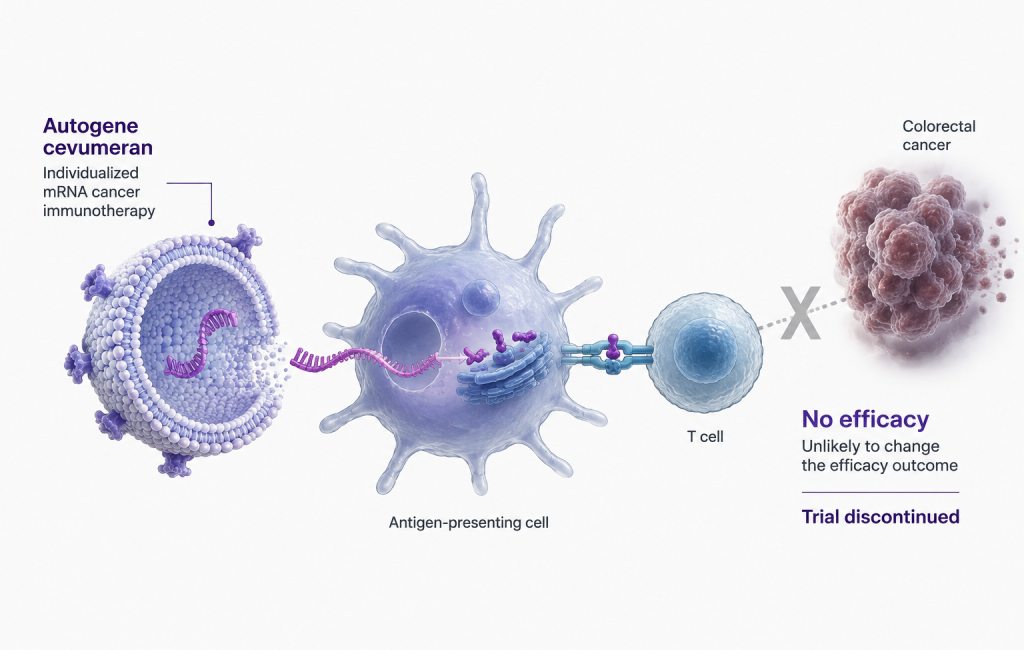
BioNTech terminates the Phase 2 BNT122-01 trial of autogene cevumeran in high-risk colorectal cancer after a DSMB review found further continuation unlikely to change efficacy.
Written By: Mansi Nakum, PharmD
Reviewed By: Pharmacally Editorial Team
BioNTech has stopped the Phase 2 BNT122-01 trial (NCT04486378) evaluating autogene cevumeran (BNT122/RO7198457), an investigational individualized mRNA cancer immunotherapy, as adjuvant monotherapy in patients with circulating tumor DNA (ctDNA)-positive, surgically resected Stage II high-risk or Stage III colorectal cancer (CRC).
The decision followed a new review by the trial’s independent Data Safety Monitoring Board (DSMB), which identified a numerical imbalance in overall survival between treatment arms and concluded that further continuation was unlikely to change the efficacy outcome. The DSMB recommended discontinuing treatment and terminating the study.
The review identified no new safety signals related to autogene cevumeran.
Trial Focused on Molecular Residual Disease
BNT122-01 evaluated whether autogene cevumeran could reduce the risk of disease recurrence when given after surgery as a monotherapy, compared with watchful waiting, the current standard of care for the studied population.
The trial enrolled patients with detectable ctDNA following surgical resection. Persistent ctDNA can indicate molecular residual disease and identifies patients at elevated risk of subsequent cancer recurrence, making this population particularly relevant for adjuvant treatment strategies.
CRC remains a challenging setting for immunotherapy. Most colorectal tumors are considered immunologically “cold” and have historically shown limited responsiveness to immune-based treatments. Patients with high-risk disease also face substantial risk of metastatic relapse despite curative-intent surgery.
Futility Boundary Had Been Crossed in 2025
The latest DSMB recommendation follows an earlier futility assessment. In October 2025, the trial crossed its predefined futility boundary.
At that time, however, the DSMB determined that the available data were not sufficiently mature to support reliable conclusions about efficacy and that follow-up was too short to adequately evaluate the primary endpoint. Because there were no safety concerns and the DSMB raised no objection to continued follow-up, BioNTech continued the trial according to protocol.
With additional data now available, the DSMB concluded that further continuation was unlikely to alter the efficacy outcome. BioNTech subsequently informed investigators and relevant regulatory authorities and moved to terminate the study.
Implications for Individualized mRNA Immunotherapy
Autogene cevumeran is an individualized mRNA cancer immunotherapy being developed jointly by BioNTech and Genentech, a member of the Roche Group. Rather than treating CRC with an off-the-shelf immunotherapy, the program uses an individualized approach tailored to the patient’s tumor.
For BioNTech, the negative outcome in CRC monotherapy provides information about the challenges of applying mRNA immunotherapy in tumors characterized by limited immune responsiveness and immune-suppressive microenvironments.
Özlem Türeci, M.D., BioNTech’s co-founder and chief medical officer, said the result will help inform patient-selection strategies and the further development of investigational mRNA cancer immunotherapies. The company remains committed to mRNA as a core component of its oncology strategy, including novel combination approaches.
Pancreatic Cancer Program Continues
BioNTech will conduct a detailed analysis of the BNT122-01 data, with the goal of assessing patient-selection factors and informing future clinical development. The company plans to share the trial results with the scientific and medical community at an appropriate time.
The termination does not affect the Phase 2 IMcode003 trial (NCT05968326), which is evaluating autogene cevumeran in combination with checkpoint inhibition and chemotherapy in the adjuvant setting for pancreatic ductal adenocarcinoma (PDAC). That study continues as planned.
Reference

About the Writer
Mansi Nakum (Linkedin) is a Pharm.D professional with a strong foundation in clinical pharmacy, evidence-based healthcare writing, and clinical data interpretation.
She has published work on Brugada syndrome and has a keen interest in guideline integration, multimodal therapy, pharmacogenomics, and antibiogram utilization.
As a healthcare writer, she focuses on translating clinical evidence into clear, accurate, and clinically relevant content, while continuously developing her expertise in evolving pharmacy practice.