
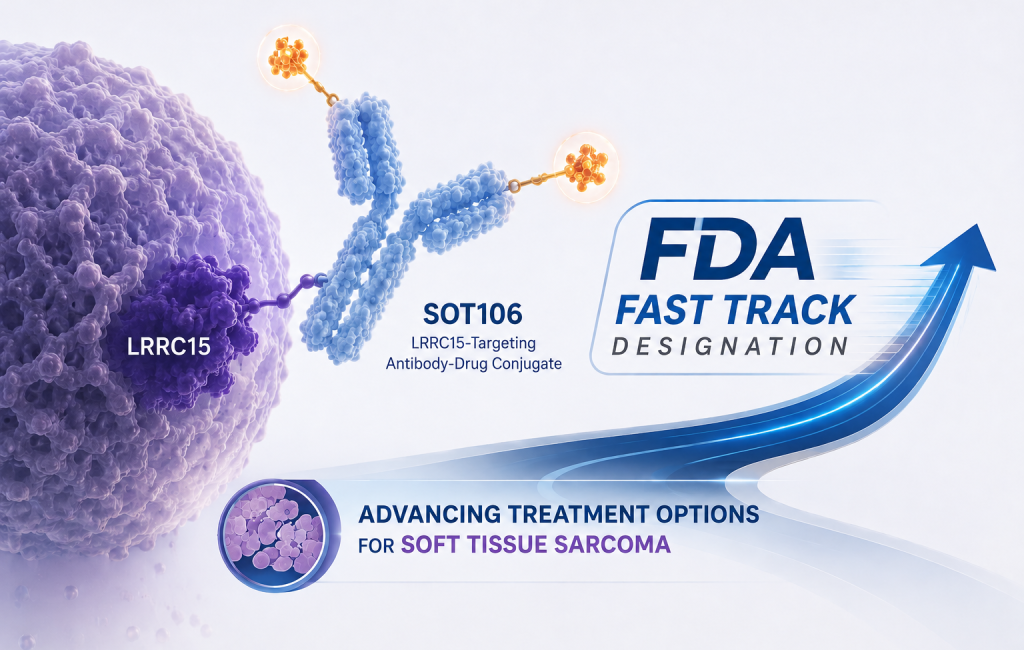
SOTIO’s SOT106, an LRRC15-targeting ADC, receives FDA Fast Track Designation for soft tissue sarcoma ahead of its planned Phase 1 trial.
Written By: Shreya Desai, PharmD
Reviewed By: Pharmacally Editorial Team
The U.S. Food and Drug Administration (FDA) has granted Fast Track Designation to SOT106, an investigational antibody-drug conjugate (ADC) targeting leucine-rich repeat-containing protein 15 (LRRC15), for the treatment of soft tissue sarcoma (STS). The designation supports accelerated regulatory interaction for a program targeting a heterogeneous group of cancers with limited treatment options in advanced or recurrent disease.
FDA Fast Track Supports SOT106 Development
Fast Track status provides opportunities for more frequent interactions with the FDA during development and can support rolling review of a marketing application and potential Priority Review if applicable criteria are met.
SOT106 remains in preclinical development, with SOTIO Biotech expecting to initiate a first-in-human Phase 1 trial later this year. The study will provide the first clinical assessment of the ADC’s safety, tolerability, pharmacokinetics, and preliminary antitumor activity.
ADC Construct Targets LRRC15-Expressing Tumors
Developed in partnership with LigaChem Biosciences, SOT106 combines SOTIO’s anti-LRRC15 antibody with LigaChem’s ConjuAll™ ADC platform and a monomethyl auristatin E (MMAE) payload, a microtubule inhibitor.
The ADC is intended to bind LRRC15-expressing cells and deliver the cytotoxic payload following target engagement. This approach could concentrate drug exposure within tumors while limiting exposure to non-target tissues, although the clinical therapeutic window remains to be established.
LRRC15 is expressed across multiple sarcoma histologies and is also found in the stromal compartment of several solid tumors. Its broad distribution provides a biological rationale for evaluating SOT106 across multiple STS subtypes rather than restricting development to a single histology.
Preclinical Data Support Clinical Translation
Human efficacy and safety data for SOT106 are not yet available. In preclinical studies, including patient-derived xenograft (PDX) models with low LRRC15 expression, SOT106 demonstrated tumor regression, in vivo stability, and an encouraging therapeutic window.
These findings provide the preclinical rationale for advancing the program into human testing. Clinical studies will determine whether the observed antitumor activity translates into meaningful responses while maintaining acceptable tolerability.
The program has already secured FDA Orphan Drug Designation for osteosarcoma, extending its potential development strategy beyond broader STS populations. SOT106 also represents SOTIO’s second ADC program to receive Fast Track Designation, following SOT109, an investigational CDH17-targeting ADC for colorectal cancer.
SOT106 Moves Toward First-in-Human Testing
Vivi Boura, M.D., chief medical officer of SOTIO, said the Fast Track designation represents an important regulatory milestone for SOT106 as the company advances the program toward clinical testing in difficult-to-treat sarcomas.
The upcoming Phase 1 study will be the key test of whether SOT106’s LRRC15-targeting strategy can translate its preclinical activity into a clinically meaningful therapeutic effect. Dose escalation will establish the safety profile and help identify an appropriate dose for subsequent studies, while pharmacokinetic and early efficacy assessments will provide the first evidence of how the ADC performs in patients.
With clinical initiation expected later this year, SOT106 is moving from preclinical validation into the first stage of human development. The resulting safety and antitumor data will determine whether the program can advance toward broader evaluation across LRRC15-expressing sarcoma populations.
Reference

About the Writer
Shreya Desai is a Doctor of Pharmacy professional with a strong academic record, having secured Rank 1 for three consecutive years, and a keen interest in clinical writing, clinical research, regulatory affairs, and pharmacovigilance.
With experience in medical communication and scientific writing, she brings strong research aptitude, scientific acumen, and effective communication skills to healthcare content development.
As a Pharmacally healthcare writer, Shreya focuses on creating clear, accurate, evidence-based medical content while translating complex scientific information into meaningful healthcare communication.