
U.S. and German real-world data show sustained disease stabilization and consistent safety with MIPLYFFA (arimoclomol) in Niemann-Pick disease type C.
Written By: Mansi Nakum, PharmD
Reviewed By: Pharmacally Editorial Team
Zevra Therapeutics presented long-term real-world data supporting sustained disease stabilization with MIPLYFFA (arimoclomol) in Niemann-Pick disease type C (NPC), including patients treated through U.S. and German early access programs for up to eight years. The findings add longer-term evidence on disease control and safety across a broad NPC population.
U.S. Data Show Sustained Disease Stability
The U.S. Expanded Access Program analysis (NCT04316637) found minimal changes in disease severity over four years, measured using the Niemann-Pick disease type C Clinical Severity Scale (NPCCSS).
Among 78 patients, mean NPCCSS scores remained essentially unchanged at year 1, at 11.2 versus 11.1 at baseline. Among 20 patients with four-year follow-up, scores remained 11.6 at both baseline and year 4.
Stabilization was consistent across age groups. At year 3, mean scores were 10.7 versus 10.8 at baseline in children and 10.7 versus 10.2 in adults.
Children aged 2 to 19 years receiving arimoclomol plus miglustat also maintained broadly stable scores. Among 27 children, mean NPCCSS scores were 9.7 at baseline and 9.1 at year 1. Among the four children with four-year data, scores were 10.0 versus 10.3.
The findings align with the pivotal phase 3 study (NCT02612129), where mean NPCCSS scores increased by 0.76 points with arimoclomol versus 2.15 points with placebo over 12 months. The company characterized this difference as a 65% reduction in disease progression.
German Experience Extends to Eight Years
The German Compassionate Use Programme included 48 people with NPC aged 2 to 63 years. Nearly half, 45.8%, started treatment as adults. Mean treatment exposure was three years, while individual exposure extended to eight years. Most participants, 46 of 48 (95.8%), received arimoclomol with miglustat.
Twenty-one participants discontinued treatment. Ten discontinued after enrolling in other clinical trials and five died. None discontinued because of arimoclomol-related adverse events.
Some participants experienced rapid clinical deterioration after stopping arimoclomol and subsequently restarted treatment. The observation supports the potential importance of treatment continuity, although the available source does not establish that deterioration was reversed after treatment was restarted.
Arimoclomol Activates Lysosomal Clearance Pathways
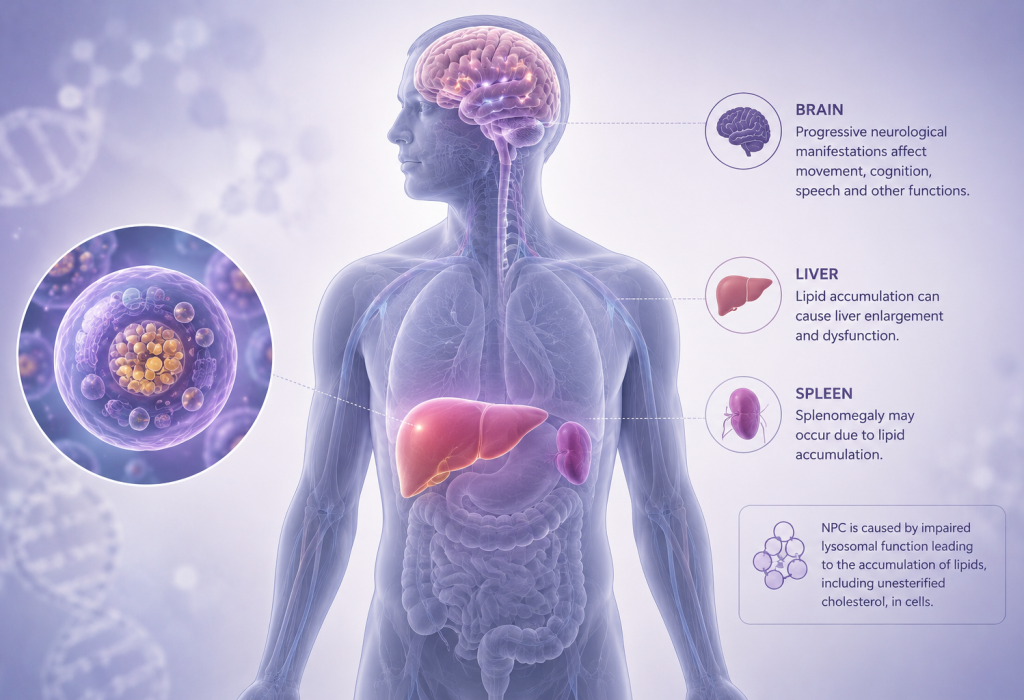
NPC is a rare, progressive lysosomal disorder caused by impaired intracellular lipid trafficking, leading to lipid accumulation and progressive neurological impairment.
Arimoclomol increases activation of the transcription factors TFEB and TFE3, which upregulate coordinated lysosomal expression and regulation (CLEAR) genes. The drug has also reduced unesterified cholesterol in lysosomes of human NPC fibroblasts in vitro. However, the direct clinical contribution of this cholesterol-lowering effect remains unconfirmed.
FDA Approval and European Regulatory Setback
The FDA approved MIPLYFFA in September 2024 in combination with miglustat for the treatment of neurological manifestations of NPC in adults and pediatric patients 2 years of age and older.
The European regulatory picture is now less favorable. On July 23, 2026, the European Medicines Agency’s Committee for Medicinal Products for Human Use recommended refusing marketing authorization for Meplyffa (arimoclomol). The agency cited uncertainty over the robustness of the efficacy evidence and noted that no benefit was demonstrated for ambulation and cognition. Zevra Denmark may request re-examination of the opinion within 15 days.
The EMA decision does not affect the U.S. approval and should be considered separately from the encouraging long-term real-world data presented at SSIEM.
The latest findings add to more than five years of patient experience involving more than 270 people with NPC across clinical trials, an open-label extension (NCT03062735), expanded access programs, and a pediatric sub-study. The U.S. and German datasets provide additional evidence on long-term treatment in a disease where sustained neurological stabilization remains a central clinical objective.
Reference

About the Writer
Mansi Nakum (Linkedin) is a Pharm.D professional with a strong foundation in clinical pharmacy, evidence-based healthcare writing, and clinical data interpretation.
She has published work on Brugada syndrome and has a keen interest in guideline integration, multimodal therapy, pharmacogenomics, and antibiogram utilization.
As a healthcare writer, she focuses on translating clinical evidence into clear, accurate, and clinically relevant content, while continuously developing her expertise in evolving pharmacy practice.