
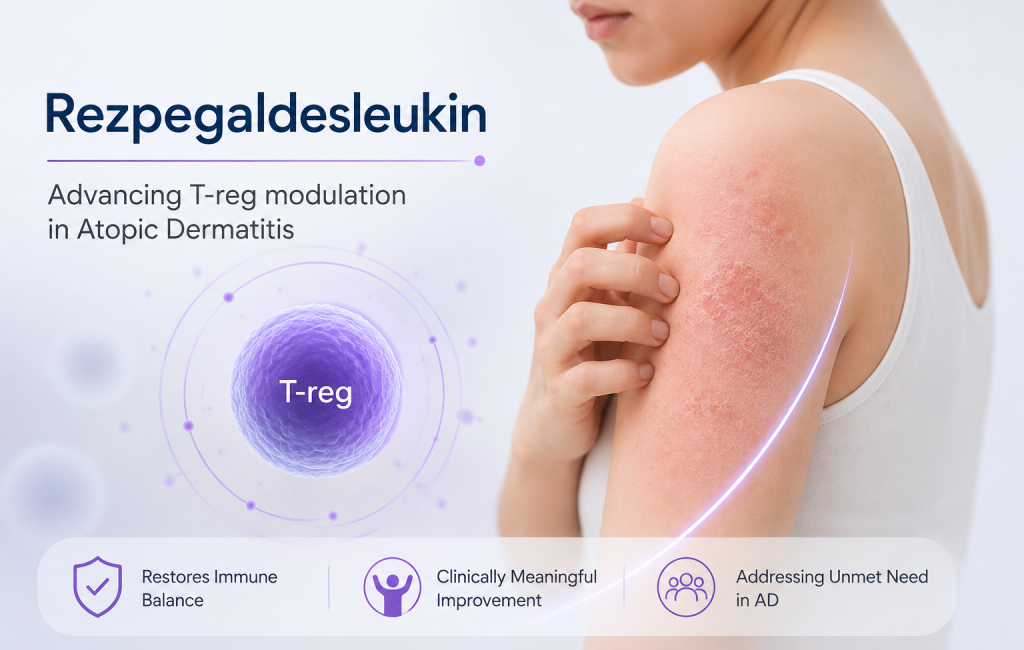
Rezpegaldesleukin met primary and key secondary endpoints in the Phase 2b REZOLVE-AD trial, supporting T-reg modulation in atopic dermatitis.
Written By: Meghana Jinka, PharmD
Reviewed By: Pharmacally Editorial Team
Nektar Therapeutics’ rezpegaldesleukin met the primary and key secondary endpoints in the 16-week induction period of the Phase 2b REZOLVE-AD trial (NCT06136741) in adults with moderate-to-severe atopic dermatitis, with the 24 μg/kg every-two-weeks regimen producing a 61% mean reduction in EASI versus 31% with placebo. The peer-reviewed findings, published in The Lancet, strengthen the clinical case for regulatory T-cell modulation and support ongoing Phase 3 development.
Broad Efficacy Across Physician and Patient Measures
REZOLVE-AD randomized 393 biologic- and JAK inhibitor-naive adults across 107 sites in 10 countries to rezpegaldesleukin 24 μg/kg every two weeks, 18 μg/kg every two weeks, 24 μg/kg every four weeks, or placebo.
All three active regimens significantly improved the primary endpoint, mean percent change from baseline in EASI at Week 16. Reductions were 61%, 58%, and 53% across the three dosing groups versus 31% with placebo, with p values of less than 0.0001, less than 0.0001, and 0.0002, respectively.
The 24 μg/kg every-two-weeks regimen also improved key secondary endpoints. EASI-75 was achieved by 42% of patients versus 17% with placebo, while EASI-90 responses were 25% versus 9%. vIGA-AD 0/1 responses reached 20% versus 8%, and 42% achieved a four-point improvement in Itch NRS compared with 16% on placebo. BSA also improved substantially, with a 54% reduction from baseline versus 17% for placebo.
Patient-reported outcomes showed similar trends. At Week 16, 72% of patients receiving the 24 μg/kg every-two-weeks regimen achieved at least a four-point DLQI improvement versus 54% with placebo. Improvements were also observed in ADCT, Pain NRS, and ADSS.
T-Reg Modulation Provides the Mechanistic Rationale
Rezpegaldesleukin activates the IL-2 receptor complex to preferentially expand regulatory T cells, or T-regs. Rather than directly blocking individual inflammatory cytokines, the approach seeks to restore immune regulation by increasing a cell population that helps maintain immune tolerance.
The trial showed EASI improvement as early as Week 2 in the 24 μg/kg dose groups, with responses continuing to deepen through Week 16. Biomarker analyses further supported the mechanism, showing dose-dependent reductions in TARC/CCL17, periostin, MDC/CCL22, and IL-19 among patients with elevated baseline levels.
Jonathan I. Silverberg, the study’s principal investigator, said the combination of rapid efficacy, consistent responses across disease severity, and a favorable safety profile supports the potential of selective T-reg expansion as a treatment strategy for atopic dermatitis.
Safety Profile Supports Phase 3 Progression
Safety findings remained consistent with the established profile of rezpegaldesleukin. Serious adverse events occurred in 2% of patients during the induction period, with no deaths and no increased risk of infections, conjunctivitis, or other safety signals commonly associated with approved AD therapies reported during the period.
The company has selected 24 μg/kg every two weeks for induction, followed by monthly and quarterly maintenance regimens, for the Phase 3 ZENITH AD program.
Phase 3 Program Advances
ZENITH AD-1 (NCT07690371) and ZENITH AD-2 (NCT07711418) began in July 2026 and are enrolling biologic- and systemic JAK inhibitor-naive patients. ZENITH AD-3 is expected to begin in September 2026 for patients with prior systemic biologic and/or JAK inhibitor exposure.
Nektar also plans to initiate a registrational Phase 3 trial in alopecia areata in early 2027, extending rezpegaldesleukin’s development into another immune-mediated disease. The REZOLVE-AD publication therefore provides both clinical evidence for the drug in atopic dermatitis and a broader validation of T-reg modulation as a potential therapeutic approach to chronic inflammatory disease.
Reference

About the Writer
Meghana Jinka (LinkedIn) is a Pharm.D graduate with a strong interest in clinical pharmacy, clinical research, pharmacovigilance, and medical writing. She has developed expertise in evaluating scientific literature, interpreting clinical data, and communicating complex medical information in a clear and accessible manner. Through clinical training, patient counseling, and healthcare awareness activities, she has gained practical experience in evidence-based medicine and patient-centered care. Passionate about healthcare communication, Meghana is committed to developing accurate, engaging, and evidence-based healthcare documents that support healthcare professionals and the wider community.