
Trastuzumab rezetecan extended median progression-free survival to 30.6 months in HER2-positive metastatic breast cancer in the phase 3 HORIZON-Breast01 trial.
Written By: Anamika Koshti, Pharm D
Reviewed By: Pharmacally Editorial Team
An interim analysis of the phase 3 HORIZON-Breast01 trial (NCT05424835), published in The Lancet Oncology, showed that the investigational HER2-directed antibody-drug conjugate (ADC) trastuzumab rezetecan (SHR-A1811) significantly improved progression-free survival (PFS) compared with pyrotinib plus capecitabine in patients with previously treated HER2-positive unresectable or metastatic breast cancer.
Trial Design and Population
HORIZON-Breast01 was a multicentre, open-label, randomised phase 3 trial conducted at 50 hospitals in China. The study enrolled patients aged 18 to 75 years with HER2-positive unresectable or metastatic breast cancer, measurable disease, ECOG performance status of 0 or 1, and previous treatment with trastuzumab and a taxane in the advanced setting or progression within 12 months of neoadjuvant or adjuvant anti-HER2 therapy.
For the primary analysis, 287 patients were randomly assigned to intravenous trastuzumab rezetecan 4.8 mg/kg every 3 weeks (n=142) or oral pyrotinib plus capecitabine (n=145). The primary endpoint was PFS assessed by blinded independent central review.
Efficacy Results
Median PFS was 30.6 months with trastuzumab rezetecan versus 8.3 months with pyrotinib plus capecitabine, corresponding to a hazard ratio of 0.22. At 12 months, 84.7% of patients receiving trastuzumab rezetecan remained progression-free compared with 35.5% in the control group.
The confirmed objective response rate was 81.7% versus 55.9%, while median duration of response was 27.8 versus 10.9 months, respectively. Overall survival data remained immature, with median overall survival not reached in either group. The interim overall survival hazard ratio was 0.31, favoring trastuzumab rezetecan.
Safety Profile
Trastuzumab rezetecan had a safety profile characterised primarily by hematologic toxicity. Grade 3 or higher decreases in neutrophil, white blood cell, and platelet counts occurred in 54%, 20%, and 11% of patients receiving trastuzumab rezetecan, compared with 9%, 3%, and 1% with pyrotinib plus capecitabine, respectively. Treatment-related serious adverse events occurred in 13% and 12% of patients.
Interstitial lung disease occurred in four patients (3%) receiving trastuzumab rezetecan. The interim publication reported a low overall incidence of ILD, with no indication that it was a predominant toxicity in the trial.
How Does Trastuzumab Rezetecan Work?
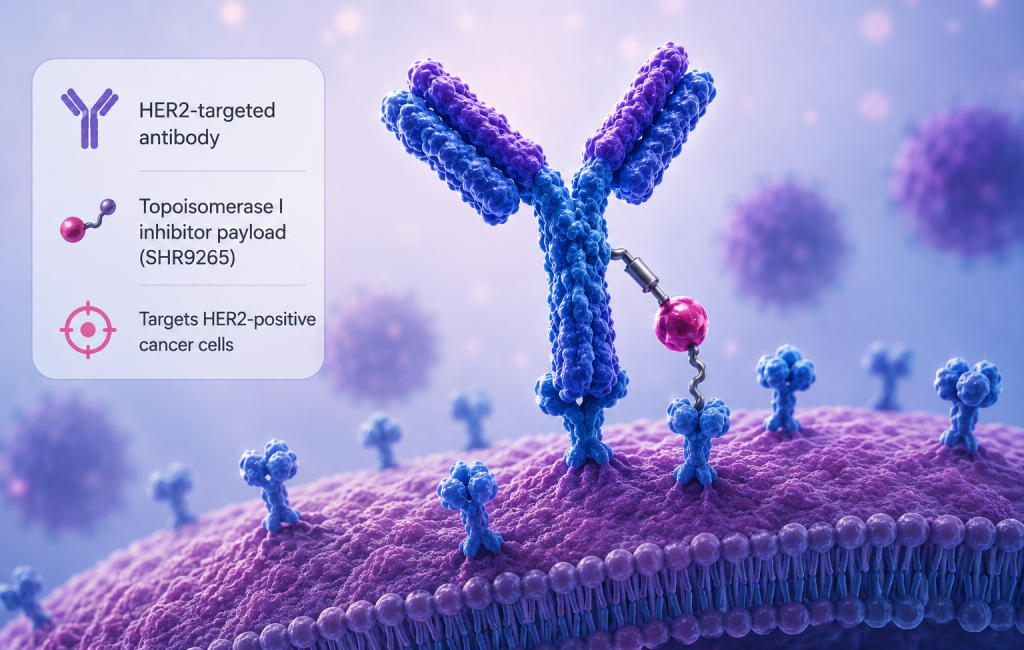
Trastuzumab rezetecan is a next-generation HER2-directed ADC designed to deliver a cytotoxic payload to HER2-expressing tumour cells. It contains a HER2-targeting antibody, a cleavable linker, and the DNA topoisomerase I inhibitor payload SHR9265.
The ADC is also being investigated in other HER2-driven cancers. In a separate phase 2 study of previously treated HER2-mutant non-small-cell lung cancer, trastuzumab rezetecan produced a confirmed objective response rate of 73%.
Clinical Context
Pyrotinib plus capecitabine is an established treatment option in China for previously treated HER2-positive advanced or metastatic breast cancer. HORIZON-Breast01 therefore provides evidence against this specific comparator and does not directly compare trastuzumab rezetecan with other HER2-directed therapies used in different treatment settings or regions.
The findings support further clinical and regulatory evaluation of trastuzumab rezetecan, although the drug remains investigational and longer follow-up is needed to assess overall survival and long-term safety. The trial was funded by Jiangsu Hengrui Pharmaceuticals, the drug’s developer.
What This Means for Patients
For patients with previously treated HER2-positive metastatic breast cancer, trastuzumab rezetecan produced substantially longer PFS and higher response rates than pyrotinib plus capecitabine in HORIZON-Breast01. The treatment also produced more hematologic toxicity, requiring appropriate monitoring.
Because the analysis is interim and the drug is not yet approved, these findings support further evaluation rather than establishing trastuzumab rezetecan as a new standard of care.
Reference
Yao H, et al. Trastuzumab rezetecan versus pyrotinib plus capecitabine for patients with HER2-positive metastatic breast cancer (HORIZON-Breast01): interim analysis of a multicentre, open-label, randomised, controlled, phase 3 trial. The Lancet Oncology. 2026;27(8):929-940. https://doi.org/10.1016/S1470-2045(26)00193-2

About the Writer
Anamika Koshti (LinkedIn) is a PharmD professional and healthcare writer with interests in clinical research, pharmacovigilance, and evidence-based medicine. She has authored peer-reviewed publications on Alzheimer’s disease and PCOS, presented research at national conferences, and gained hands-on experience in medical content development and clinical data interpretation. She is committed to translating complex medical research into accurate, accessible content for healthcare professionals and patients.