
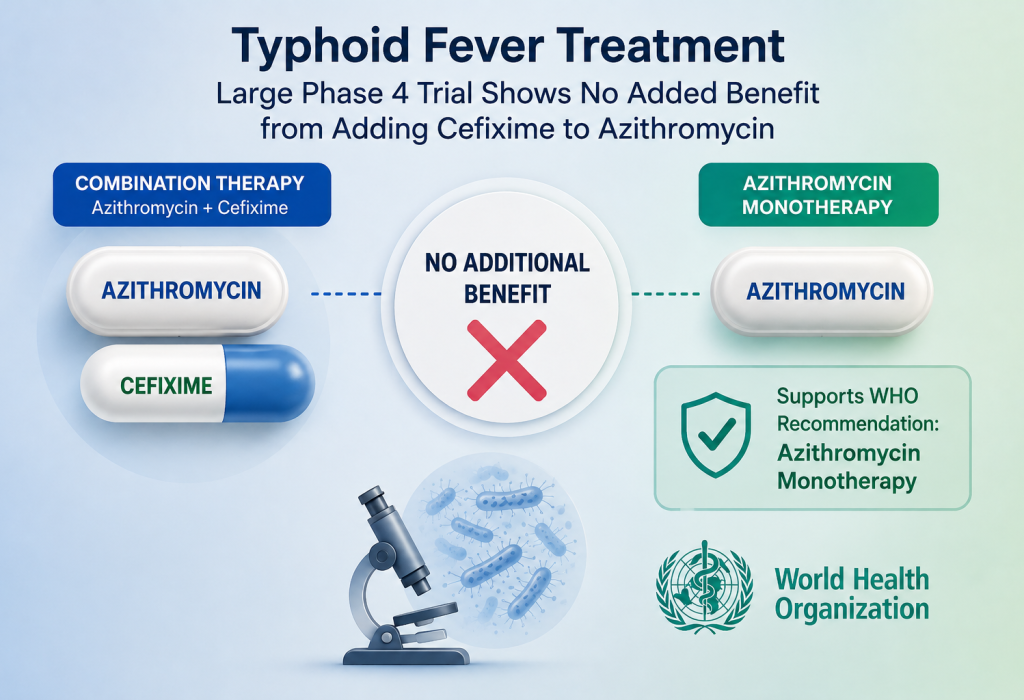
A phase 4 ACT-South Asia trial found adding cefixime to azithromycin did not reduce treatment failure in uncomplicated typhoid fever.
Written By: Anamika Koshti, PharmD
Reviewed By: Pharmacally Editorial Team
A phase 4 trial published in The Lancet Infectious Diseases has found that adding cefixime to azithromycin does not reduce treatment failure in patients with suspected or confirmed uncomplicated typhoid fever, compared with azithromycin alone. The ACT-South Asia trial, conducted across Nepal, Bangladesh, and Pakistan, is the largest study to test this combination and supports the World Health Organization’s existing recommendation of azithromycin monotherapy.
Why Researchers Tested the Combination?
Azithromycin and cefixime are both widely used for typhoid fever, yet each carries reported failure rates of 10 percent or higher. Because typhoid bacilli reside mainly inside cells while also circulating in the bloodstream and bone marrow, researchers hypothesized that azithromycin’s intracellular activity paired with cefixime’s extracellular activity might close each drug’s individual gaps and improve tissue sterilization. Smaller earlier studies, including an observational study in Israeli travelers and a small Nepali trial, had suggested combination treatment might shorten fever clearance, prompting this larger confirmatory trial. Diagnostic uncertainty adds to the challenge: blood cultures, the standard confirmatory test, have only moderate sensitivity, so many clinicians in the region already treat presumptively for typhoid using combinations of antibiotics without microbiological confirmation.
Trial Design
The ACT-South Asia trial (NCT04349826) was a double-blind, parallel-group, randomized, placebo-controlled phase 4 study conducted at 13 secondary and tertiary care hospitals in Nepal, Bangladesh, and Pakistan. Patients aged 2 to 65 years with acute undifferentiated fever lasting more than 2 days and less than 14 days, a C-reactive protein level of at least 10 mg/L, and negative tests for dengue, scrub typhus, malaria, and COVID-19 were randomized 1:1 to seven days of oral azithromycin plus cefixime, or azithromycin plus a matched placebo.
The azithromycin dose was 20 mg/kg, up to a maximum of 1 g, once daily, while cefixime was given at 10 mg/kg, up to a maximum of 400 mg, twice daily. The primary endpoint was a composite measure of treatment failure, including prolonged fever, microbiological failure, the need for rescue treatment, or typhoid-related complications or relapse within 28 days. The primary analysis was conducted in a modified intention-to-treat population.
Investigators originally planned to enroll 1,500 participants but expanded recruitment to approximately 1,850 because the proportion of participants with blood culture-confirmed typhoid was lower than anticipated.
Results Showed No Added Benefit
Between May 2021 and September 2025, the trial screened 46,947 individuals and randomized 1,847, with 1,831 included in the modified intention-to-treat analysis. Treatment failure occurred in 44 of 915 patients (5.1 percent) in the azithromycin-cefixime group and 44 of 916 patients (5.1 percent) in the azithromycin-placebo group, an absolute risk difference of essentially zero (95% CI −2.08 to 2.08; P=1.00).
Among the 350 patients with blood culture-confirmed typhoid, treatment failure occurred in 19 of 179 patients (11.2 percent) in the combination group versus 26 of 171 patients (16.0 percent) in the azithromycin-alone group. The absolute risk difference was 4.84 percentage points, but the difference was not statistically significant (95% CI −2.52 to 12.21; P=0.20).
Fever clearance times were also similar between the two groups. In the modified intention-to-treat population, the median fever clearance time was 1.83 days with azithromycin plus cefixime compared with 1.80 days with azithromycin plus placebo (P=0.86). Among participants with blood culture-confirmed typhoid, median fever clearance times were 4.17 days and 4.70 days, respectively, with no statistically significant difference.
More than half of the participants were younger than 16 years, and the baseline characteristics were broadly similar between the two treatment groups.
Safety Findings
Adverse events occurred at similar rates in both arms: 16 percent in the azithromycin-cefixime group and 16 percent in the azithromycin-placebo group. Serious adverse events requiring hospitalization occurred in 21 participants (2 percent) receiving azithromycin-cefixime and 17 participants (2 percent) receiving azithromycin alone. Most serious adverse events were gastrointestinal, followed by respiratory events and hypersensitivity reactions.
One participant in the combination group died following a road traffic accident. The death was not reported as being related to the study drugs.
Antimicrobial Stewardship Implications
The study authors noted that combining azithromycin with cefixime remains common practice across South Asia for both confirmed and suspected typhoid fever, despite this trial finding no clinical benefit to the approach. They cautioned that this pattern of combination prescribing could accelerate cephalosporin resistance in the region, since cefixime and ceftriaxone resistance was already observed in 19 percent of Salmonella Typhi isolates tested, concentrated in Pakistan and largely associated with extensively drug-resistant typhoid strains.
By contrast, azithromycin resistance was uncommon and confined to isolates from Nepal in this study. The findings support the WHO recommendation of oral azithromycin alone for clinically suspected or blood culture-confirmed uncomplicated typhoid fever and suggest that adding cefixime does not improve treatment outcomes.
WHO Recommendation on Azithromycin
The findings support the WHO recommendation of oral azithromycin alone for clinically suspected or culture-confirmed uncomplicated typhoid fever, particularly in settings where fluoroquinolone resistance is common. The study provides additional evidence that adding cefixime does not improve treatment outcomes and may contribute unnecessarily to cephalosporin resistance.
What This Means for Patients?
For patients being treated for typhoid fever or suspected typhoid in South Asia, this trial supports staying with a single, well-established antibiotic rather than assuming that combining two drugs offers extra protection. Azithromycin alone led to treatment success in the large majority of participants, while adding cefixime did not meaningfully change treatment failure or fever clearance outcomes. Among participants who provided serial stool samples, follow-up cultures from day 14 onward were negative, showing complete clearance of fecal carriage among culture-confirmed participants with available serial samples.
Adding cefixime did not meaningfully change outcomes but could contribute to antibiotic resistance over time, a concern for future patients who may need cefixime or related drugs to remain effective. Patients whose infections do not respond to azithromycin should still be evaluated individually, particularly in regions with documented antimicrobial resistance. The findings apply to uncomplicated typhoid fever treated in the outpatient setting and should not be interpreted as evidence against individualized treatment for severe or complicated infections.
Reference
World Health Organization, Weekly Epidemiological Record, Volume 101 • Issue 32

About the Writer
Anamika Koshti (LinkedIn) is a PharmD professional and healthcare writer with interests in clinical research, pharmacovigilance, and evidence-based medicine. She has authored peer-reviewed publications on Alzheimer’s disease and PCOS, presented research at national conferences, and gained hands-on experience in medical content development and clinical data interpretation. She is committed to translating complex medical research into accurate, accessible content for healthcare professionals and patients.