
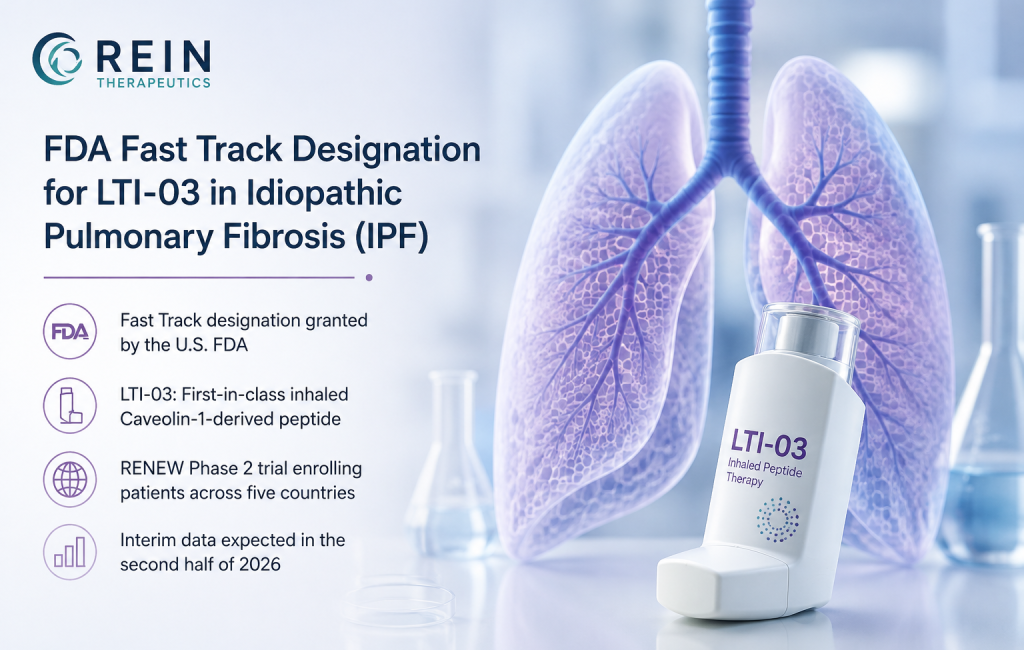
The FDA granted Fast Track designation to Rein Therapeutics’ LTI-03 for idiopathic pulmonary fibrosis as the Phase 2 RENEW trial advances toward interim data in 2026.
Written By: Siddhi Bhadekar, M.Pharm (QA)
Reviewed By: Pharmacally Editorial Team
Rein Therapeutics announced on August 20, 2026, that the U.S. Food and Drug Administration granted Fast Track designation to LTI-03 for the treatment of IPF. The designation applies to therapies for serious conditions that address an unmet medical need and can provide sponsors with more frequent interactions and written communication with the FDA during development.
Fast Track designation can also allow eligible programs to submit sections of a marketing application on a rolling basis. A Fast Track therapy may qualify for Accelerated Approval or Priority Review if it meets the applicable regulatory requirements. LTI-03 previously received FDA Orphan Drug designation for IPF.
IPF Remains a Serious Unmet Medical Need
IPF is a progressive and ultimately fatal interstitial lung disease characterized by the accumulation of scar tissue in the lungs. As fibrosis advances, lung function progressively deteriorates.
Approved antifibrotic therapies can slow the rate of disease progression in some patients, but they do not halt or reverse established fibrosis. The company notes that median survival following diagnosis is approximately three to five years, underscoring the need for therapies that could provide broader disease-modifying effects.
LTI-03 Targets Caveolin-1 Biology
LTI-03 is an investigational inhaled peptide derived from Caveolin-1 biology, a signaling pathway involved in fibrotic activity in lung tissue.
The therapeutic approach is based on two potential effects: suppressing profibrotic signaling involved in scar formation while preserving alveolar progenitor cells that are important for lung tissue repair and regeneration.
Early data suggest that LTI-03 could potentially combine antifibrotic activity with support for lung repair. Whether this proposed mechanism translates into clinically meaningful preservation of lung function will be evaluated in the ongoing Phase 2 program.
RENEW Phase 2 Trial Evaluates Safety and Lung Function
The randomized, placebo-controlled RENEW Phase 2 trial (NCT06968845) is evaluating the safety, tolerability, and efficacy of LTI-03 in patients with IPF.
The study is expected to enroll approximately 120 participants across the United States, United Kingdom, Australia, Poland, and Germany. Patients are randomized to receive one of two LTI-03 dose levels or placebo.
Safety is the primary endpoint, measured by the incidence of treatment-emergent adverse events through Week 24. Change from baseline in forced vital capacity (FVC) is the primary efficacy endpoint.
FVC provides an objective measure of lung function and will help determine whether LTI-03 can preserve pulmonary capacity during treatment. The interim analysis is expected in the second half of 2026.
Interim Data Will Guide Further Development
Brian Windsor, President and CEO of Rein Therapeutics, said the Fast Track designation provides an opportunity for closer engagement with the FDA as the RENEW trial advances. He also reaffirmed that the company remains on track to report interim data during the second half of 2026.
The upcoming readout will be an important milestone for LTI-03, providing clinical evidence on its safety and potential effect on lung function. The strength of the Phase 2 findings will help determine the next stage of clinical development and the program’s future regulatory path.
For now, LTI-03 remains investigational. Its potential to address both pulmonary fibrosis and tissue repair will depend on evidence generated through the RENEW trial and subsequent clinical studies.
Reference

About the Writer
Siddhi Rajendra Bhadekar (Linkedin) is an M.Pharm professional with expertise in medical and scientific writing, literature review, publication writing, and evidence synthesis, supported by four peer-reviewed publications.
She brings working knowledge of ICH-GCP, MedDRA, pharmacovigilance, ADR/AE reporting, clinical data management, and regulatory documentation.
With experience across pharmaceutical R&D, Quality Control, and Quality Assurance, she combines scientific research skills with strong attention to accuracy and detail.
Her background in manuscript development, publication planning, and scientific communication enables her to translate complex healthcare information into clear, reliable content.