
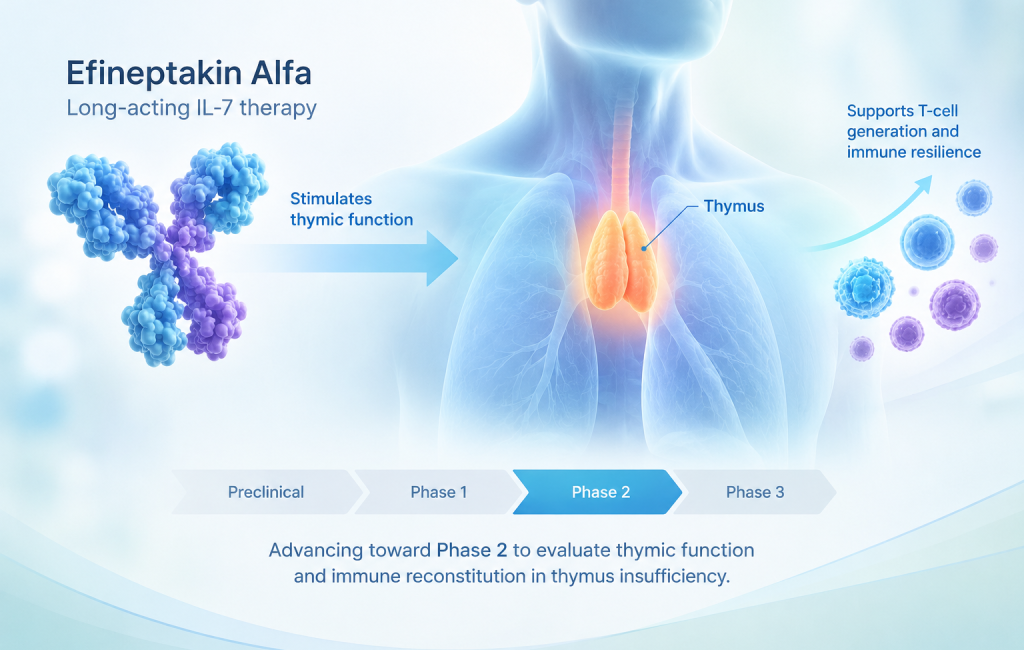
Tolerance Bio will advance efineptakin alfa, a long-acting IL-7 therapy, into Phase 2 studies targeting thymic function and immune reconstitution.
Written By: Umesh Hanumante,
M.Pharm (Reg. Affairs)
Reviewed By: Pharmacally Editorial Team
Tolerance Bio has secured an exclusive license from NeoImmuneTech for efineptakin alfa (NT-I7), a long-acting interleukin-7 (IL-7) fusion protein, expanding its thymus-focused pipeline and enabling the company to enter clinical-stage development. The agreement covers development and commercialization for selected thymus-related indications in the Americas and Europe, with Phase 2 studies planned to evaluate whether IL-7-mediated stimulation can enhance thymic function and improve immune resilience.
Efineptakin Alfa Targets Thymic and T-Cell Recovery
Efineptakin alfa is a long-acting IL-7 therapy containing two IL-7 moieties fused to NeoImmuneTech’s hyFc platform. The molecular design extends exposure and supports sustained IL-7 activity compared with native cytokine signaling.
IL-7 has an established role in T-cell biology. It supports thymic activity as well as T-cell differentiation, proliferation, and survival. As the thymus progressively involutes with age, its ability to generate new T cells declines, contributing to weaker immune responses and reduced immune resilience.
This decline can become more pronounced during chronic disease and inflammatory states. Patients with cancer and people living with HIV who fail to achieve adequate immune recovery despite antiretroviral therapy represent populations in which impaired T-cell reconstitution remains a significant clinical challenge.
Clinical Experience Supports Further Development
Efineptakin alfa has been evaluated in more than 800 participants across 15 clinical studies. According to the companies, these studies have generated human safety, tolerability, pharmacologic, and clinical proof-of-principle data supporting additional development.
The available clinical experience with IL-7 has also shown increases in thymic and T-cell function in immunologically vulnerable populations, including people with cancer and HIV immunological non-response. Tolerance Bio plans to build on this evidence rather than develop the molecule as an entirely untested approach to immune restoration.
The company has not yet disclosed the detailed design, enrollment targets, endpoints, or timing of its planned Phase 2 studies.
HIV Immunological Non-Response Among Initial Targets
Tolerance Bio expects HIV immunological non-response to be among the first indications evaluated. Despite effective antiretroviral therapy, some people living with HIV experience persistently poor CD4+ T-cell recovery, leaving them at increased risk of adverse clinical outcomes.
The company views this population as a potential model of accelerated immune aging and impaired thymic output. Demonstrating meaningful immune reconstitution in this setting could provide clinical evidence for broader development of IL-7-based approaches to thymic insufficiency.
License Expands Tolerance Bio’s Thymus Pipeline
The transaction marks a strategic expansion of Tolerance Bio’s therapeutic platform, which includes biologic drugs, thymus-targeting mRNA programs, and thymus cell therapies. The company intends to combine these approaches to preserve, regenerate, and modulate thymic function.
Under the agreement, NeoImmuneTech is eligible for potential development and sales milestone payments of up to $260 million, alongside equity consideration and tiered royalties on net sales.
Tolerance Bio CEO Francisco Leon said the license provides a route to rapidly advance a clinically characterized IL-7 therapy into Phase 2 development, while NeoImmuneTech CEO Taekyung Kim highlighted the partnership’s potential to extend efineptakin alfa into thymic insufficiency indications.
Phase 2 Development Will Establish the Next Clinical Test
The immediate priority is to define whether efineptakin alfa can produce clinically meaningful improvements in thymic activity and immune reconstitution. Results from the planned Phase 2 program will help determine whether the therapy can move beyond immune-compromised populations toward broader applications in immune resilience and healthspan.
Reference

About the Writer
Umesh Hanumante (M.Pharm) (LinkedIn) is a pharmacy professional and healthcare writer with a background in Regulatory Affairs, pharmaceutical innovation, and clinical research. He has around two years of industry experience as an Executive PMT at Troikaa Pharmaceuticals Ltd and qualified GPAT 2024. His areas of interest include regulatory compliance, dossier preparation, clinical trials, emerging therapies, and advancements in the global pharmaceutical and healthcare sector.